
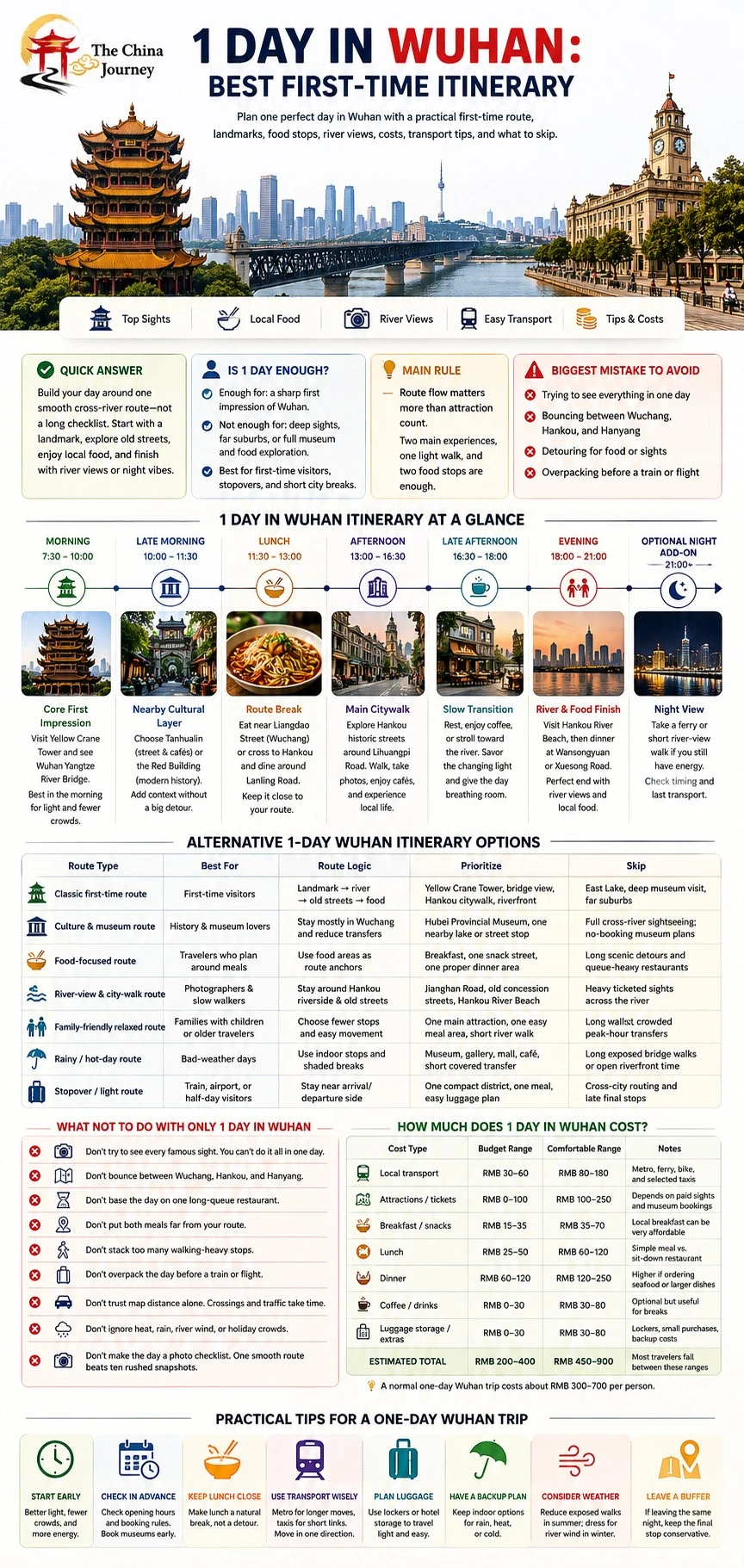
Yes, but only as a city preview. One day can cover one landmark, one walkable historic area, one food stop, and one evening atmosphere stop. It cannot cover East Lake in depth, a slow museum visit, far suburbs, or several districts well.
A good one-day Wuhan itinerary is about route flow, not attraction stacking. Start with your arrival point, departure point, luggage plan, weather, and main interest. Then choose one theme, move in one direction, put the heaviest stop in the morning, and keep the evening lighter.
Use this first-time structure as a route framework, not a fixed schedule. It balances one landmark, one light cultural layer, food, river views, and old-street atmosphere without forcing too many districts into one day. Adjust it by arrival point, weather, bookings, and energy.
| Time | Route Stage | What to Do | Why It Works | Watch Out For |
|---|---|---|---|---|
| Morning | Core first impression | Visit Yellow Crane Tower and see Wuhan Yangtze River Bridge | Starts with Wuhan’s strongest landmark and river view | Arrive early; expect crowds |
| Late Morning | Nearby cultural layer | Choose Tanhualin or Red Building | Adds context without a major detour | Skip it if the morning runs long |
| Lunch | Route break | Eat near Liangdao Street or cross to Hankou first | Keeps food tied to the route | Avoid long restaurant detours |
| Afternoon | Main citywalk | Explore Hankou historic streets around Lihuangpi Road | Shifts from landmark Wuhan to old-street Wuhan | Do not try to cover the whole area |
| Late Afternoon | Slow transition | Rest, walk toward the river, or stop for coffee | Gives the day breathing room | Do not add another heavy attraction |
| Evening | River and food finish | Visit Hankou River Beach, then dinner near Wansongyuan or Xuesong Road | Natural ending with river views and local food | Leave enough time if departing that night |
| Optional Night Add-on | Night view | Take a ferry or short river-view walk | Adds atmosphere if you still have energy | Check timing and last transport |
This route gives first-time visitors a realistic Wuhan day: Wuchang landmarks first, Hankou old streets next, river views and food at the end. It is designed to feel complete without pretending to cover the whole city.
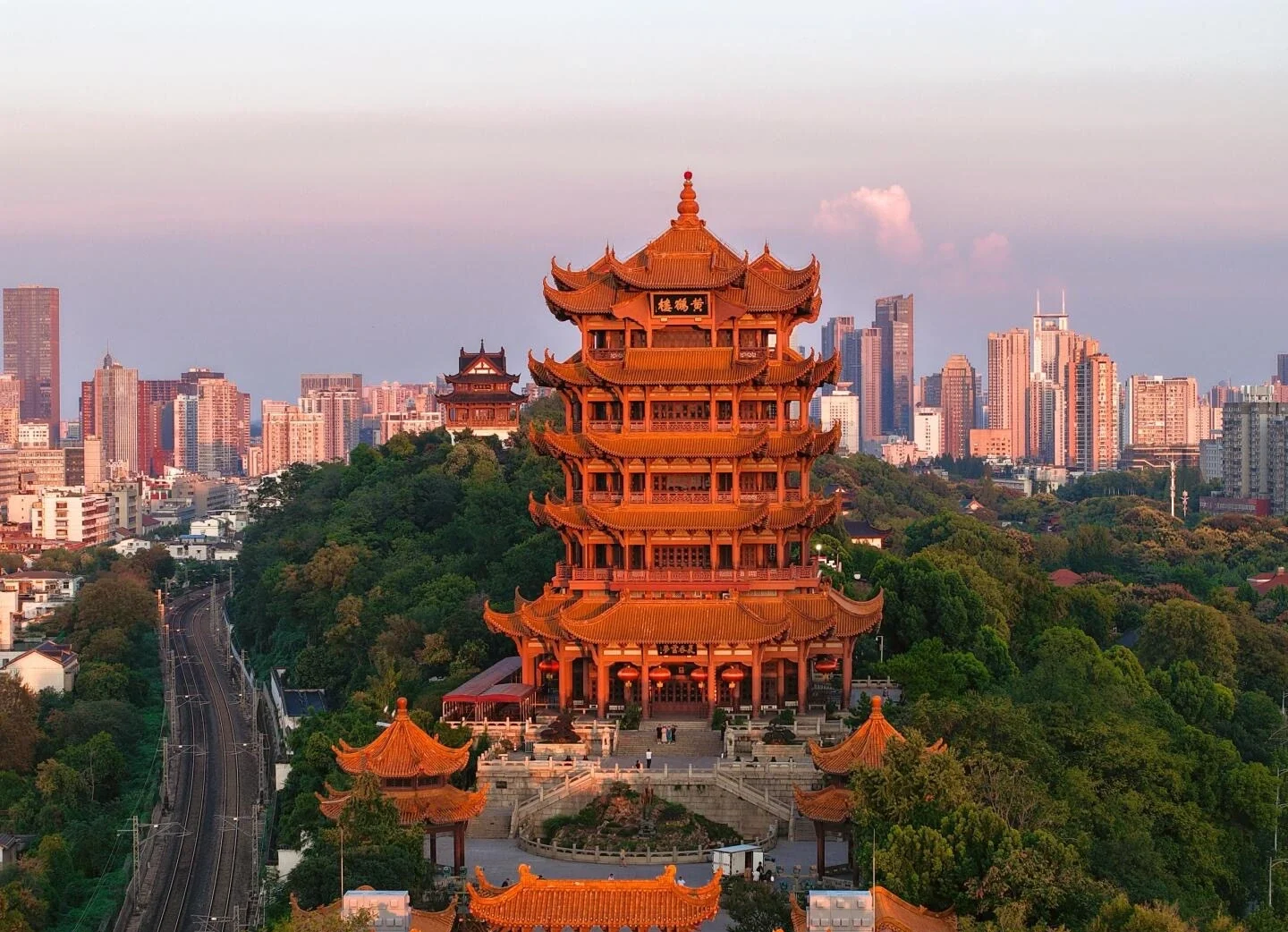
Begin with Yellow Crane Tower (黄鹤楼) and the Wuhan Yangtze River Bridge (武汉长江大桥). Together, they give the quickest visual read of the city: tower, river, bridge, and the three-town layout in one area.
Go in the morning for better energy, clearer light, and more manageable crowds. Allow about 1.5–2 hours for Yellow Crane Tower, plus 30–40 minutes if you want to walk part of the bridge.
Yellow Crane Tower requires a ticket, and advance online purchase is safer on weekends and holidays. Some travelers mention that the current tower is a reconstruction, but the view, setting, and cultural weight still make it worthwhile. With only one day, do not linger over every display. The main value is looking across the Yangtze River and understanding Wuhan’s scale.
Walk the bridge if the weather is comfortable. It feels more powerful than only viewing it from above.
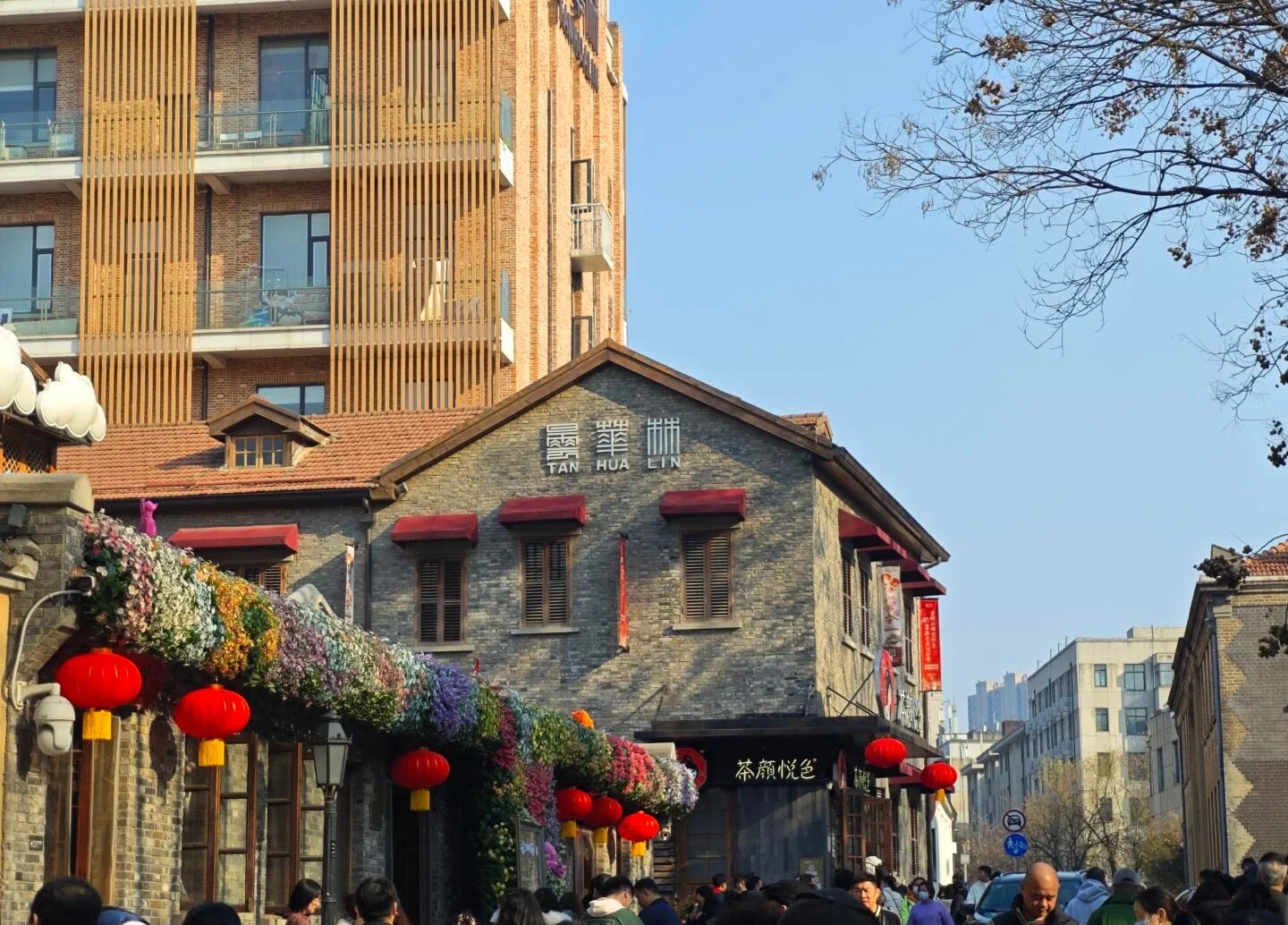
After the morning landmark stop, add only one nearby cultural layer if time and energy allow. This should be a route-friendly supplement, not a forced extra attraction.
For a lighter, more atmospheric stop, choose Tanhualin (昙华林). It works better for travelers who like old buildings, cafés, small shops, photos, and a softer street-walk mood. Just keep expectations realistic. Some visitors enjoy its photogenic feel, while others find it too commercial.
For a more historical stop, choose the Xinhai Revolution Museum / Red Building (辛亥革命武昌起义纪念馆). It is better for travelers interested in modern Chinese history and the Wuchang Uprising. The building itself is memorable, and the visit fits naturally with the Wuchang side of the route.
Both choices are close enough to make sense after Yellow Crane Tower. You do not need to do both. If Yellow Crane Tower and the bridge take longer than expected, skip this layer and go straight to lunch. A smooth day is better than a crowded schedule.

Lunch should connect the morning and afternoon, not pull you off-route. If you are still in Wuchang, Liangdao Street (粮道街) works for quick local snacks such as hot dry noodles, doupi, shaomai, and simple Wuhan-style bites.
If you want a cleaner afternoon transition, cross to Hankou before lunch and eat around Lanling Road (兰陵路) or a nearby food area. This puts you closer to the afternoon citywalk and avoids another transfer.
Keep a backup nearby. Popular shops can have queues, and waiting too long rarely makes sense on a one-day route. Avoid a very heavy lunch, especially in summer, or the afternoon walk will feel much harder.
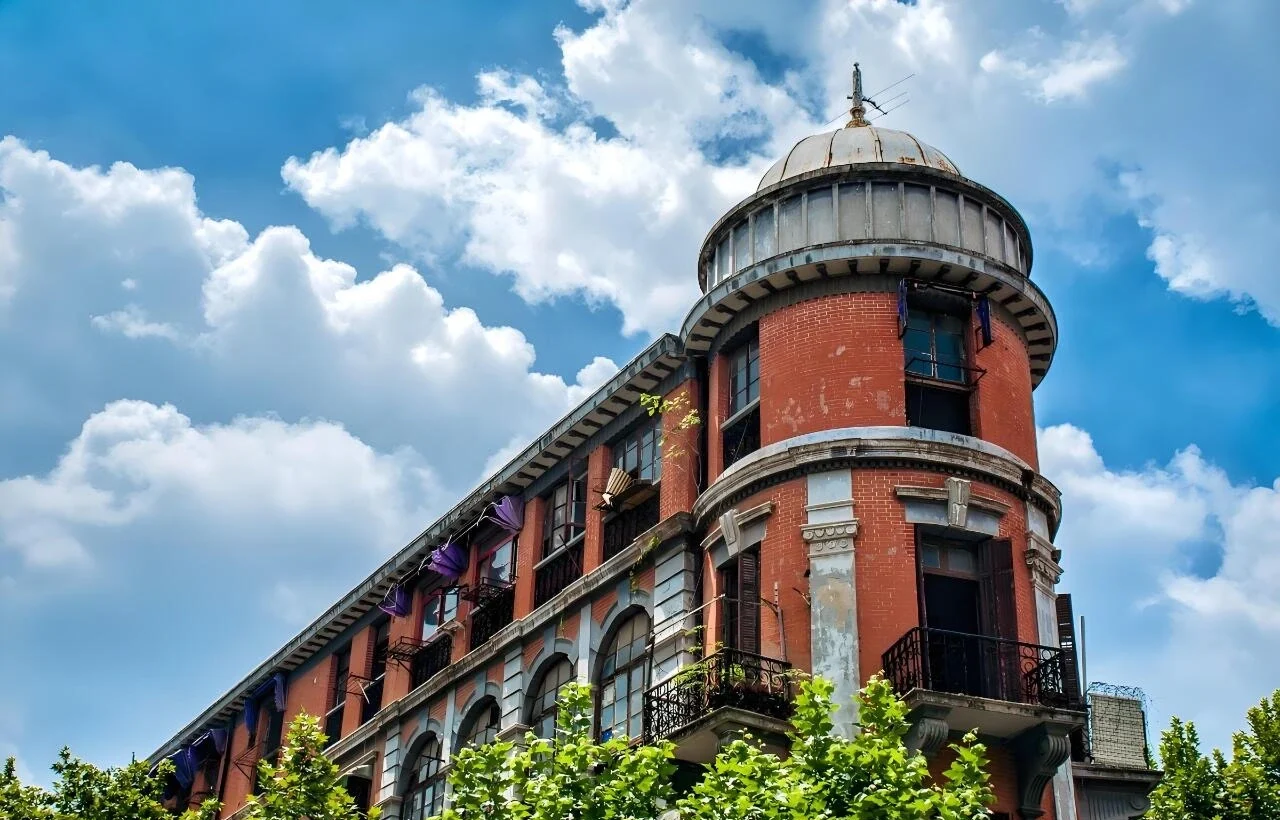
In the afternoon, shift from Wuchang to Hankou. The day changes from tower, bridge, and river-scale views to old concession streets, historic buildings, cafés, lanes, and everyday city life.
Use Lihuangpi Road (黎黄陂路) as the center. From there, branch into nearby old streets, Jianghan Road, or river-facing lanes depending on your pace. Do not try to finish the whole district.
This section is best for walking, photography, coffee breaks, architecture, and observing local life. In hot or rainy weather, use cafés, malls, galleries, or indoor stops as breaks. If you want a lighter afternoon, walk one main stretch and save energy for the riverfront.
Around 4–5 pm, move toward the river instead of adding another major sight. Rest in a café, walk through quieter streets, or watch the light change on the old buildings.
This buffer is not wasted time. It keeps the day from feeling rushed and leaves energy for the riverfront, dinner, and any evening departure.

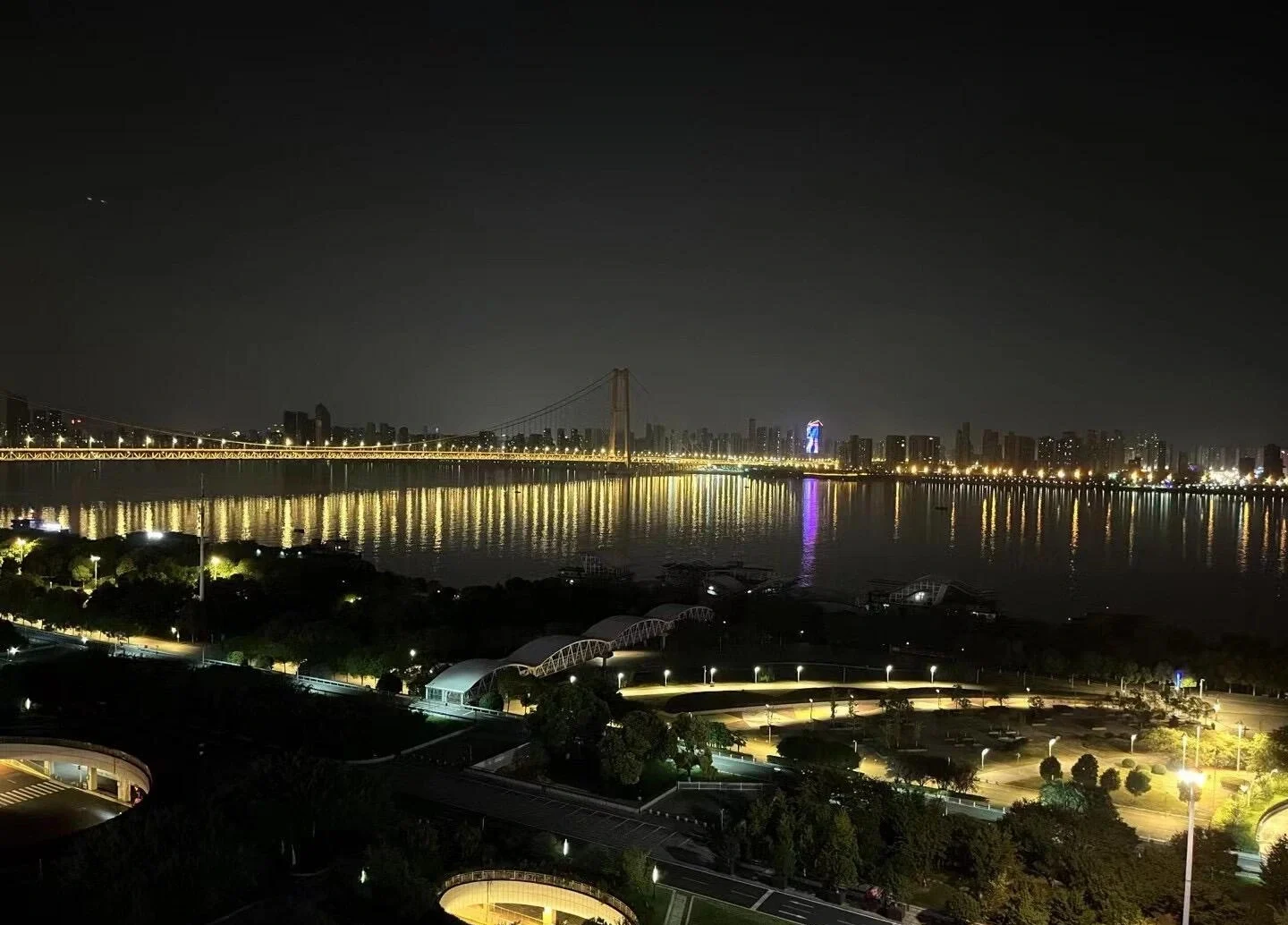
End around Hankou River Beach (汉口江滩). The open riverfront, bridges, skyline, evening light, and night views make it a natural finish after the tighter old-street walk.
Arrive before sunset if timing works, but do not try to walk the full riverfront. Choose one convenient section and slow down.
For dinner, Wansongyuan (万松园) or Xuesong Road (雪松路) works well for a lively local food ending. Hubei dishes, lotus root soup, seasonal crayfish, beef noodles, barbecue, and other local-style meals all fit this kind of finish.
If you leave Wuhan that night, shorten the river walk or choose dinner closer to your departure route. Do not risk a train or flight for one more food stop, especially if you still need to collect luggage.
One day in Wuhan works better when you choose one main theme and one light secondary experience. Do not combine several heavy routes, such as museum depth, East Lake, Yellow Crane Tower, old streets, and a food hunt. Use this table to match the day to your interest, energy, weather, and arrival point.
| Route Type | Best For | Route Logic | Prioritize | Skip |
|---|---|---|---|---|
| Classic first-time route | First-time visitors | Landmark → river → old streets → food | Yellow Crane Tower, bridge view, Hankou citywalk, riverfront | East Lake, deep museum visit, far suburbs |
| Culture and museum route | History and museum lovers | Stay mostly in Wuchang and reduce transfers | Hubei Provincial Museum, one nearby lake or street stop | Full cross-river sightseeing; no-booking museum plans |
| Food-focused route | Travelers who plan around meals | Use food areas as route anchors | Breakfast, one snack street, one proper dinner area | Long scenic detours and queue-heavy restaurants |
| River-view and city-walk route | Photographers and slow walkers | Stay around Hankou riverside and historic streets | Jianghan Road, old concession streets, Hankou River Beach | Heavy ticketed sights across the river |
| Family-friendly relaxed route | Families with children or older travelers | Choose fewer stops and easier movement | One main attraction, one easy meal area, short river walk | Long walks, crowded peak-hour transfers |
| Rainy / hot-day route | Bad-weather days | Use indoor stops and shaded breaks | Museum, gallery, mall, café, short covered transfer | Long exposed bridge walks or open riverfront time |
| Stopover / light route | Train, airport, or half-day visitors | Stay near the arrival/departure side | One compact district, one meal, easy luggage plan | Cross-city routing and late final stops |
These are rough 2026 references for an independent one-day Wuhan trip. Main costs include local transport, tickets, food, drinks, and luggage storage. The total depends most on taxi use, paid sights, and whether you choose simple local meals or sit-down restaurants. Poor route planning is the biggest hidden cost.
| Cost Type | Budget Range | Comfortable Range | Notes |
|---|---|---|---|
| Local transport | RMB 30–60 | RMB 80–180 | Metro, ferry, bike, and selected taxis |
| Attractions / tickets | RMB 0–100 | RMB 100–250 | Depends on paid sights and museum bookings |
| Breakfast / snacks | RMB 15–35 | RMB 35–70 | Local breakfast can be very affordable |
| Lunch | RMB 25–50 | RMB 60–120 | Simple meal vs. sit-down restaurant |
| Dinner | RMB 60–120 | RMB 120–250 | Higher if ordering seafood or larger dishes |
| Coffee / drinks | RMB 0–30 | RMB 30–80 | Optional but useful for breaks |
| Luggage storage / extras | RMB 0–30 | RMB 30–80 | Station lockers, small purchases, backup costs |
| Estimated total | RMB 200–400 | RMB 450–900 | Most travelers fall between these ranges |
A normal one-day Wuhan trip does not need to be expensive. For many travelers, RMB 300–700 per person is realistic. Spend a little more on transport when it saves time, avoids backtracking, or protects your energy.


Explore the beauty of West Lake, a UNESCO World Heritage site in Hangzhou, featuring serene landscapes, iconic pavilions, and seasonal attractions like lotus blooms and misty mountains.

A clear and structured 2026 forecast for people born in 2008, covering study luck, relationships, health, personal growth, and practical guidance.

Explore the Yangtze River, China’s longest river, renowned for its breathtaking scenery, vibrant culture, historic sites, and natural wonders.

The Qing dynasty ruled China from 1644 to 1912, lasting 268 years. It was the last imperial dynasty before China became a republic.

Discover the rich flavors of Anhui cuisine, featuring traditional dishes like braised fish, bamboo shoots, and unique local specialties, rooted in centuries-old culinary traditions.

Explore Taoism’s philosophy, practices, deities, rituals, and its profound influence on Chinese culture, spirituality, and daily life.


