
Yes, 3 days is enough for a highly focused first Beijing trip, but only if you treat it as a compact highlight route. It can give you Beijing’s strongest first impression, but the schedule has little room for slow exploring, failed bookings, or last-minute detours.
A 3-day Beijing itinerary needs strict planning. The city is large, key sights take time, reservations can decide your order, and the Great Wall takes a full day by itself. My rule is simple: protect the non-negotiable experiences first, then cut anything that competes with them.
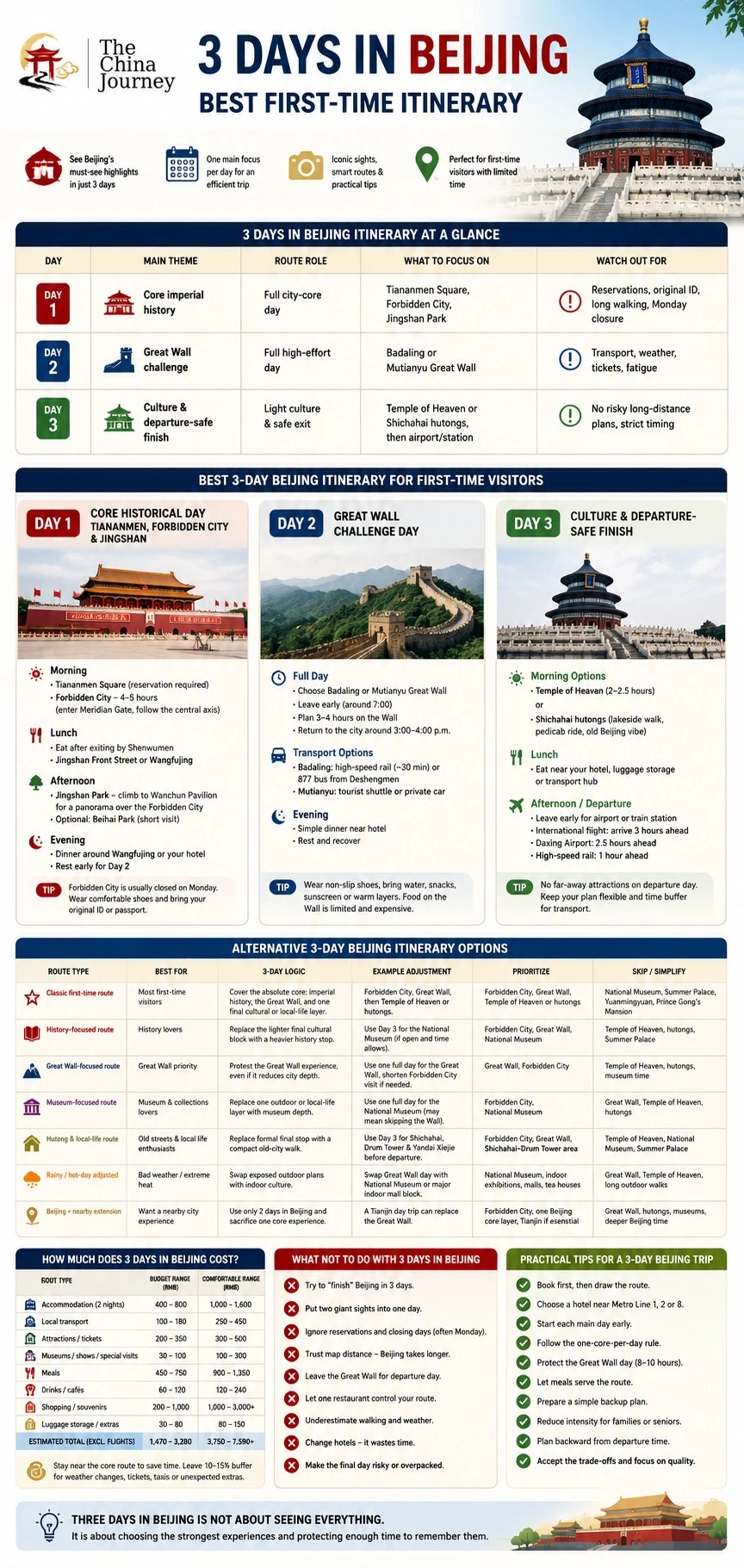
Use this as a tight first-time framework, not a loose schedule. Each day protects one core experience. Adjust the order by Forbidden City booking, Tiananmen reservation, Monday closures, arrival and departure times, and weather.
| Day | Main Theme | Route Role | What to Focus On | Watch Out For |
|---|---|---|---|---|
| Day 1 | Core imperial history | Full city-core day | Tiananmen Square, Forbidden City, Jingshan Park | Reservations, original ID, long walking, Monday closure |
| Day 2 | Great Wall challenge | Full high-effort day | Badaling or Mutianyu Great Wall | Transport, weather, tickets, fatigue |
| Day 3 | Culture and departure-safe finish | Light culture and safe exit | Temple of Heaven or Shichahai hutongs, then airport/station | No risky long-distance plans, strict timing |
This 3-day Beijing itinerary is for first-time visitors with very limited time who still want Beijing’s essential experiences. It is not a slow-travel route, and it assumes you have three usable sightseeing days. Adjust the order by Forbidden City booking, Tiananmen reservation, Monday closures, arrival and departure time, and weather.

Start with Tiananmen Square (天安门广场) if your reservation and timing allow. Entry to the square area requires real-name reservation through the official channel, usually 1–9 days ahead. Carry the original passport or ID used for the reservation, because checks can be strict.
After the square, walk toward the Meridian Gate, the main entrance for the Forbidden City (故宫). Book the Forbidden City 1–7 days ahead through the official Palace Museum channel when tickets are available, and choose the earliest entry slot if possible, usually around 8:30.
Give the Forbidden City at least 4–5 hours. A strong first-time route follows the central axis through the main halls, then moves into the inner court and Imperial Garden. If you care about imperial objects, add the Treasure Gallery; it requires a separate ticket but is worth considering on a short trip.
Food inside the Forbidden City is limited and can feel expensive for what you get. Bring light snacks and water if allowed, or eat after leaving through Shenwumen. Jingshan Front Street and Wangfujing are practical options after the palace visit.
After exiting from Shenwumen, cross to Jingshan Park (景山公园). Spend about 30–45 minutes climbing to Wanchun Pavilion. This is the classic viewpoint over the Forbidden City and Beijing’s central axis, and it gives the whole palace visit a strong visual finish.
If time and energy still hold, add a short visit to Beihai Park. Keep it brief. This is already the heaviest city-core day in the itinerary.
Eat around Wangfujing or near your hotel. After a full day of walking, do not push into another major night plan. Rest early, because Day 2 is the Great Wall.
This day puts Beijing’s strongest imperial and city-core sights together. Tiananmen, the Forbidden City, and Jingshan connect naturally on foot, so the route saves time and avoids unnecessary transfers.
The Forbidden City is usually closed on Monday. Bring the original booking document, wear very comfortable shoes, and expect security checks, crowds, open courtyards, and long walking. Do not add another large indoor sight on the same day. If you arrive in Beijing only in the afternoon, move this day later and adjust the Great Wall day around your actual ticket dates.

Use Day 2 for the Great Wall (长城). This is a full-day challenge, not a side activity. In a 3-day Beijing route, the Great Wall must stand alone.
Most first-time visitors choose between Badaling Great Wall (八达岭长城) and Mutianyu Great Wall (慕田峪长城).
Badaling is the most classic and best-known section. It has the most convenient transport and strong visitor facilities, but it also gets the largest crowds. You can take the Jingzhang high-speed rail from Beijing North Railway Station or Qinghe Station, with a ride of around 30 minutes, or use the 877 bus from Deshengmen. If you choose the high-speed rail, buy tickets ahead.
Mutianyu is known for better scenery, more greenery, and a relatively calmer feel. It is popular with international travelers, but transport needs more planning. You can use tourist shuttles from Qianmen Tourist Distribution Center or Dongzhimen transport hub, or arrange a private car. Cable car and toboggan options are available.
Leave around 7:00 if possible. The goal is to arrive before the main tour-group peak and give yourself enough time for entry, shuttle or cable car movement, climbing, photos, rest, and the return trip. Plan about 3–4 hours on the Wall itself. Returning to the city around 3:00–4:00 p.m. is usually more stable than pushing the day too late.
Keep the evening simple. Eat near your hotel or close to your return route, then rest. A filling local dinner is enough. This is not the night for another ambitious plan.
Day 2 is the endurance day. Transport, weather, queues, climbing, and return time all consume energy. Trying to add the Ming Tombs or another major sight usually turns the day into a rushed and tiring checklist.
Weather affects the Great Wall heavily. Wind, heat, cold, rain, or haze can change the experience fast. Wear non-slip shoes and bring water, snacks, sunscreen, a hat, or warm layers depending on the season. Food options on the Wall are limited and often expensive.

Plan Day 3 backward from your flight or train time.
If your flight or train leaves in the afternoon or evening, use the morning for one controlled cultural experience. Temple of Heaven (天坛) is the strongest final choice for many first-time visitors. Take Metro Line 5 to Tiantan Dongmen Station and allow about 2–2.5 hours for the core area, especially the Hall of Prayer for Good Harvests, Echo Wall, and Circular Mound Altar.
The alternative is Shichahai (什刹海). This works better if you want a lighter local-life ending instead of another formal historic site. Walk along the lakes, get a quick feel for old Beijing lanes, or take a one-hour pedicab hutong ride after agreeing on the price clearly.
If your flight or train leaves around noon or early afternoon, do not force sightseeing. Have breakfast at the hotel, pack properly, store luggage if needed, take a short nearby walk, and buy simple souvenirs such as Daoxiangcun (稻香村) pastries.
Eat near your hotel, near your luggage storage point, on the way to the airport or station, or inside the transport hub. Choose something quick and predictable. This is not the day for a slow meal across town.
Leave early for your airport or train station. For an international flight from Beijing Capital International Airport, arrive at least 3 hours ahead. For Beijing Daxing International Airport, arrive at least 2.5 hours ahead. For high-speed rail, arrive at least 1 hour before departure.
Add more buffer if you have luggage, tax refund, peak-hour traffic, or a long transfer from your hotel.
Day 3 is the safety day. It adds one final cultural or local-life layer, but it must protect your departure. The activity should be easy to stop, easy to reach, and easy to abandon if timing changes.
Do not schedule the Great Wall, Ming Tombs, far suburbs, strict museum bookings, or any activity with unpredictable queues on departure day. Set a hard deadline for when you must return to the hotel or luggage point, then work backward from that time.
Use the standard 3-day Beijing itinerary as the base, then adjust only when your travel style clearly requires it. With just 3 days, every replacement has a cost. This table shows what to swap, not how to fit everything into one short trip.
| Route Type | Best For | 3-Day Logic | Example Adjustment | Prioritize | Skip / Simplify |
|---|---|---|---|---|---|
| Classic first-time route | Most first-time visitors | Cover the absolute core: imperial history, the Great Wall, and one final cultural or local-life layer. | Keep the standard structure: Forbidden City, Great Wall, then Temple of Heaven or hutongs. | Forbidden City, Great Wall, Temple of Heaven or hutongs | National Museum, Summer Palace, Yuanmingyuan, Prince Gong’s Mansion |
| History-focused route | Travelers mainly interested in imperial and national history | Replace the lighter final cultural block with a heavier history stop. | Use Day 3 for the National Museum if it is open and your departure time allows. | Forbidden City, Great Wall, National Museum | Temple of Heaven, hutongs, Summer Palace |
| Great Wall-focused route | Travelers who see the Great Wall as the top priority | Protect the Great Wall experience, even if it reduces city depth. | Use the clearest full day for the Great Wall, then make the Forbidden City visit shorter if needed. | Great Wall, Forbidden City | Temple of Heaven, hutongs, museum time |
| Museum-focused route | Travelers strongly interested in history, art, and collections | Replace one outdoor or local-life layer with museum depth, accepting a major trade-off. | Use one full day for the National Museum, but this may mean skipping the Great Wall. | Forbidden City, National Museum | Great Wall, Temple of Heaven, hutongs |
| Family-friendly route | Families with children or lower walking tolerance | Reduce daily intensity and choose easier movement where possible. | Choose a Great Wall section with cable car or slide options, or replace one heavy block with Beijing Zoo or China Science and Technology Museum. | Forbidden City, easier Great Wall visit, child-friendly stop | Long museum blocks, heavy palace routes, extra walking |
| Photography route | Travelers focused on light, angles, and viewpoints | Plan around early entry, golden hour, and fewer rushed transfers. | Enter the Forbidden City early, time the Great Wall for late light, and use Day 3 morning for Temple of Heaven. | Forbidden City, Great Wall, Temple of Heaven, Jingshan | Indoor museums, shopping, weak midday light |
| Hutong and local-life route | Travelers who prefer old streets and daily Beijing texture | Replace the formal final cultural stop with a compact old-city walk. | Use Day 3 for Shichahai, Drum Tower, and Yandai Xiejie before departure. | Forbidden City, Great Wall, Shichahai–Drum Tower area | Temple of Heaven, National Museum, Summer Palace |
| Rainy / hot-day adjusted route | Travelers facing rain, extreme heat, haze, or poor outdoor conditions | Swap exposed outdoor plans with indoor culture or controlled city blocks. | If the Great Wall day is unsafe or unpleasant, swap it with the National Museum or a major indoor mall block. | National Museum, indoor exhibitions, malls, tea houses | Great Wall, Temple of Heaven, long outdoor walks |
| Beijing + nearby extension route | Travelers who strongly want a nearby city despite limited time | Use only 2 days for Beijing and sacrifice one core Beijing experience. | A Tianjin day trip can replace the Great Wall, but this is not recommended for most first-time visitors. | Forbidden City, one Beijing core layer, Tianjin if essential | Great Wall, hutongs, museums, deeper Beijing time |
The estimates below are based on my Beijing travel experience and recent 2026-style visitor spending references. They assume 2 hotel nights for one independent traveler. Actual spending depends on season, hotel location, Great Wall transport, cable cars, meals, taxis, shows, shopping, and optional experiences. International flights are not included.
| Cost Type | Budget Range | Comfortable Range | Notes |
|---|---|---|---|
| Accommodation | Around RMB 400–800 | Around RMB 1,000–1,600 | Based on 2 nights; a central hotel saves serious time on a short trip. |
| Local transport | Around RMB 100–180 | Around RMB 250–450 | Budget trips use subway and buses; comfortable trips may add taxis, ride-hailing, or Great Wall transport. |
| Attractions / tickets | Around RMB 200–350 | Around RMB 300–500 | Covers core paid sights; cable cars, galleries, or special areas raise the total. |
| Museums / shows / special visits | Around RMB 30–100 | Around RMB 100–300 | Includes audio guides, small special visits, hutong rides, or short experiences. |
| Meals | Around RMB 450–750 | Around RMB 900–1,350 | Simple meals stay affordable; roast duck, hotpot, and better restaurants raise costs. |
| Drinks / cafés | Around RMB 60–120 | Around RMB 120–240 | Useful for breaks during high-walking days. |
| Shopping / souvenirs | Around RMB 200–1,000 | Around RMB 1,000–3,000+ | Highly flexible, from snacks and tea to crafts or branded goods. |
| Luggage storage / extras | Around RMB 30–80 | Around RMB 80–150 | Covers lockers, small supplies, rain gear, medicine, or backup costs. |
| Estimated total | Around RMB 1,470–3,280 | Around RMB 3,750–7,590+ | Excludes international flights and major shopping. |
For a 3-day Beijing trip, hotel location matters more than saving a small amount on room price. Stay near the core route if possible, because lost transport time is hard to recover. Leave a 10–15% buffer for weather changes, ticket issues, Great Wall transport changes, taxis, or unexpected extras.
A 3-day Beijing trip can work, but it needs stricter planning than a 4-day, 5-day, or 7-day route. My rule is simple: every optional stop must support the main route, not compete with it.


Yes, most Terracotta Soldiers are hollow in the torso for firing and handling, while heads and limbs are solid for detail carving and strength.

English is common in Shenzhen’s transport, hotels, malls, and expat areas. Basic English works well, though fluency varies by district and profession.

Learn which dates belong to Earth Dragon years, how Wu Earth, Chen Dragon, and Great Forest Wood differ, plus folk traits and compatibility without fate claims.

Hubei, home to Chu culture, historic landmarks like the Three Kingdoms, and natural wonders like the Three Gorges, offers a rich blend of heritage and scenic beauty.

Discover the 1998 Earth Tiger zodiac meaning and 2026 forecast, including personality, career, wealth, love, health, lucky elements, and practical advice.

China announced 10 new immigration measures to support openness and high-quality development, including visa, e-channel, and policy upgrades.


