Yes, 4 days is enough for a focused first Beijing trip, but it leaves little room for loose planning. This is a compact route, not a slow travel plan. The key is to decide what matters most before the trip starts, then protect those priorities from weak add-ons, long transfers, and last-minute overpacking.

A good 4-day Beijing itinerary needs route discipline. Beijing is large, key sights require reservations, many museums close on fixed days, and the Great Wall takes a full day by itself. With only 4 days, there is little room for poor sequencing. The best route should be clear, compact, and adjustable, not overloaded.
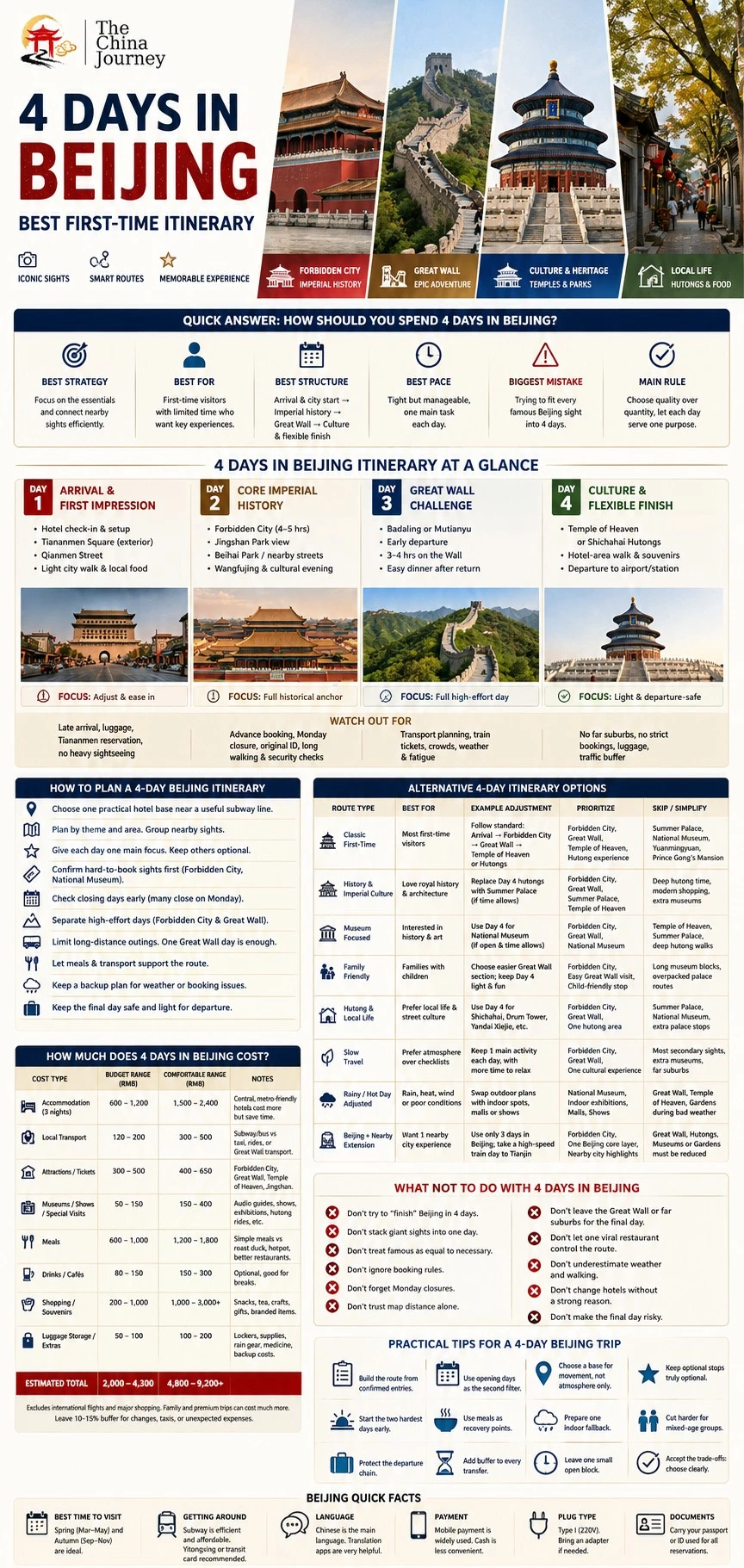
Use this as a compact first-time framework, not a fixed schedule. Adjust the order by Forbidden City and museum reservations, Monday closures, arrival and departure times, weather, and physical energy.
| Day | Main Theme | Route Role | What to Focus On | Watch Out For |
|---|---|---|---|---|
| Day 1 | Arrival and first impression | Adjust and ease in | Hotel check-in, payment and transport setup, Tiananmen Square exterior, Qianmen Street, light city walk | Late arrival, luggage, Tiananmen reservation, no heavy sightseeing |
| Day 2 | Core imperial history | Full historical anchor | Forbidden City, Treasure Gallery or Clock Gallery, Jingshan Park, Wangfujing or a light cultural evening | Advance booking, Monday closure, original ID, security checks, long walking |
| Day 3 | Great Wall challenge | Full high-effort day | Badaling or Mutianyu Great Wall, early departure, 3–4 hours on the Wall, easy dinner after return | Transport planning, high-speed rail tickets, crowds, weather, fatigue |
| Day 4 | Culture and flexible finish | Light culture and departure safety | Temple of Heaven or Shichahai hutongs if time allows; hotel-area walk, souvenirs, airport or station transfer if time is tight | No far suburbs, no strict bookings, luggage, traffic buffer, transport timing |
This 4-day Beijing itinerary is designed for first-time visitors who have limited time but still want the city’s core experiences. It is not a slow-travel route. The order should follow your Forbidden City and National Museum reservation dates, Monday closures, arrival and departure times, and weather. Treat the daily plan as a framework, not a fixed script.

Arrive in Beijing, then transfer into the city by airport express, subway, taxi, or ride-hailing. For a 4-day trip, hotel location is not a small detail. Staying near Metro Line 1, Line 2, or Line 8 can save real time. Practical areas include Wangfujing, Qianmen, Dongzhimen, or other central metro-connected districts.
After check-in, handle the basics first: luggage, mobile payment, maps, and subway access. You can use Yitongxing (亿通行) for metro travel, or use a Beijing transit card if that works better for your setup. Do not treat arrival day as a full sightseeing day.
Choose by arrival time and energy.
If you arrive before mid-afternoon and feel fresh, take the subway to Tiananmen East Station for the Tiananmen Square area. Entry usually requires real-name reservation at least one day ahead, so check the current rule before going and carry the same document used for booking. Afterward, walk toward Qianmen Street for a light first look at old commercial Beijing.
If you arrive late or feel tired, stay near your hotel, take a short neighborhood walk, and have a simple first meal, such as zhajiangmian or roast duck.
Eat near your hotel or around Qianmen. Keep the evening easy and rest early. Before the day ends, try to confirm the key reservations for the next few days, especially the Forbidden City and National Museum of China if they are part of your backup plan.
Arrival day is for setup and adjustment, not achievement. The goal is to enter the city smoothly, get payment and transport ready, and build a light first impression without hurting Day 2.
Do not schedule the Forbidden City, Great Wall, National Museum, or any hard-to-reschedule attraction on Day 1. If you enter Tiananmen Square, carry the original passport or ID used for reservation. If your flight arrives late, skip sightseeing and rest.

Make the Forbidden City (故宫) the core of Day 2. This is the foundation of a first Beijing trip, so give it your best energy.
Book 1–7 days ahead through the official Palace Museum channel when available, and choose the earliest entry slot if possible, usually around 8:30. Enter from the Meridian Gate and carry the original passport or ID used for booking. A strong first-time route follows the central axis through the Hall of Supreme Harmony, Hall of Central Harmony, Hall of Preserving Harmony, the inner court, and the Imperial Garden. Then add one or two side palace areas based on interest and stamina.
Plan at least 4–5 hours. The Treasure Gallery and Clock Gallery are worthwhile if you care about imperial collections, but they require separate tickets.
Food inside the Forbidden City is limited and can feel expensive for what you get. Bring light snacks and water if allowed, or eat after exiting from Shenwumen, near Jingshan Front Street, Donghuamen, or Wangfujing.
After leaving through Shenwumen, cross to Jingshan Park. Spend about 30–60 minutes climbing to Wanchun Pavilion for the classic view over the Forbidden City and Beijing’s central axis. This is one of the best visual finishes to a palace visit.
If you still have energy, add Beihai Park, nearby old-city streets, or a short hutong walk around Nanchizi. Keep the afternoon nearby and light.
Wangfujing is a practical dinner and walking option. If you want a cultural evening, book a Peking opera or acrobatics performance in advance, such as Chang’an Grand Theatre or Tiandi Theatre.
Put the Forbidden City in the strongest part of the day, then use Jingshan as the natural follow-up. Do not add another giant site on the same day.
The Forbidden City is usually closed on Monday. Bring the original booking document, wear very comfortable shoes, and prepare for long open courtyards, security checks, crowds, and limited shade. Avoid carrying unnecessary bags.
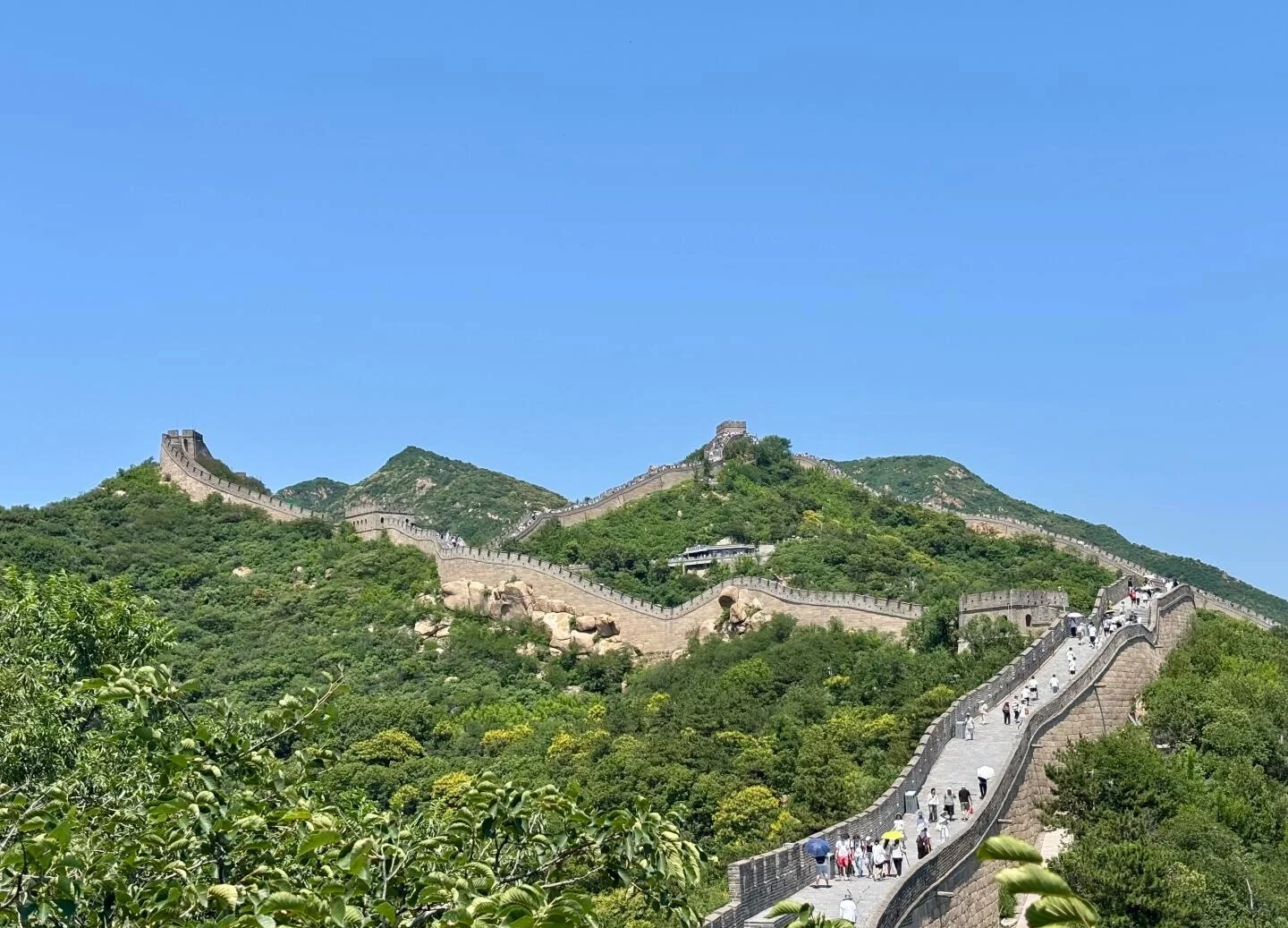
Use Day 3 for the Great Wall. This is a full-day challenge, not a half-day add-on. Do not combine it with the Ming Tombs or another major attraction.
Most first-time visitors choose between Badaling and Mutianyu.
Badaling Great Wall is the most classic and best-known section. It has strong facilities and convenient transport, including high-speed rail from Beijing North Railway Station or Qinghe Station, and the 877 bus from Deshengmen. It also has cable car and pulley options, but crowds are often heavier.
Mutianyu Great Wall is known for better scenery, more greenery, and relatively fewer crowds. It is popular with international travelers and photographers. Transport takes more planning, using tourist shuttle routes, Dongzhimen-area transfers, or a private car. Cable car and toboggan options are also available.
Whichever section you choose, leave early, ideally around 7:00–8:00. Aim to arrive before the main tour-group peak. Plan 3–4 hours for actual walking, climbing, photos, rest, and shuttle or cable car time. Returning to the city around mid-to-late afternoon is more realistic than pushing the day too hard.
Keep dinner simple and close to your hotel or return route. After the Great Wall, a filling meal, massage, or early night is more useful than another ambitious plan.
This is the pure high-effort day of the route. Transport, climbing, queues, weather, and return time all consume energy, so the Great Wall should stand alone.
Buy high-speed rail tickets early if you choose Badaling. Wear non-slip sports shoes. Bring water, snacks, sunscreen, a hat, or warm layers depending on the season. Food options on the Wall are limited and often expensive. Check the weather before leaving.
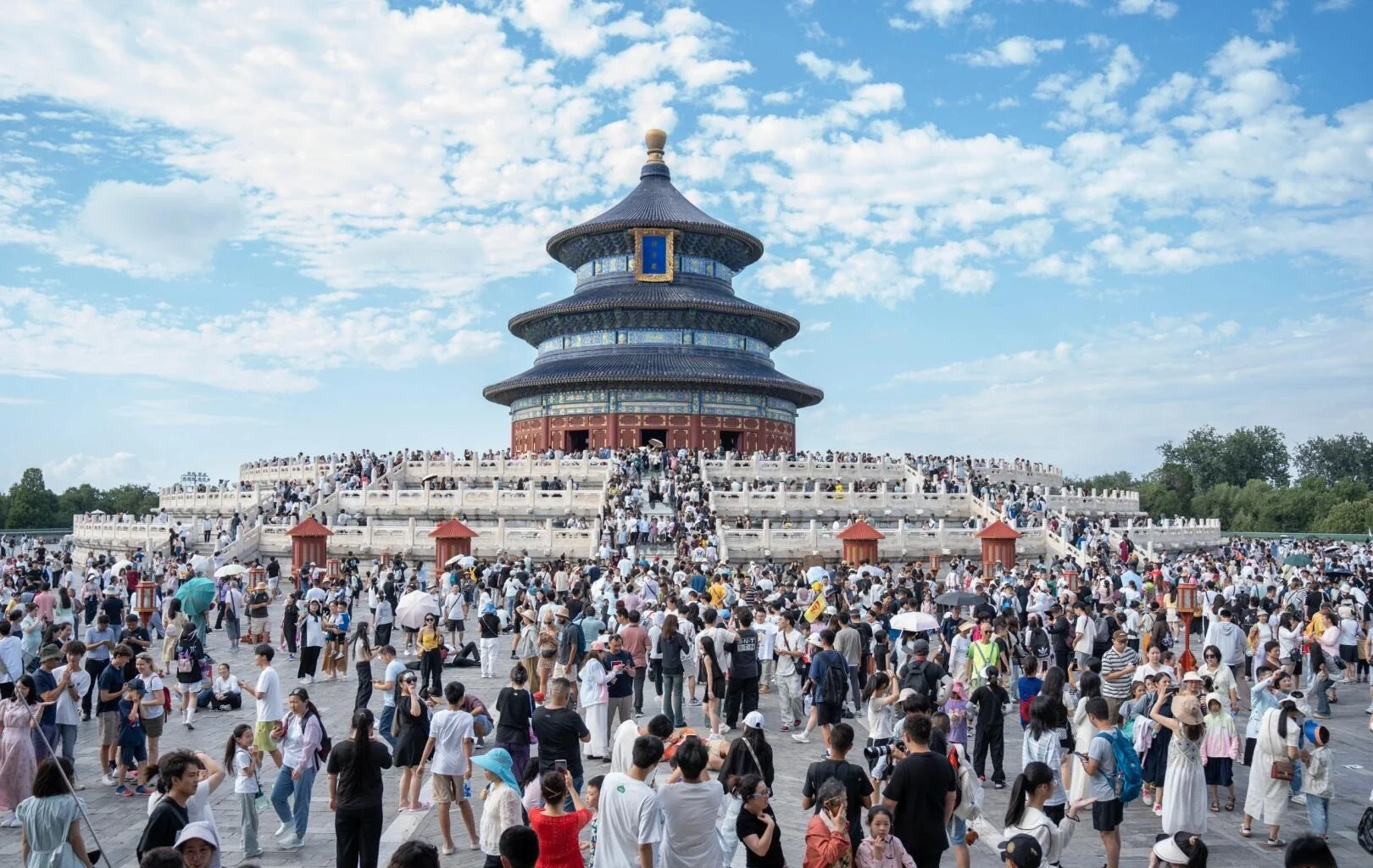
Plan Day 4 around your flight or train time.
If you have half a day or more, Temple of Heaven is a strong final choice. Take Line 5 to Tiantan Dongmen Station and allow about 2–2.5 hours for the core route, especially the Hall of Prayer for Good Harvests, Echo Wall, and Circular Mound Altar.
Another good option is the Shichahai hutong area. You can walk by the lakes, see old Beijing street life, visit Prince Gong’s Mansion if you have a reservation, or take a pedicab ride after agreeing on the price clearly.
If your flight or train leaves around midday or early afternoon, do not force a sightseeing plan. Sleep a little later, pack properly, store luggage, take a short walk near your hotel, and buy practical souvenirs such as local pastries or tea.
Eat near your hotel, luggage storage point, or transport route. Choose something efficient and predictable. This is not the right day for a slow meal across the city.
Leave for your airport or train station early. As a practical rule, arrive at Beijing Capital International Airport at least 3 hours before an international flight, Beijing Daxing International Airport at least 2.5 hours before, and high-speed rail stations at least 1 hour before departure. Add more buffer for luggage, tax refund, traffic, or peak travel periods.
Day 4 has two jobs: add a final cultural layer and protect your departure. Choose something close, flexible, and easy to abandon if timing changes.
Do not schedule the Great Wall, Ming Tombs, far suburbs, strict museum bookings, or anything with unpredictable queues on departure day. Confirm your flight or train time, arrange checkout and luggage storage early, and keep all documents easy to access.
Use the standard 4-day Beijing itinerary as the base, then adjust it by travel style. This section is not a second full itinerary. It shows how different travelers can replace or simplify certain parts of the route while keeping the trip realistic. With only 4 days, every change has a cost, so prioritize carefully and avoid adding more just because a place is famous.
| Route Type | Best For | 4-Day Logic | Example Adjustment | Prioritize | Skip / Simplify |
|---|---|---|---|---|---|
| Classic first-time route | Most first-time visitors | Balance imperial history, the Great Wall, and one final cultural or local-life layer. | Follow the standard structure: arrival, Forbidden City, Great Wall, then Temple of Heaven or hutongs. | Forbidden City, Great Wall, Temple of Heaven, hutong experience | Summer Palace, National Museum, Yuanmingyuan, Prince Gong’s Mansion |
| History and imperial culture route | Travelers deeply interested in Ming-Qing history and royal architecture | Use the final culture block for one more imperial or royal site instead of local-life wandering. | Replace the Day 4 hutong option with Summer Palace if departure time allows. | Forbidden City, Great Wall, Summer Palace, Temple of Heaven | Deep hutong time, modern shopping, extra museums |
| Museum-focused route | Travelers interested in history, art, and major collections | Replace one outdoor culture block with a museum-heavy plan, but accept a tighter rhythm. | Use Day 4 for the National Museum of China if your departure is late and the museum is open. | Forbidden City, Great Wall, National Museum | Temple of Heaven, Summer Palace, deep hutong walks |
| Family-friendly route | Families with children, especially school-age kids | Reduce walking pressure and add easier, more interactive choices. | Choose a Great Wall section with cable car support, then keep Day 4 light with an easier city activity. | Forbidden City, easier Great Wall visit, light city walk, child-friendly stop | Long museum blocks, overpacked palace routes, heavy gardens |
| Photography route | Photographers who care about light, angles, and viewpoints | Plan around early entry, sunset light, and slower shooting windows. | Enter the Forbidden City early, time the Great Wall for better light, and use Day 4 morning for Temple of Heaven. | Forbidden City, Great Wall, Jingshan, Temple of Heaven, hutong light | Large indoor museums, long shopping blocks |
| Hutong and local-life route | Travelers who prefer old streets, daily life, food streets, and local texture | Trade one formal cultural site for a deeper hutong and neighborhood walk. | Use Day 4 for Shichahai, Drum Tower, Yandai Xiejie, or nearby hutong areas before departure. | Forbidden City, Great Wall, one focused hutong area | Summer Palace, National Museum, extra palace-style stops |
| Slow travel route | Travelers who prefer atmosphere over checklists | Cut the number of sights and keep one main activity each day. | Keep Day 2 to Forbidden City + Jingshan, Day 3 to one Great Wall section, and Day 4 to a slow hutong or Temple of Heaven visit. | Forbidden City, Great Wall, one cultural experience | Most secondary sights, extra museums, far suburbs |
| Rainy / hot-day adjusted route | Travelers facing rain, heat, wind, or poor outdoor conditions | Swap exposed outdoor plans with indoor culture, malls, shows, or lighter food routes. | If weather is bad, replace Day 4 outdoor plans with the National Museum, an indoor cultural stop, or a mall-based rest block. | National Museum, indoor exhibitions, malls, teahouses, shows | Great Wall, Temple of Heaven, or gardens during bad weather |
| Beijing + nearby extension route | Travelers who strongly want one nearby city despite limited time | Use only 3 days for Beijing and sacrifice one core Beijing layer for a fast side trip. | Replace the Great Wall or Day 4 culture block with an early high-speed train day to Tianjin, then return at night. | Forbidden City, one Beijing core layer, nearby city highlights | Great Wall, hutongs, museums, or gardens must be heavily reduced |
A 4-day Beijing trip usually means 3 hotel nights, local transport, attraction tickets, meals, and a few optional experiences. The estimates below are based on my Beijing travel experience and 2026-style traveler spending references. Actual cost depends on season, hotel location, meal choices, Great Wall transport, cable cars, shows, shopping, and taxi or ride-hailing use.
| Cost Type | Budget Range | Comfortable Range | Notes |
|---|---|---|---|
| Accommodation | Around RMB 600–1,200 | Around RMB 1,500–2,400 | Based on 3 nights. A central, metro-friendly hotel usually costs more but saves time. |
| Local transport | Around RMB 120–200 | Around RMB 300–500 | Budget trips rely mainly on subway and buses; comfortable trips may add taxis, ride-hailing, or Great Wall transport. |
| Attractions / tickets | Around RMB 300–500 | Around RMB 400–650 | Covers major paid sights such as the Forbidden City, Great Wall, Temple of Heaven, and Jingshan. |
| Museums / shows / special visits | Around RMB 50–150 | Around RMB 150–400 | Audio guides, Peking opera, acrobatics, special exhibitions, or hutong rides can add cost. |
| Meals | Around RMB 600–1,000 | Around RMB 1,200–1,800 | Simple meals keep costs lower; roast duck, hotpot, and better restaurants raise the budget. |
| Drinks / cafés | Around RMB 80–150 | Around RMB 150–300 | Optional, but useful for breaks during heavy sightseeing days. |
| Shopping / souvenirs | Around RMB 200–1,000 | Around RMB 1,000–3,000+ | Highly flexible, depending on snacks, tea, crafts, gifts, or branded shopping. |
| Luggage storage / extras | Around RMB 50–100 | Around RMB 100–200 | Covers lockers, small supplies, rain gear, medicine, or backup costs. |
| Estimated total | Around RMB 2,000–4,300 | Around RMB 4,800–9,200+ | Excludes international flights and major shopping. Family and premium trips can cost much more. |
For most travelers, hotel location matters more than saving a small amount on tickets. Stay near a useful subway line, spend where it saves time or energy, and leave a 10–15% buffer for weather changes, booking changes, taxis, or unexpected extras.
A 4-day Beijing trip can work very well, but it needs tighter planning than a 5-day or 7-day route. My rule is simple: decide the non-negotiable experiences first, then make every smaller stop support the route.


Compare trains and flights in China by door-to-door time, cost, luggage, booking, reliability and route length to choose the better option for your trip.

A clear and structured 2026 forecast for people born in 2009, highlighting academic luck, personal growth, relationships, health, and key strategies for steady progress.

Explore Chongqing’s iconic skyline, historic sites, vibrant alleys, and stunning river views. Discover the best of this dynamic mountain city.

The Forbidden City in China was named for its imperial exclusivity, celestial symbolism, and walled structure. Learn the history and meaning here.

Discover the best of Dalian with our full travel guide—explore beaches, seafood, history, transport tips, and top attractions for all travelers.

Born in 1981? Learn the Metal Rooster’s dates, Xin-You meaning, Pomegranate Wood Na Yin, personality, compatibility, and detailed 2027 outlook.