
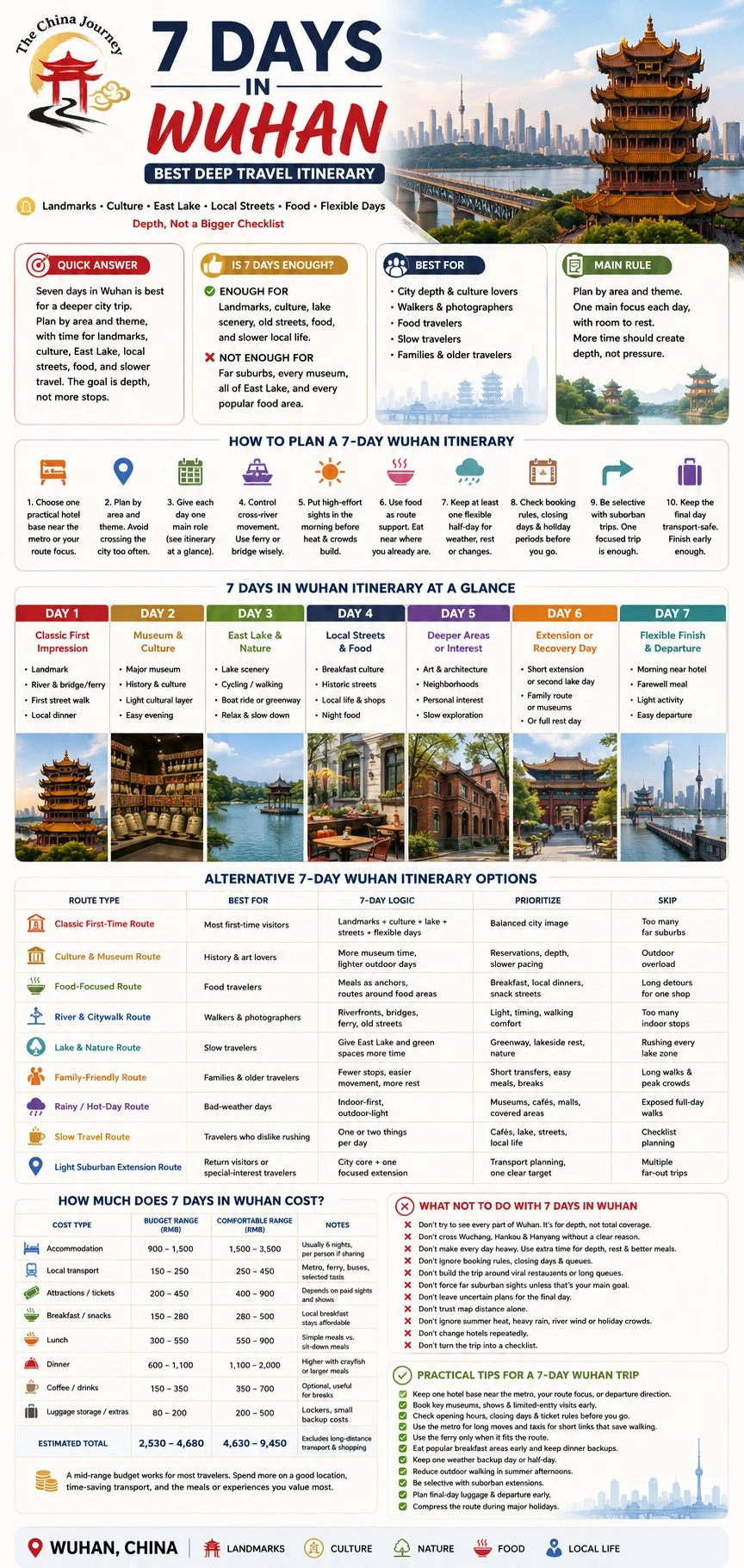
Yes. Seven days is enough for a deep city-focused Wuhan trip: landmarks, river views, culture, East Lake, historic streets, food, one personal-interest day, and one flexible day. It is not enough for every suburb, museum, shopping area, or food trend. Use the week for depth, not total coverage.
Wuhan is large, so even seven days need route discipline. Plan by area, theme, and energy. Keep one hotel base, make food and transport support the route, and use the extra time for depth, rest, or one focused extension.
Use this as a first-time or deep-city framework, not a fixed schedule. Each day has a role, but the order can shift with arrival time, weather, bookings, energy, and interests.
| Day | Main Theme | Route Role | What to Focus On | Watch Out For |
|---|---|---|---|---|
| Day 1 | Classic river-city first impression | Build the city image | Landmark, river, bridge/ferry, first street walk | Compress if arriving late |
| Day 2 | Museum and cultural depth | Understand Wuhan beyond landmarks | Major museum, history, light cultural layer | Booking rules and fatigue |
| Day 3 | East Lake and nature | Slow the trip down | Lake scenery, cycling/walking, rest | Weather and distance |
| Day 4 | Hankou streets and food | Add local life and city texture | Breakfast culture, old streets, dinner | Queues and over-walking |
| Day 5 | Deeper local neighborhoods or special interest | Go beyond the standard route | Art, architecture, local streets, personal interest | Do not make it scattered |
| Day 6 | Optional extension or slow recovery day | Add depth without rushing | Light day trip, second lake day, family route, or rest | Avoid overcommitting |
| Day 7 | Flexible finish and departure | Complete the trip smoothly | Missed area, final meal, shopping, departure | Keep transport safe |

Day 1 should give you Wuhan’s river-city frame: a landmark, a river crossing, one compact street area, and a local dinner. Keep it smooth and avoid chasing every famous name immediately.
If you arrive early, start with Yellow Crane Tower (黄鹤楼). It gives a fast visual read of the river, bridge, Wuchang, Hankou, and Wuhan’s wide layout.
Plan around 1.5–2 hours. Buy tickets online ahead on weekends or holidays, and go early if possible. The tower is reconstructed and can feel crowded, but the view and setting still make it useful for understanding Wuhan’s river-city structure.
If you arrive in the afternoon, keep the day light with a river walk, ferry ride, bridge view, or easy old-street dinner. Move the tower to another free morning if needed.
Lunch should connect the morning and afternoon. If you are still in Wuchang, Liangdao Street (粮道街) can work for quick local bites such as Hot Dry Noodles (热干面), doupi, or shaomai. Do not turn lunch into a food hunt. If one shop has a long queue, move on. Hubu Alley is convenient but commercial, so treat it as a fallback.
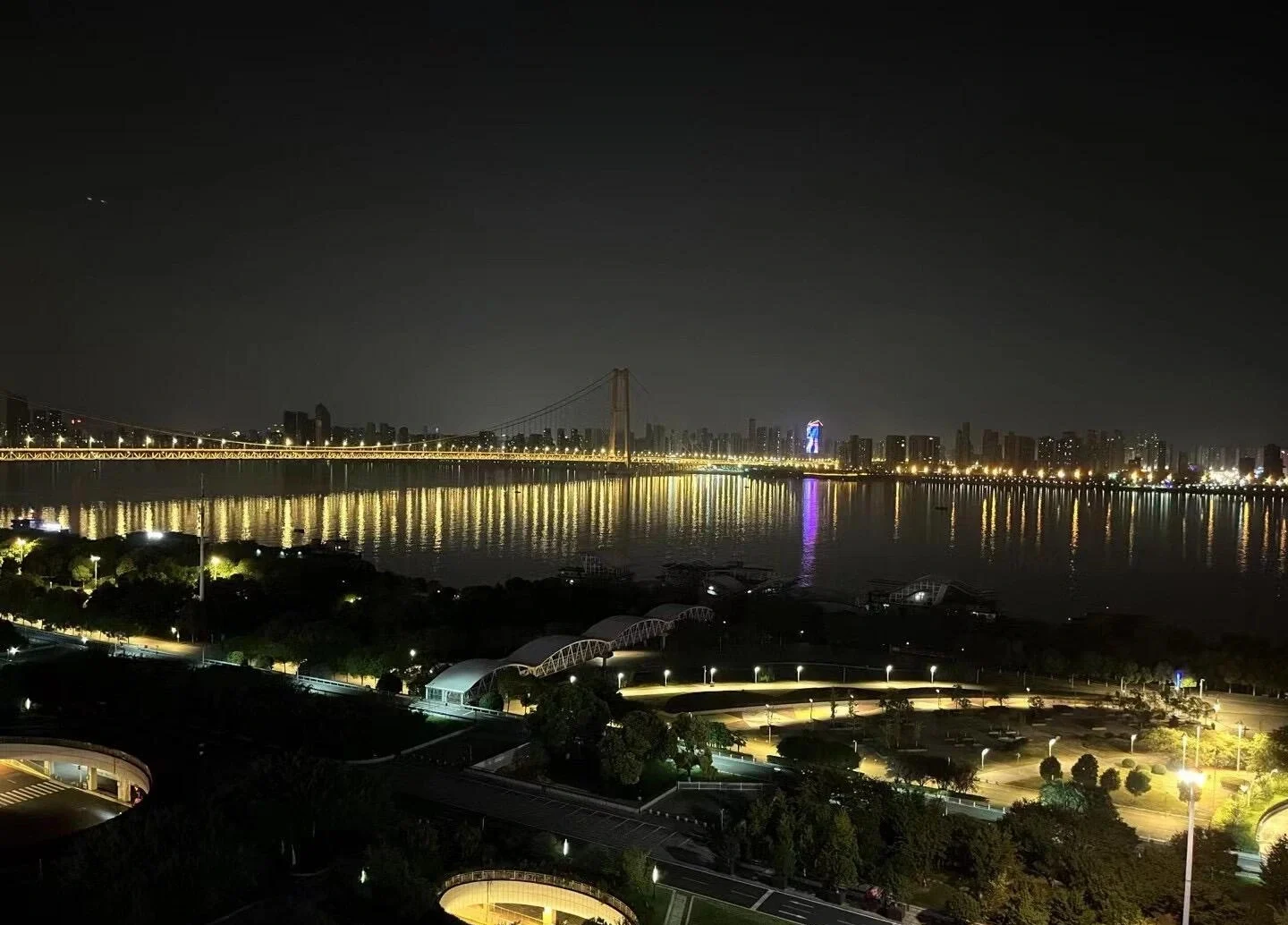
Use the afternoon to move from Wuchang to Hankou. A ferry or bridge-view transfer works well because it combines transport, river views, and local life. Wuhan Yangtze River Bridge (武汉长江大桥) can also fit if the weather and your walking energy are good.
After reaching Hankou, choose one compact area. Jianghan Road (江汉路), the Jianghan Customs House exterior, and Lihuangpi Road (黎黄陂路) can fit naturally, but do not try to cover every old concession street. Pick a small range, walk slowly, and take breaks.
End with Hankou River Beach (汉口江滩) and a local dinner. Choose one convenient riverfront section for evening light, skyline, bridges, and open river air. You do not need to walk the whole waterfront.
Wansongyuan (万松园) or another local food area can work for dinner. Crayfish (小龙虾), lotus root soup, Hubei dishes, barbecue, and beef noodles all fit this kind of evening. During crayfish season, weekends, and holidays, keep backups ready. If you arrived late, choose either river views or dinner, not both.

Day 2 adds cultural depth after the first-day landmarks. Keep it simple: one major cultural stop in the morning, then one lighter layer later.
Make Hubei Provincial Museum (湖北省博物馆) the main plan if it matches your interests. It needs time and focus, so allow about 2.5–4 hours.
Check reservations, closing days, and peak-period rules before building the day around it. If Bianzhong Bells (编钟) performances are available, check the schedule and fee separately. Focus on the strongest collections instead of trying to read every display.
Eat near the museum, on the way to your afternoon area, or somewhere you can sit and recover. After a heavy museum morning, convenience matters more than a famous restaurant across town.
Add one lighter cultural layer: a historical street, architecture area, art space, or relaxed cultural walk. Do not stack another heavy museum unless that is your main travel purpose.
If the museum takes longer than expected, reduce the afternoon to a short walk and coffee break.
Keep the evening low-intensity. Eat near your hotel or afternoon area. If you plan a show, check tickets, location, and end time in advance; otherwise, use the night to recover.
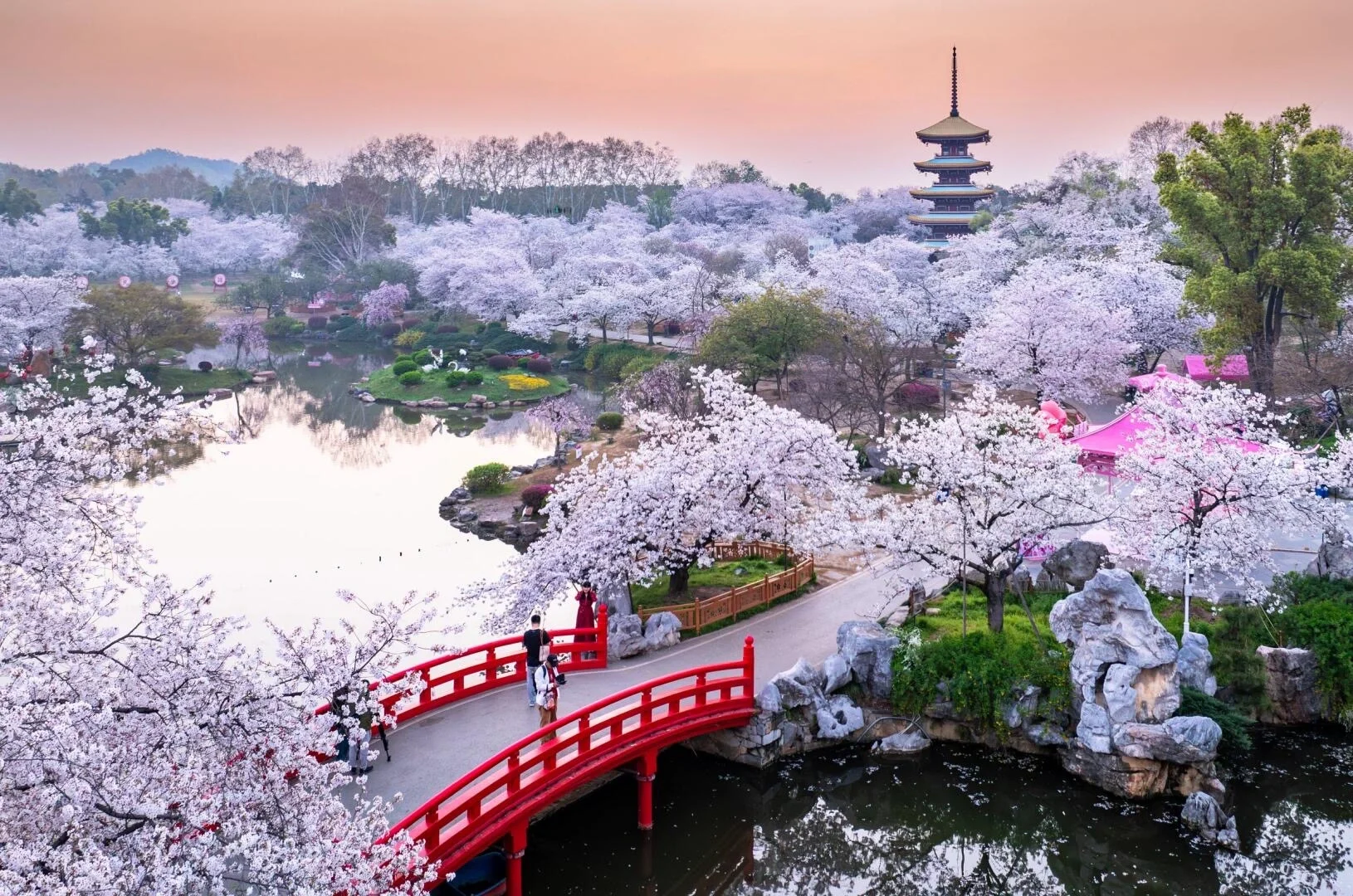
Day 3 is where seven days feels better than a short visit. Use it to slow down by the water instead of treating East Lake as a photo stop.
Spend the morning around East Lake (东湖), but do not try to see all of it. Choose one section, one greenway segment, or one clear experience.
Cycling, walking, a short lakeside route, a boat ride, or one scenic area can work. Pick based on weather and energy. In hot seasons, start early because open lake areas feel exposed by midday.
Keep lunch near the lake area or on your return route. If the morning involved cycling or long walking, choose somewhere convenient and restful.
Continue with a lighter lake experience, or switch to a café, art space, shaded walk, or indoor backup. If rain, heat, or wind makes the lake uncomfortable, change plans.
Keep dinner simple and close to your hotel or route end. Avoid a major night activity unless you still have real energy.
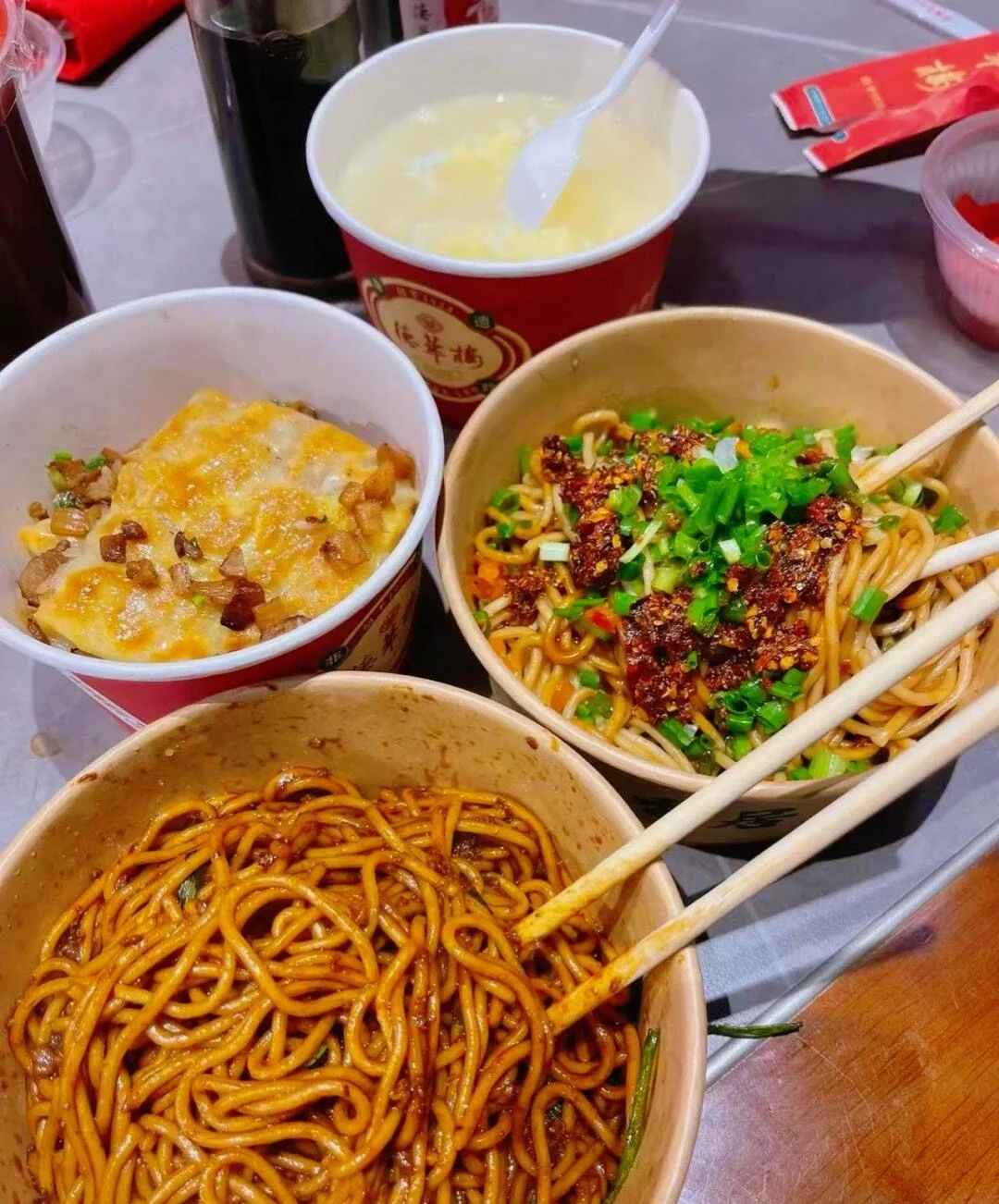
Day 4 should feel more local. This is not only a food day. It is about breakfast culture, old streets, architecture, local routines, and the everyday side of Wuhan.
Start with Wuhan breakfast culture, often called Guozao (过早). Shanhaiguan Road (山海关路) can work if it fits your hotel and route, but the method matters more than the exact street: go early, stay flexible, and do not depend on one viral shop.
Try a few nearby items instead of losing the morning to one queue. If you are not food-focused, keep breakfast short and move into the street-walk section.
Use lunch as a bridge between the morning food area and the afternoon streets. Keep it light, local, or simple.
Stay near where you already are or where you are going next. Do not cross the city for one famous restaurant.
Spend the afternoon in Hankou’s historic streets, old concession area, or nearby local lanes. Choose one core range and stay within it.
Look for architecture, cafés, small shops, and daily street life. This is a local texture day, not a mission to finish every street. Walk slowly and rest when heat or distance starts to weaken the experience.
Use the evening for a local dinner, night-food area, or short river-view finish. Keep queue logic strict: if a popular restaurant has a long wait, switch quickly.
Do not make dinner a ranking exercise. Choose a practical area, keep a backup, and let the evening stay easy.

Day 5 is where 7 days becomes different from a 5-day route. You can add a more personal layer, but it still needs one clear direction. Do not turn this into a leftovers day.
Choose one deeper theme: architecture, art, a campus area, an old community, religious architecture, a small museum, a creative district, or another focused interest from your research.
Keep the day on that theme. A strong Day 5 should feel personal, not scattered. Build the route around nearby places that support the same idea.
Keep lunch near the morning area or on the way to your afternoon route. It should support the theme, not pull you across the city.
If the morning has been walking-heavy, choose a place where you can sit down and recover.
Continue the morning theme or add one low-pressure related stop. This is a good time for slow walking, photography, local observation, a café break, or a small area you can explore without pressure.
If you feel tired, make this a recovery block. Seven days gives you space to rest without feeling that you are wasting the trip.
Keep the evening free or easy. Eat near your base, near the afternoon area, or somewhere that does not require a long transfer.
Avoid a heavy night plan. Day 6 needs flexibility, and you should not enter it already drained.

Day 6 is the flexible value of a 7-day route. It can be a short extension, second lake day, family-friendly plan, museum or art completion day, or pure recovery. It should not automatically become a far-suburb day.
Choose one direction only. If you are tired, rest is valid. If you go farther, the transfer is worth it only when the destination truly matters to you.
Let lunch follow the day’s theme. If you are farther from the center, keep it realistic and stable. If this is a slow city day, lunch can be part of the experience, but not a detour.
Continue the same theme or return to the city. Do not add another unrelated district just because you still have time. If the day includes outdoor or suburban travel, leave enough return buffer.
Have dinner near your accommodation or route end. Avoid uncertain long-distance night plans, and use the evening to reset for the final day.
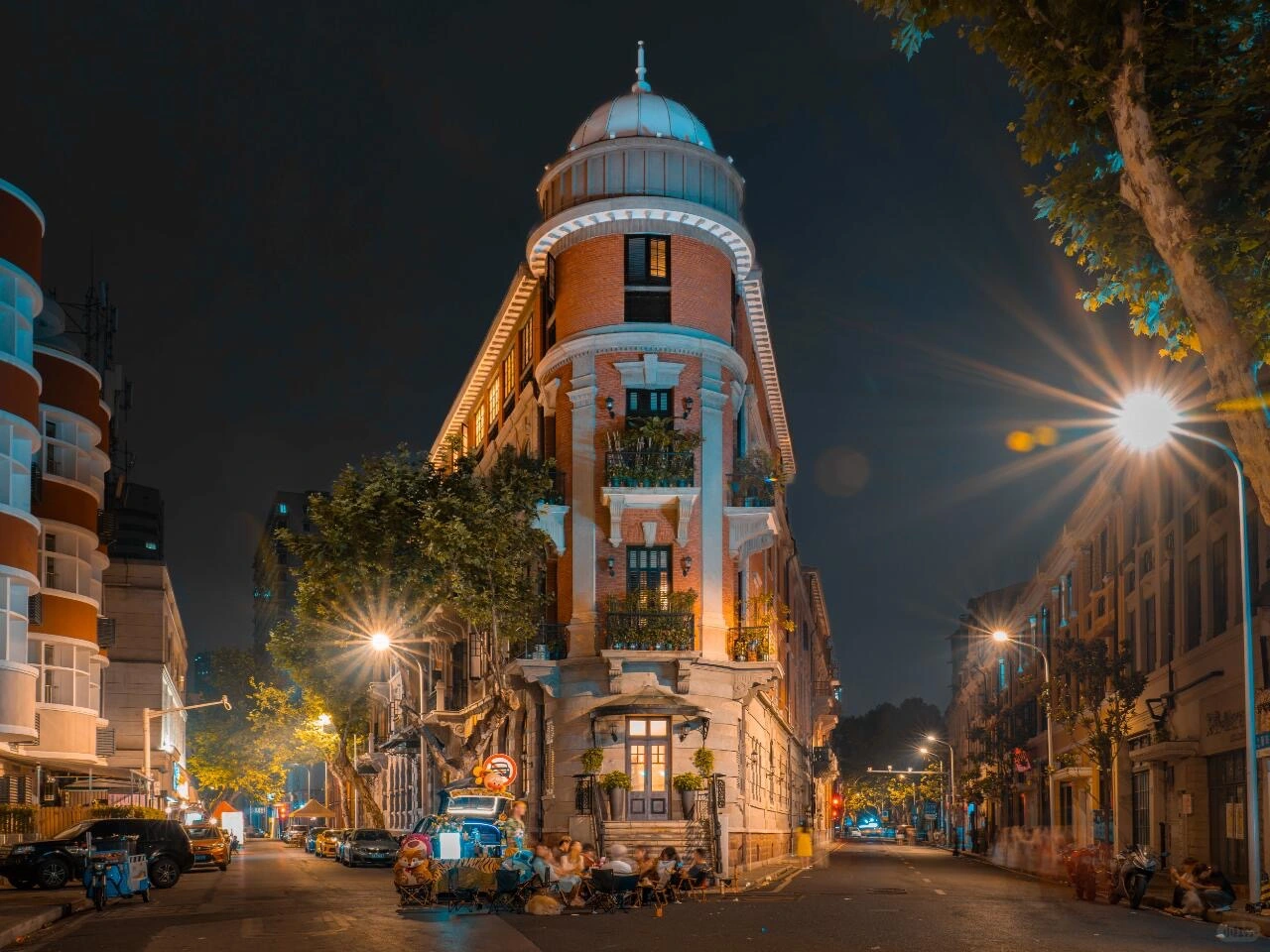
Day 7 is for a clean ending. It is not the day to squeeze in every missed place. Keep the route close, light, and transport-safe.
Choose the morning based on departure time. If you leave early, go straight into travel mode.
If you have time, choose one light activity near your hotel, luggage point, or departure route. A short street walk, small museum, lake walk, café, souvenir stop, or final local breakfast can all work. Keep it simple.
Lunch can be your farewell meal, especially if you leave in the evening. Choose somewhere close to your hotel, luggage storage, station route, or airport route.
If your transport is later in the day, lunch is often safer than saving a big local meal for dinner.
Transport safety comes first. A short walk, light shopping, coffee stop, or simple neighborhood visit is enough.
End major activities by mid-afternoon if you need to collect luggage and transfer to a station or airport. Build in more buffer than the map suggests.
If you are leaving, eat near your departure route or at the station or airport. Do not gamble on traffic for one last faraway stop.
If you are staying overnight, choose an easy final evening: a quiet street, light night view, or relaxed food area. The best final day should feel calm, not rushed.
Seven days gives more flexibility than a 5-day trip, but it still works best with one main direction. Use this table to match the route to your interests, then keep each day focused.
| Route Type | Best For | 7-Day Logic | Prioritize | Skip |
|---|---|---|---|---|
| Classic first-time route | Most first-time visitors | Landmarks + culture + lake + streets + flexible days | Balanced city image | Too many far suburbs |
| Culture and museum route | History and art lovers | More museum time, lighter outdoor days | Reservations, depth, slower pacing | Outdoor overload |
| Food-focused route | Food travelers | Meals as anchors, routes built around food areas | Breakfast, local dinners, snack streets | Long detours for one shop |
| River and citywalk route | Walkers and photographers | Riverfronts, bridges, ferry, old streets | Light, timing, walking comfort | Too many indoor stops |
| Lake and nature route | Slow travelers | Give East Lake and green spaces more time | Greenway, lakeside rest, nature | Rushing every lake zone |
| Family-friendly route | Families and older travelers | Fewer stops, easier movement, more rest | Short transfers, easy meals, breaks | Long walks and peak crowds |
| Rainy / hot-day route | Bad-weather days | Indoor-first, outdoor-light | Museums, cafés, malls, covered areas | Exposed full-day walks |
| Slow travel route | Travelers who dislike rushing | One or two things per day | Cafés, lake, streets, local life | Checklist planning |
| Light suburban extension route | Return visitors or special-interest travelers | City core plus one focused extension | Transport planning, one clear target | Multiple far-out trips |
These are rough 2026 references for an independent 7-day Wuhan trip. Main costs are accommodation, transport, tickets, meals, drinks, and small extras. Your budget depends most on hotel location, taxi use, paid sights, shows, meal choices, and route efficiency.
| Cost Type | Budget Range | Comfortable Range | Notes |
|---|---|---|---|
| Accommodation | RMB 900–1,500 | RMB 1,500–3,500 | Usually 6 nights, per person if sharing |
| Local transport | RMB 150–250 | RMB 250–450 | Metro, ferry, buses, selected taxis |
| Attractions / tickets | RMB 200–450 | RMB 400–900 | Depends on paid sights and shows |
| Breakfast / snacks | RMB 150–280 | RMB 280–500 | Local breakfast stays affordable |
| Lunch | RMB 300–550 | RMB 550–900 | Simple meals vs. sit-down meals |
| Dinner | RMB 600–1,100 | RMB 1,100–2,000 | Higher with crayfish or larger meals |
| Coffee / drinks | RMB 150–350 | RMB 350–700 | Optional, useful for breaks |
| Luggage storage / extras | RMB 80–200 | RMB 200–500 | Lockers, small backup costs |
| Estimated total | RMB 2,530–4,680 | RMB 4,630–9,450 | Excludes long-distance transport and shopping |
Seven days in Wuhan does not need to be expensive. A mid-range budget works for most travelers. Spend more on a good location, time-saving transport, and the meals or experiences you value most.


Learn the exact Wood Rat years, how Jia-Zi combines Wood and Water, what Gold in the Sea means, and how traits and compatibility are traditionally interpreted.

A typical Terracotta Warrior weighs about 180 kg (396 lbs). Lighter kneeling figures are around 100 kg, while heavier generals and horses can exceed 300 kg.

A clear and gentle 2026 forecast for children born in 2019, highlighting learning growth, independence development, relationships, health, and practical guidance.

Discover Shanghai Hongqiao Airport’s history, smart services, flight network, and travel tips. Your essential guide to China’s most connected domestic hub.

The Great Wall was built to protect China’s farming civilization from northern invasions and became a symbol of defense, unity, and empire.

Explore Dragon years and exact dates, Chen’s Earth meaning, five Dragon types, cultural symbolism, compatibility, and the 2026–2027 traditional folk outlooks.


