

Travel Tips
Top 10 China Travel Agencies for 2025 Tours
Discover the 10 best travel agencies for China tours in 2025, offering custom trips, expert guides, and unique cultural experiences across the country.
 Written by
Anthony
Written by
Anthony
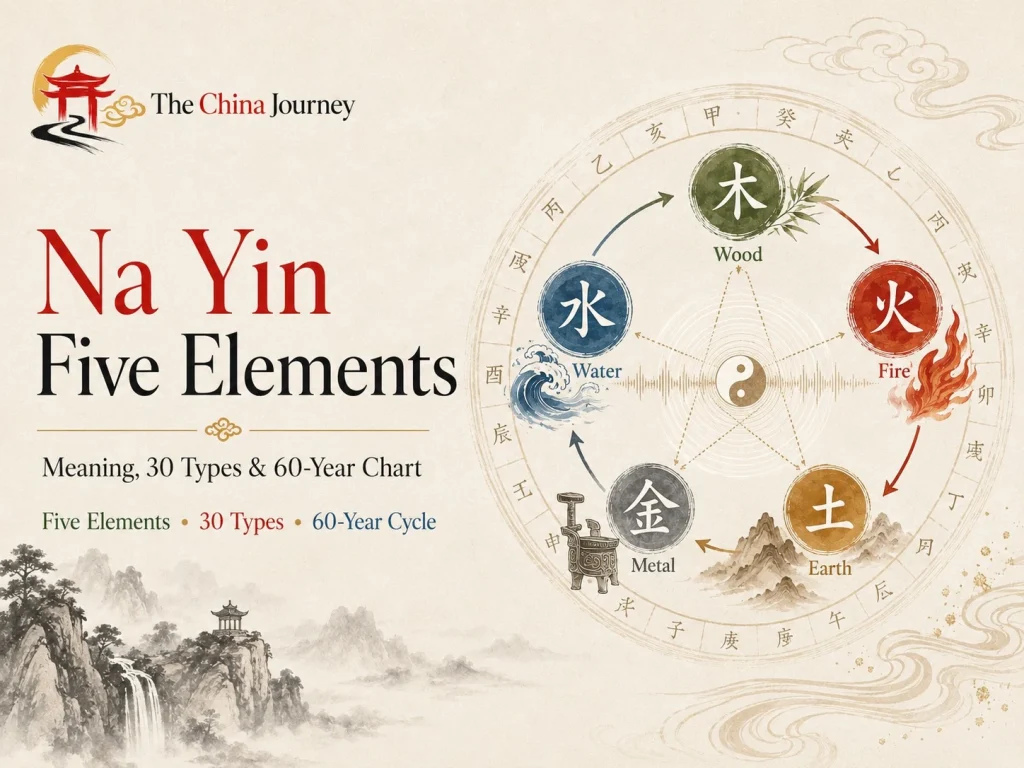
Wuxing is a five-part system for describing how phenomena emerge, develop, stabilize, contract and return to a latent state. Its five categories are Wood (木), Fire (火), Earth (土), Metal (金) and Water (水). Wood suggests growth and extension; Fire, heat and outward activity; Earth, support and transformation; Metal, consolidation and form; Water, descent, storage and flow.
The categories operate through two principal relationships. The Generating Cycle (相生) moves Wood → Fire → Earth → Metal → Water → Wood, representing support or continuity. The Controlling Cycle (相克) moves Wood → Earth → Water → Fire → Metal → Wood, representing limits that keep one tendency from dominating. This emphasis on interaction is why academic discussions often translate wuxing as the “Five Phases” or “Five Processes,” although “Five Elements” remains the familiar English name.[2]
The same birth year can appear to have two different Chinese elements. A person born in the Xin-You year commonly labeled 1981, for example, may be called a Metal Rooster because Xin is a Metal Heavenly Stem and You is the Rooster branch. Yet Xin-You belongs to Pomegranate Wood in the Na Yin system.
Neither label is automatically wrong. They answer different questions. This guide explains what Na Yin means, how to find the correct category, how all 60 Jiazi map to 30 named types, and how to read their traditional images without turning them into deterministic claims.
Na Yin is a Five-Element classification applied to complete Gan-Zhi combinations. Na can suggest receiving, including or assigning, while yin refers here to tone. In the surviving discussion in Xiao Ji’s Wuxing Dayi, Na Yin is explained through the five tones—gong, shang, jue, zhi and yu—and a traditional numerical system.[1]
This historical “tone” belongs to an old framework joining music theory, calendrical categories and correlative thought. It is not a measurable sound emitted by a person, a hidden frequency or a modern energy code. For the broader meanings of Wood, Fire, Earth, Metal and Water, see the separate Wuxing guide.
Na Yin does not replace the ordinary Wuxing identities of the two characters. Jia remains a Wood stem and Zi remains a Water branch even though Jia-Zi is classified as Gold in the Sea. The Na Yin name is an additional result assigned to the combination, not a claim that the stem and branch have changed their original correspondences.
The ten Heavenly Stems and twelve Earthly Branches advance together to form a sequence of 60 valid pairs, beginning with Jia-Zi and ending with Gui-Hai.[2] Na Yin groups these pairs two at a time: a yang combination is followed by a yin combination, and both receive the same named classification.
Later texts describe the tonal derivation with the metaphor “like marries like; a child is born after eight.” This is specialist language for relationships within an old pitch-generating model, not a modern biological or scientific rule. Readers who need the complete calendrical foundation can first review the Heavenly Stems and Earthly Branches.
Do not assume that a Gan-Zhi year changes on January 1. Two conventions are commonly encountered. Popular zodiac lookup uses Lunar New Year, the first day of the first lunar month. Four Pillars practitioners commonly change the year pillar at Lichun, the Start of Spring. These boundaries can fall on different dates, so a January or February birthday may be assigned to the preceding Gan-Zhi under one or both conventions.
Use the convention appropriate to the system you are consulting and verify the exact date. Hong Kong Observatory publishes Gregorian–lunar conversion tables for 1901–2100.[3] For the popular Lunar New Year convention used by this site, the Chinese zodiac calculator can identify the Gan-Zhi from a full birth date.
The difference matters only around the changeover, but it can change every result downstream. If Lunar New Year falls after Lichun, a birth date between the two may belong to one year in a Four Pillars calculation and the preceding zodiac year in a popular lookup. Record both the date and the convention whenever you compare results from different calculators.
Once you know the Gan-Zhi, find that exact pair in the chart. A Gregorian year’s final digit can help identify its Heavenly Stem in a limited context, but it cannot distinguish all 30 Na Yin names.
| Example | Gan-Zhi | Common Year Label | Na Yin |
|---|---|---|---|
| 1981 | Xin-You 辛酉 | Metal Rooster | Pomegranate Wood |
| 1988 | Wu-Chen 戊辰 | Earth Dragon | Great Forest Wood |
| 2026 | Bing-Wu 丙午 | Fire Horse | Heavenly River Water |
The year numbers are convenient labels, not universal January-to-December date ranges. Always resolve the boundary first when the birthday falls near Lunar New Year or Lichun.
Each row contains two consecutive Gan-Zhi combinations that share one Na Yin. The example years show two appearances of the same pair within 1924–2043. Birthdays near the beginning of a Gregorian year still require an exact boundary check.
| Gan-Zhi Pair | Na Yin | Element | Example Years |
|---|---|---|---|
| Jia-Zi 甲子 / Yi-Chou 乙丑 | Gold in the Sea (海中金) | Metal | 1924–1925; 1984–1985 |
| Bing-Yin 丙寅 / Ding-Mao 丁卯 | Fire in the Furnace (炉中火) | Fire | 1926–1927; 1986–1987 |
| Wu-Chen 戊辰 / Ji-Si 己巳 | Great Forest Wood (大林木) | Wood | 1928–1929; 1988–1989 |
| Geng-Wu 庚午 / Xin-Wei 辛未 | Roadside Earth (路旁土) | Earth | 1930–1931; 1990–1991 |
| Ren-Shen 壬申 / Gui-You 癸酉 | Sword-Edge Metal (剑锋金) | Metal | 1932–1933; 1992–1993 |
| Jia-Xu 甲戌 / Yi-Hai 乙亥 | Fire on the Mountain (山头火) | Fire | 1934–1935; 1994–1995 |
| Bing-Zi 丙子 / Ding-Chou 丁丑 | Stream Below the Valley (涧下水) | Water | 1936–1937; 1996–1997 |
| Wu-Yin 戊寅 / Ji-Mao 己卯 | City-Wall Earth (城头土) | Earth | 1938–1939; 1998–1999 |
| Geng-Chen 庚辰 / Xin-Si 辛巳 | White Wax Gold (白蜡金) | Metal | 1940–1941; 2000–2001 |
| Ren-Wu 壬午 / Gui-Wei 癸未 | Willow Wood (杨柳木) | Wood | 1942–1943; 2002–2003 |
| Jia-Shen 甲申 / Yi-You 乙酉 | Spring Water (泉中水; also 井泉水) | Water | 1944–1945; 2004–2005 |
| Bing-Xu 丙戌 / Ding-Hai 丁亥 | Roof Tile Earth (屋上土) | Earth | 1946–1947; 2006–2007 |
| Wu-Zi 戊子 / Ji-Chou 己丑 | Thunderbolt Fire (霹雳火) | Fire | 1948–1949; 2008–2009 |
| Geng-Yin 庚寅 / Xin-Mao 辛卯 | Pine and Cypress Wood (松柏木) | Wood | 1950–1951; 2010–2011 |
| Ren-Chen 壬辰 / Gui-Si 癸巳 | Long-Flowing Water (长流水) | Water | 1952–1953; 2012–2013 |
| Jia-Wu 甲午 / Yi-Wei 乙未 | Gold in the Sand (沙中金) | Metal | 1954–1955; 2014–2015 |
| Bing-Shen 丙申 / Ding-You 丁酉 | Fire at the Foot of the Mountain (山下火) | Fire | 1956–1957; 2016–2017 |
| Wu-Xu 戊戌 / Ji-Hai 己亥 | Flatland Wood (平地木) | Wood | 1958–1959; 2018–2019 |
| Geng-Zi 庚子 / Xin-Chou 辛丑 | Wall Earth (壁上土) | Earth | 1960–1961; 2020–2021 |
| Ren-Yin 壬寅 / Gui-Mao 癸卯 | Gold Leaf (金箔金) | Metal | 1962–1963; 2022–2023 |
| Jia-Chen 甲辰 / Yi-Si 乙巳 | Buddhist Lamp Fire (佛灯火; also 覆灯火) | Fire | 1964–1965; 2024–2025 |
| Bing-Wu 丙午 / Ding-Wei 丁未 | Heavenly River Water (天河水) | Water | 1966–1967; 2026–2027 |
| Wu-Shen 戊申 / Ji-You 己酉 | Great Post-Road Earth (大驿土) | Earth | 1968–1969; 2028–2029 |
| Geng-Xu 庚戌 / Xin-Hai 辛亥 | Hairpin and Bracelet Gold (钗钏金) | Metal | 1970–1971; 2030–2031 |
| Ren-Zi 壬子 / Gui-Chou 癸丑 | Mulberry Wood (桑柘木) | Wood | 1972–1973; 2032–2033 |
| Jia-Yin 甲寅 / Yi-Mao 乙卯 | Great Stream Water (大溪水) | Water | 1974–1975; 2034–2035 |
| Bing-Chen 丙辰 / Ding-Si 丁巳 | Earth in the Sand (沙中土) | Earth | 1976–1977; 2036–2037 |
| Wu-Wu 戊午 / Ji-Wei 己未 | Heavenly Fire (天上火) | Fire | 1978–1979; 2038–2039 |
| Geng-Shen 庚申 / Xin-You 辛酉 | Pomegranate Wood (石榴木) | Wood | 1980–1981; 2040–2041 |
| Ren-Xu 壬戌 / Gui-Hai 癸亥 | Great Sea Water (大海水) | Water | 1982–1983; 2042–2043 |
English translations vary widely across books and websites. This page uses one consistent project glossary. Spring Water is also called Well Spring Water in translations of 井泉水, while the lamp category appears in Chinese as 覆灯火 and, in later popular usage, 佛灯火. Here it is standardized as Buddhist Lamp Fire.
The table is a lookup tool, not a scale from weak to strong or unlucky to lucky. A type appearing later in the sequence is not more developed than an earlier type, and the physical size of an image does not determine the value of a person born under it.
The names turn abstract classifications into images drawn from landscapes, materials, buildings, transport and everyday objects. The descriptions below explain those traditional images only. They are not standardized personality profiles or evidence that people born under one name share the same abilities or future.
Four distinctions make the names easier to read. Some describe location, such as metal in the sea or fire on a mountain. Others describe scale, from a spring to the sea; condition, from concealed gold to a finished blade; or function, from roadside earth to roof tiles. The image gives each category texture without changing its underlying element.
The Metal names trace different conditions of a valuable material: hidden, newly forming, mixed with other matter, sharpened, spread into a thin surface or completed as ornament. They should not be reduced to money. Jin (金) is the Wuxing category Metal, even when “Gold” better preserves the image in a particular name.
| Na Yin | Traditional Image |
|---|---|
| Gold in the Sea (海中金) | Value remains hidden beneath deep water and needs suitable conditions before it can be revealed or refined. |
| Sword-Edge Metal (剑锋金) | Metal has been forged into a sharp blade, emphasizing a finished edge, cutting power and decisive function. |
| White Wax Gold (白蜡金) | Metal is still unrefined or newly forming. The image emphasizes valuable material that has not yet become a durable implement. |
| Gold in the Sand (沙中金) | Gold is mixed with sand and must be separated, tested and refined before its value becomes clear. |
| Gold Leaf (金箔金) | Gold has been beaten into a very thin decorative layer, emphasizing visible refinement and surface brilliance. |
| Hairpin and Bracelet Gold (钗钏金) | Metal has been refined into personal ornaments, joining material value with craftsmanship, finish and social use. |
The Wood names distinguish environments and uses rather than ranking one tree above another. A forest emphasizes collective scale, willow and evergreen species emphasize different growth forms, and mulberry or pomegranate introduces the practical work of nourishment and fruiting.
| Na Yin | Traditional Image |
|---|---|
| Great Forest Wood (大林木) | A broad, thriving forest suggests strong roots, abundant growth and resources formed by many trees together. |
| Willow Wood (杨柳木) | Willow branches bend with wind and water. Their image combines softness, responsiveness and survival through flexibility. |
| Pine and Cypress Wood (松柏木) | Evergreen pine and cypress endure cold seasons, making them traditional images of persistence, integrity and longevity. |
| Flatland Wood (平地木) | Wood rooted on ordinary level ground represents steady development under open, practical conditions rather than dramatic terrain. |
| Mulberry Wood (桑柘木) | Mulberry and cudrania trees supported sericulture and rural livelihoods, so the image stresses nourishment and useful production. |
| Pomegranate Wood (石榴木) | A fruit-bearing tree symbolizes concentrated vitality, visible results, abundance and the continuation of a family line. |
The Water sequence uses source, channel, elevation and volume to create contrast. A valley stream, a spring and a long river do not carry the same image, while the celestial river and the sea move beyond the scale of an ordinary local watercourse.
| Na Yin | Traditional Image |
|---|---|
| Stream Below the Valley (涧下水) | A small stream follows low mountain channels. Its movement is subtle, local and shaped by the terrain around it. |
| Spring Water (泉中水) | Water rises from a dependable source. The image emphasizes clarity, nourishment and continuity at a modest scale. |
| Long-Flowing Water (长流水) | A watercourse continues over distance, suggesting sustained movement, connection and progress rather than a sudden surge. |
| Heavenly River Water (天河水) | The celestial river evokes the Milky Way and rain from above, giving this water an elevated and expansive image. |
| Great Stream Water (大溪水) | A substantial mountain stream moves outward with more force and volume while remaining directed by a channel. |
| Great Sea Water (大海水) | The sea receives many rivers and suggests breadth, depth, inclusion and movement too large for a narrow boundary. |
Fire varies by containment, height, visibility and duration. A furnace concentrates heat for transformation; lightning releases it suddenly; a lamp preserves a small flame; and fire in the sky illuminates across a much wider field.
| Na Yin | Traditional Image |
|---|---|
| Fire in the Furnace (炉中火) | Heat is concentrated inside a controlled vessel, where pressure and temperature transform raw material. |
| Fire on the Mountain (山头火) | Fire at a high, exposed position is visible from afar and strongly affected by wind and surrounding conditions. |
| Thunderbolt Fire (霹雳火) | Lightning appears suddenly and forcefully. Its image is impact, abrupt transformation and a short, intense release. |
| Fire at the Foot of the Mountain (山下火) | Low fire near settled ground suggests practical warmth, scattered lights and influence that remains close to daily life. |
| Buddhist Lamp Fire (佛灯火; 覆灯火) | A small oil lamp gives steady light through darkness, making continuity, illumination and protected flame its central images. |
| Heavenly Fire (天上火) | Sunlight or fire across the sky illuminates widely, emphasizing visibility, radiance and influence over a broad area. |
The Earth names are unusually connected to the built environment. Soil becomes a route, a defensive wall, a roof or a finished surface. These human uses give the images meanings of support, movement, enclosure and structure without making every Earth category identical.
| Na Yin | Traditional Image |
|---|---|
| Roadside Earth (路旁土) | Soil beside a road supports continual passage and service while remaining exposed to changing surroundings. |
| City-Wall Earth (城头土) | Rammed earth forms a defensive wall, making boundaries, protection, duty and collective security its main images. |
| Roof Tile Earth (屋上土) | Earth has been shaped and fired into roof tiles that create shelter, order and a protected place to live. |
| Wall Earth (壁上土) | Earth applied to a wall defines space, covers a surface and supports separation, protection and stable structure. |
| Great Post-Road Earth (大驿土) | The broad earth of an old postal route supports movement, transport, migration and networks between distant places. |
| Earth in the Sand (沙中土) | Loose earth mixed with sand needs gathering and organization before it can provide a firm foundation. |
Xin-You, commonly labeled 1981, shows why a single person can receive more than one correct element label. Each result comes from a different part of the system.
| Layer | 1981 Result | What It Describes |
|---|---|---|
| Zodiac branch element | You Rooster = Metal | The fixed primary Wuxing association of the Earthly Branch |
| Year-stem element | Xin = Metal | The element used in the common label Metal Rooster |
| Na Yin | Pomegranate Wood | The named category assigned to the complete Xin-You combination |
| Full Four Pillars | Requires birth year, month, day and hour | The broader traditional chart, not a result derived from the year alone |
For a fuller comparison of the fixed branch element, changing Heavenly Stem element, Na Yin and complete chart, read Chinese Zodiac Elements.
Older fate-calculation traditions gave the birth-year designation a prominent role. In later Four Pillars practice, Na Yin may be consulted as an additional symbolic layer, but it does not replace the Day Master, month command, Ten Gods, luck cycles or relationships across the complete chart.
A birth-year Na Yin therefore cannot establish overall element balance, a favorable element, a supposedly missing element or a remedy. Those conclusions require a different method and much more information, and they remain part of a traditional interpretive system rather than scientific diagnosis.
This distinction also explains why buying an object, choosing a color or changing a name cannot be justified simply by saying that a year Na Yin “needs” another element. Even within traditional practice, relationships among a full set of stems and branches require more context than one paired label provides.
The Sui-dynasty Wuxing Dayi, compiled by Xiao Ji, preserves a detailed discussion of Na Yin numbers. It identifies yin with the five tones and relates Gan-Zhi values to a numerical method for assigning an elemental category.[1] This is evidence for an established tonal and numerical framework by the Sui period.
The framework should be read in its historical intellectual setting. Ancient Chinese writers coordinated music, calendars, numbers and Wuxing through systems of correspondence. Calling this a modern sound frequency theory imports a concept the text does not claim.
The exact dates at which all 30 image names emerged are difficult to establish. The surviving discussion in Wuxing Dayi explains the tonal and numerical classification, while the Ming work San Ming Tong Hui preserves the full set of images and extended explanations for Gold in the Sea, Fire in the Furnace, Great Forest Wood and the other categories.[4]
The names do more than replace Metal, Wood, Water, Fire and Earth with decorative language. They distinguish condition, scale, location and use: Metal may be concealed, unrefined, forged or ornamental; Water may be a spring, a stream, a celestial river or the sea. These are traditional interpretive metaphors, not separate physical substances.
Later compilations sometimes attribute the system to legendary or very early figures, but such attributions are not enough to date the complete 30-name scheme. A careful history separates what a surviving text actually contains from later claims about who first created the method.
| Traditional Context | What the Use Means | Modern Limit |
|---|---|---|
| Birth-year designation | People may be described by names such as Gold in the Sea life or Pomegranate Wood life. | A year label does not describe a whole person. |
| Earlier fate-calculation methods | The year pillar and its Na Yin held an important place in some older systems. | Historical use is not scientific validation. |
| Four Pillars commentary | Some practitioners use Na Yin as a secondary symbolic relationship among pillars. | It cannot replace the complete chart. |
| Folk marriage comparison | Families sometimes compared the generating or controlling relationships of two birth-year Na Yin elements. | It cannot predict relationship quality or success. |
Learning these uses helps explain historical language and family customs. It does not justify choosing a spouse, career, investment, medical treatment, home color or auspicious date from a birth-year Na Yin alone.
Generating and controlling relationships also need cautious language. In Wuxing, generation can describe support and control can describe regulation; neither automatically means good or bad. Applying those relationships to two isolated year labels cannot produce an objective compatibility score or forecast an event.
| Common Mistake | Accurate Correction |
|---|---|
| Changing the Gan-Zhi year on January 1 | Popular zodiac lookup uses Lunar New Year; Four Pillars commonly uses Lichun. |
| Treating the Heavenly Stem element as Na Yin | The stem and the complete pair use separate classification rules and can produce different elements. |
| Treating the zodiac branch element as Na Yin | The branch has a fixed primary association; Na Yin belongs to the complete Gan-Zhi pair. |
| Reading the 30 images as fixed personality types | They are traditional metaphors, not standardized psychological categories. |
| Using the Gregorian year’s last digit to find Na Yin | The last digit cannot distinguish all 30 types; identify the Gan-Zhi and use the fixed mapping. |
| Using a birth-year Na Yin as a complete BaZi reading | A full chart also requires the month, day and hour pillars. |
| Assuming a controlling relationship guarantees conflict | Wuxing control is a symbolic relationship, not a verdict on real people or events. |
Na Yin assigns 30 named Five-Element images to the 60 Gan-Zhi combinations, with two consecutive combinations sharing each name. Find the correct Gan-Zhi first, then use the fixed chart rather than guessing from the zodiac animal or year digit.
The result is a precise traditional calendar and metaphysical label within its proper scope. It is not a scientific personality test, a complete BaZi chart or a reliable basis for medical, financial, career or relationship decisions.
Yes. Na Yin is the spaced romanization used on this page, while Nayin is a common compact spelling. Both refer to 纳音.
Each Na Yin is shared by two consecutive Gan-Zhi combinations. Jia-Zi and Yi-Chou share Gold in the Sea, for example. Dividing the 60 combinations into pairs produces 30 names.
First identify the correct Gan-Zhi for your birth date under the convention being used. Then find that pair in the 60 Jiazi chart. January and February birthdays need special care because the year does not change on January 1.
Not necessarily. The zodiac animal comes from one Earthly Branch, the common birth-year element comes from the Heavenly Stem, and Na Yin comes from the complete Stem-Branch pair. The results may match or differ.
No. Every pillar in a BaZi chart has a Gan-Zhi combination and therefore a Na Yin, but BaZi analyzes the year, month, day and hour together. A year Na Yin is only one possible layer within that larger system.
Traditional texts and folk practices attach interpretations to Na Yin, but a birth-year category cannot reliably determine personality, career suitability, compatibility or life outcomes. Use the names as cultural symbolism, not decision rules.
Bing-Wu, the Gan-Zhi commonly labeled 2026, has Heavenly River Water as its Na Yin. Ding-Wei, commonly labeled 2027, shares the same type. A person born in early 2026 may still belong to the preceding Yi-Si year, depending on the exact date and whether Lunar New Year or Lichun is used.
No reliable last-digit shortcut can identify all 30 Na Yin types. The final digit may help with the Heavenly Stem for many modern Gregorian year labels, but Na Yin requires the complete Gan-Zhi pair and its fixed mapping.

Discover the 10 best travel agencies for China tours in 2025, offering custom trips, expert guides, and unique cultural experiences across the country.

Plan 5 days in Kunming with city walks, nature, lake views, local life, costs, route options, and practical first-time tips.

Plan your first Taiyuan trip with the best things to do, where to stay, what to eat, and how to fit Taiyuan into a wider Shanxi route.
Learn the Year of the Rat in Chinese zodiac, including Rat years, personality traits, Five Elements, compatibility, lucky signs, and 2026 forecast.

A clear and structured 2026 forecast for people born in 1948, covering career, wealth, relationships, health, and practical guidance for a steady and safe year.

Wondering how many days to spend in Shanghai? Compare 1–7 day stays, Disney plans, museums, side trips, and first-time travel advice.

Share your travel ideas, and we’ll help you plan a smooth, personalized trip across China.

Share your travel ideas, and we’ll help you plan a smooth, personalized trip across China.
We’re looking for experienced, part-time local guides to serve international travelers.
Requirements:
• Fluent in at least one foreign language
• 3–5 years guiding international visitors
• Able to operate in multiple regions in China
• Competitive and reasonable pricing
• Proven customer reviews or testimonials
• Professional, reliable, and responsive
• Flexible availability for custom trips
Hi there!
Just a quick heads-up — a helpful user named Volker let me know that some of the non-English content on this site may not be accurate.
This site is a one-person project I run part-time. I research and publish all the content myself, and the translations are currently done by machine (Google Translate). Balancing accuracy and accessibility across multiple languages is a real challenge.
If you spot any errors, I recommend switching to the English version using the button at the bottom left. I’ll continue working to improve the translations over time.
I truly appreciate your understanding. And if you have any suggestions, feel free to leave a comment — it means a lot to me.
— Anthony 2025.6.18

