
 Written by
Anthony
Written by
Anthony
Decide by door-to-door time. Add the journey to your departure terminal, check-in and security, baggage collection, and the transfer from your Chengdu arrival hub to the hotel. TFU is around 50 kilometers southeast of central Chengdu, so a short flight can still become a long travel day.
| Starting situation | Best default | Likely Chengdu hub | Why it works | Consider the alternative when… |
|---|---|---|---|---|
| Overseas with a nonstop Chengdu flight | Fly nonstop | Usually TFU; some regional flights use CTU | Fewest connections and lowest disruption risk | A one-stop itinerary is much cheaper or arrives at a better time |
| Overseas with no practical nonstop | Book one through ticket via a major hub | Usually TFU | Checked-through baggage and airline protection simplify the connection | A stopover in another Chinese city is part of the trip |
| Chongqing or Xi’an | High-speed train | Usually Chengdu East | Central stations, strong service, and little airport overhead | A discounted flight fits unusually well |
| Zhangjiajie or Guiyang | High-speed train | Chengdu East or South | Direct rail is usually simpler than flying | No suitable direct train runs that day |
| Beijing or Shanghai | Fly | Usually TFU | The flight normally saves several hours | You prefer an overnight sleeper or airfare is poor value |
| Guangzhou or Shenzhen | Fly or overnight sleeper | TFU or Chengdu East | Flying is quicker; a sleeper can replace a hotel night | The evening train fits your schedule |
| Hong Kong | Direct flight or direct high-speed train | CTU/TFU or Chengdu East | Both through journeys are possible | Choose by total time, fare, luggage, and arrival hub |
| Leshan or Emei | High-speed train | Often Chengdu South or East | Short regional journey | There is normally no reason to fly |
| Western Sichuan without rail | Bus, tour vehicle, or private transfer | Route-dependent | Reaches mountain areas beyond the rail network | Rail reaches a practical gateway town |
Tianfu International Airport is Chengdu’s principal long-haul gateway. Direct routes serve parts of Europe and many Asian hubs, but the network changes seasonally. Search the exact dates instead of relying on a static city list.
If there is no practical nonstop, Beijing, Shanghai, Guangzhou, Shenzhen, and Hong Kong are useful Chinese connecting hubs. Singapore, Bangkok, Seoul, Tokyo, and Kuala Lumpur may work well from Asia or Oceania. The best connection is often the one that stays on a single ticket and avoids changing airports—not the one with the shortest advertised layover.
Buy a through ticket when possible. It provides one itinerary, clearer baggage instructions, and airline help if the first flight causes a missed connection. On separate tickets, the second carrier normally has no obligation to rebook you.
At your first mainland-China airport, allow time for immigration, baggage collection where required, customs, terminal movement, and another check-in. A 2.5- to 3-hour connection is a reasonable minimum at a familiar same-airport hub; longer is safer for separate tickets.
Separate tickets also create an immigration question. A traveler without a regular Chinese visa should not assume that a connection qualifies for 240-hour visa-free transit. Eligibility depends on nationality, entry port, permitted area, and confirmed onward travel to a third country or region. Check the National Immigration Administration’s current rules before booking.[8]
At 6:00 a.m. on July 30, 2026, selected Hong Kong, Macao, and Taiwan flights began moving from TFU Terminal 1 to CTU Terminal 1 in phases. Both airports now handle regional flights, and one airline may use different airports for different services.[1]
| Chengdu Tianfu International Airport | Chengdu Shuangliu International Airport | |
|---|---|---|
| Code | TFU | CTU |
| Location | Roughly 50 km southeast of central Chengdu | Roughly 16 km southwest of central Chengdu |
| Typical role | Most long-haul international flights plus many domestic services | Many domestic services plus selected Hong Kong, Macao, and Taiwan flights |
| Main rail link | Metro Line 18; Tianfu Airport national-rail station | Metro Line 10; Shuangliu Airport national-rail station |
| Typical drive to central Chengdu | About 40–60 minutes in good traffic | About 30–40 minutes in good traffic |
| Main advantage | Wider long-haul network | Much closer to the center |
| Main caution | The airport-to-hotel leg is substantial | Never infer the airport from “regional flight”; verify the code |
The number-one mistake is searching only for “Chengdu Airport.” Check TFU or CTU on every segment, including the return. The airports are far apart, and correcting a mistake can consume hours.
Line 19 has direct airport-to-airport trains with an in-vehicle time of about 30 minutes on the fastest pattern, but express services do not run continuously.[3] A self-transfer still includes terminal walking, possible immigration, baggage collection, and re-check-in. Allow at least four to five hours between separate flights; overnight is safer.
Flying usually makes sense when the comparable high-speed train takes more than six hours.
From Beijing, a flight of roughly three hours often becomes a 5.5- to 7-hour door-to-door trip. A daytime high-speed train can take around eight to nine hours, so the plane generally retains a useful advantage. From Shanghai, the gap is larger because daytime rail commonly takes ten hours or more. Guangzhou and Shenzhen are closer calls: flying is quicker, while an overnight sleeper can save a hotel night.
Do not compare a “2.5-hour flight” with an “eight-hour train” without adding access time. From landing at TFU, allow roughly 1.5 to 2 hours for baggage and the trip to a central hotel. CTU is closer, although its metro route into the center may require a change.
Flying is rarely sensible from Chongqing. The fastest benchmark high-speed services take about 62 minutes, and even slower departures normally beat the airport process.[11] Rail is also usually preferable from Xi’an, Guiyang, and other cities with a direct journey under about six hours.
| Airport and mode | Useful connection | In-vehicle time | Best for | Watch out for |
|---|---|---|---|---|
| TFU, Metro Line 18 | Chengdu South, then transfer toward Tianfu Square or Chunxi Road | Limited-stop service about 33 minutes to Chengdu South | Light luggage and daytime arrivals | Express and local schedules differ |
| TFU, national rail | Chengdu East or South | Fastest current services about 27–30 minutes | Hotels near a rail hub or onward trains | Limited departures; dated 12306 ticket required |
| TFU, taxi/DiDi | Direct to hotel | Often 40–60 minutes’ driving | Heavy luggage, late arrival, groups | Traffic and fare vary |
| CTU, Metro Line 10 | Change at Taipingyuan for Line 3 | Often 45–60 minutes after boarding | Light luggage and daytime arrivals | Transfer walking adds time |
| CTU, national rail | Chengdu South or East on a suitable service | Service-dependent | Connecting to another train | Check the exact dated departure |
| CTU, taxi/DiDi | Direct to hotel | Often 30–40 minutes’ driving | Heavy luggage or groups | Rush-hour traffic can erase the advantage |
Chengdu Metro’s limited-stop Line 18 pattern has an in-vehicle time of about 33 minutes between Chengdu South and TFU.[2] Tianfu Airport’s national-rail station has current services reaching Chengdu East in as little as 27 minutes on the train.[5] That service is fast but not “turn up and go”: frequency is limited, tickets are tied to one departure, and a delayed flight can make the booking useless.
These are vehicle times, not landing-to-hotel times. Add immigration if applicable, baggage, walking, waiting, transfers, and the last leg. For a late arrival, check the final metro, rail, and airport-bus departure that day; if timing is uncertain, budget for a taxi.
High-speed rail is usually best for a direct journey under six hours, particularly from Chongqing, Xi’an, Guiyang, Kunming, and Zhangjiajie.
Chengdu East, South, and West are connected to the metro and closer to the main hotel districts than TFU. There is no airport-style liquid screening, and baggage handling is generally simpler, although current China Railway size and weight rules still apply.
For a first journey, arrive 45–60 minutes before departure. Chengdu East is enormous, and you must enter, pass security, locate the waiting area, and reach the gate. Allow more time during Spring Festival, National Day, May Day, and the summer peak.
Choose G-, D-, or C-series services for most tourist journeys. K-, T-, and Z-series trains can be useful sleepers but are much slower.
The January 26, 2026 plan listed 371 train pairs at Chengdu East, 77 at Chengdu South, 59 at Chengdu West, and 79 on the Chengdu–Guanxian corridor.[4] These dated figures may change, but they show why Chengdu East is the default hub.
| Station | Chinese name | Common uses | Metro | Main caution |
|---|---|---|---|---|
| Chengdu East | 成都东站 | Chongqing, Xi’an, Beijing, Shanghai, Guangzhou, Shenzhen, Zhangjiajie, and other trunk routes | Lines 2 and 7 | Huge station; allow time for walking and security |
| Chengdu South | 成都南站 | Leshan, Emei, Guiyang, Kunming, and selected southbound services | Lines 1, 7, and 18 | Allocations change; verify the exact train |
| Chengdu West | 成都西站 | Selected western Sichuan, conventional trains, and some Dujiangyan/Qingcheng services | Lines 4 and 9 | Farther from the center |
| Xipu | 犀浦站 | Interchange for some Dujiangyan and Qingcheng Mountain trains | Line 2 plus suburban rail | Useful only for particular itineraries |
| Chengdu Railway Station / old North Station | 成都站 / 火车北站 | Not a normal arrival option during reconstruction | Lines 1 and 7 nearby | Closed for rebuilding in July 2026; reopening planned for 2027 |
The old Chengdu Railway Station stopped handling passengers for reconstruction and remained an active construction site in July 2026.[10] If an old guide says to use “Chengdu Station” or “North Railway Station,” check 12306 instead.
Allow roughly 25–35 minutes by metro from Chengdu East to the central area, 20–30 minutes from Chengdu South, and 35–45 minutes from Chengdu West. Add station walking and the final walk to the hotel.
Tickets normally go on sale 15 days before departure. Buy promptly for major holidays and summer weekends. A ticket from Chengdu East cannot be used from Chengdu South.
| Starting point | Recommended mode | Typical journey | Likely arrival | Main caution |
|---|---|---|---|---|
| Chongqing | High-speed train | Roughly 1–2 hours | Usually Chengdu East | Check the full station at both ends |
| Xi’an | High-speed train | Roughly 3–4 hours | Usually Chengdu East | Book early on busy dates |
| Zhangjiajie | Direct train when available | About 5 hours | Chengdu East | Limited direct service |
| Beijing | Fly in most cases | About 5.5–7 hours door to door | Usually TFU | Overnight rail may suit budget travelers |
| Shanghai | Fly | About 5.5–7 hours door to door | Usually TFU | Add the long Shanghai airport transfer |
| Guangzhou/Shenzhen | Fly or overnight sleeper | Flight about 5–6 hours door to door | TFU or Chengdu East | Compare arrival times, not only fare |
| Hong Kong | Direct flight or direct high-speed train | Flight roughly 2.5–3 hours; rail is a full-day trip | CTU/TFU or Chengdu East | Airport varies; direct rail is limited |
| Guiyang | High-speed train | Roughly 2.5–4 hours | South or East | Check the Chengdu station |
| Kunming | High-speed train | Roughly 5–7 hours | South or East | Flying may win if rail timing is poor |
| Leshan/Emei | High-speed train | Roughly 1–1.5 hours | South or East | Do not go to the wrong station |
| Jiuzhaigou area | Train from Huanglongjiuzhai plus road transfer | Roughly 2 hours by rail plus road leg | Chengdu East | The rail station is not at the park entrance |
Chongqing–Chengdu is the clearest train-first route. Benchmark services can run in about 62 minutes, although many take longer and use different Chongqing stations. Even after both city transfers, rail normally beats flying.
From Xi’an, a direct high-speed train generally takes around three to four hours and arrives at a city-connected station. The 2026 timetable also added a direct Chengdu East–Zhangjiajie West service at about five hours.[4] It is limited, so search the exact date.
From Beijing, flying normally saves two to three hours compared with a daytime high-speed train. From Shanghai, its advantage is usually larger. The calculation changes if the flight lands late at TFU, the airfare is poor, your hotel is beside Chengdu East, or an overnight sleeper replaces a hotel night.
Compare four timestamps: leaving the first hotel, reaching the departure terminal, arriving in Chengdu, and entering the Chengdu hotel. That comparison is more useful than either carrier’s advertised duration.
Older guides often say travelers must change in Shenzhen, but Hong Kong MTR’s destination list effective July 1, 2026 includes Chengdu East among its direct long-distance destinations.[9]
The train is a comfortable city-center-to-city-center full-day journey with simpler baggage handling. A direct flight is much faster and especially attractive when it uses CTU. Because Hong Kong services are split between TFU and CTU, choose only after checking the airport code.
Buses and private transfers mainly serve western Sichuan routes that remain awkward by rail, including parts of journeys toward Kangding, Danba, or Daocheng. They are not sensible defaults from Chongqing, Xi’an, Beijing, Shanghai, or Guangzhou.
Bus stations serve different directions, so obtain the Chinese station name and current departure point. In mountain areas, a reputable tour vehicle or private transfer can be easier than piecing together several buses.
A foreign driving licence alone does not authorize ordinary driving in mainland China. Travelers need an appropriate Chinese licence or qualifying temporary permit, and rental-company rules also apply.[7] Hiring a driver is usually simpler for a short visit.
Confirm the exact arrival hub before arranging anything else.
From overseas, fly and prefer a through ticket when a connection is required. From cities within roughly six hours by direct rail, take the train. From Beijing, Shanghai, Guangzhou, or Shenzhen, calculate the hotel-to-hotel journey; flying usually wins, but sleepers can offer better value.
Choosing the right hub matters more than saving 20 minutes of running time. TFU and CTU sit on different sides of the metropolitan area, while Chengdu East, South, and West serve different patterns. Read the code and full station name twice before paying.
CTU is much closer: roughly 16 kilometers southwest of central Chengdu, compared with about 50 kilometers for TFU. In good traffic, a taxi may take 30–40 minutes from CTU and 40–60 minutes from TFU. The route and airline usually determine which airport you use.
Yes. Line 19 offers direct airport-to-airport trains, with the fastest in-vehicle time about 30 minutes.[3] Express departures are limited. For a self-transfer on separate tickets, allow at least four to five hours; overnight is safer.
Yes. TFU has nonstop links to several European and Asian cities, while CTU handles selected Hong Kong, Macao, and Taiwan services. Routes change seasonally, so check the airline and airport systems for your date.
Chengdu East is the most common hub. Chengdu South is useful for selected southbound trains and connects with Line 18. Chengdu West handles selected western, suburban, and conventional services. The old Chengdu Railway Station is closed for reconstruction in July 2026.
Yes. Register with the English 12306 service, enter the passport details exactly, complete verification, and bring the original document. Use a passport-enabled gate if available or the staffed channel if it is not recognized.[7]
Yes. Chengdu East is a direct Hong Kong West Kowloon destination under the timetable effective July 1, 2026.[9] It is a full-day journey with limited service. Flying is normally faster; rail offers a central departure and simpler baggage handling.
[1] Sichuan Daily / Sichuan Online. July 30: Selected Hong Kong, Macao and Taiwan Passenger Flights Move to Chengdu Shuangliu Airport
[2] Chengdu Rail Transit. Line 18 Adds a 33-Minute Direct Service Between Tianfu Airport and Chengdu South
[3] China News Service. Chengdu Metro Line 19 Phase II Opens, Linking Both Airports
[4] China Railway Chengdu Station via Guangming Online. Chengdu Railway Hub Implements a New Timetable from January 26
[5] Chengdu Municipal Government / Chengdu Release. Tianfu Airport Railway Station Reaches Chengdu East in as Little as 27 Minutes
[6] China Railway. Railway 12306 English Website
[7] State Council of the People’s Republic of China. Guide to Working and Living in China
[8] National Immigration Administration. China’s 240-Hour Visa-Free Transit Policy
[9] MTR Corporation. High Speed Rail Destinations
[10] Chengdu Daily / Red Star News. Latest Progress on Chengdu North Railway Station Reconstruction
[11] Chongqing Municipal People’s Government. Chengdu–Chongqing High-Speed Rail: Fastest Journey About 62 Minutes


China is slightly larger than the US by land area (9.6M vs 9.37M km²), but total area varies depending on whether water bodies are included.

Planning a China trip? Learn how many days you need in China, what 3–5, 7–9, or 10–14 days really allow, and how to choose the right itinerary length.
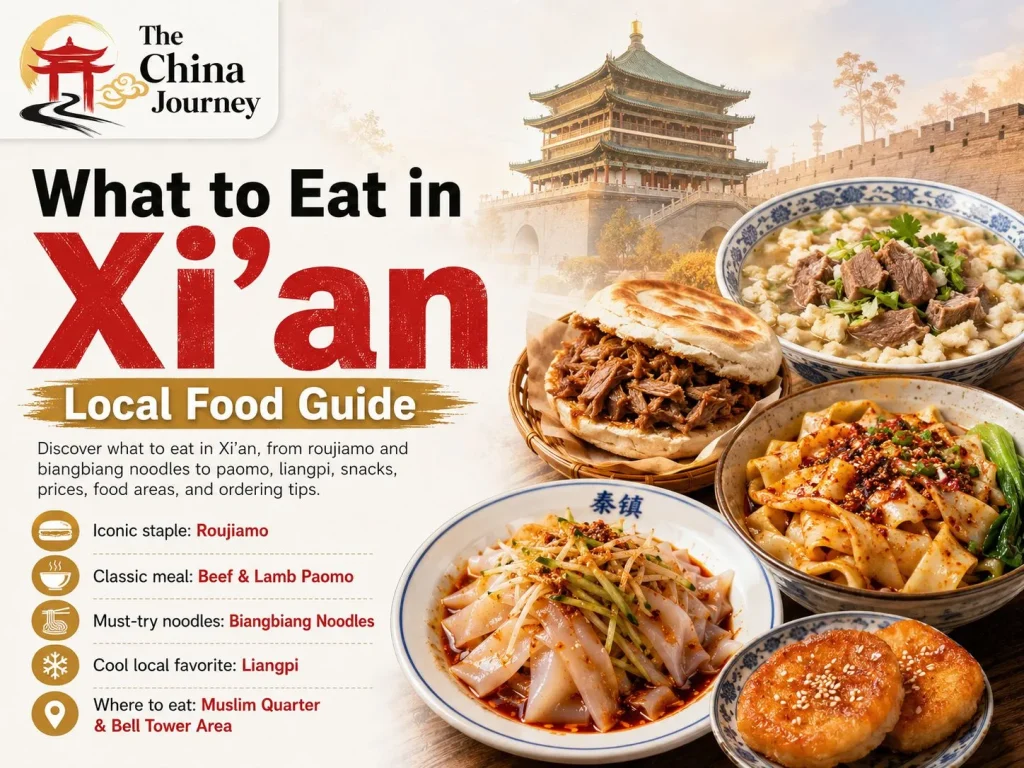
Discover what to eat in Xi’an, from roujiamo and biangbiang noodles to paomo, liangpi, snacks, prices, food areas, and ordering tips.

Find the best and worst times to visit China with tips on weather, crowds, festivals, and regional seasons to plan a smooth and unforgettable trip.

Explore Chongqing’s iconic skyline, historic sites, vibrant alleys, and stunning river views. Discover the best of this dynamic mountain city.

A clear and structured 2026 forecast for people born in 1962, covering career, wealth, relationships, health, and practical tips for steady progress.

Share your travel ideas, and we’ll help you plan a smooth, personalized trip across China.

Share your travel ideas, and we’ll help you plan a smooth, personalized trip across China.
We’re looking for experienced, part-time local guides to serve international travelers.
Requirements:
• Fluent in at least one foreign language
• 3–5 years guiding international visitors
• Able to operate in multiple regions in China
• Competitive and reasonable pricing
• Proven customer reviews or testimonials
• Professional, reliable, and responsive
• Flexible availability for custom trips
Hi there!
Just a quick heads-up — a helpful user named Volker let me know that some of the non-English content on this site may not be accurate.
This site is a one-person project I run part-time. I research and publish all the content myself, and the translations are currently done by machine (Google Translate). Balancing accuracy and accessibility across multiple languages is a real challenge.
If you spot any errors, I recommend switching to the English version using the button at the bottom left. I’ll continue working to improve the translations over time.
I truly appreciate your understanding. And if you have any suggestions, feel free to leave a comment — it means a lot to me.
— Anthony 2025.6.18


