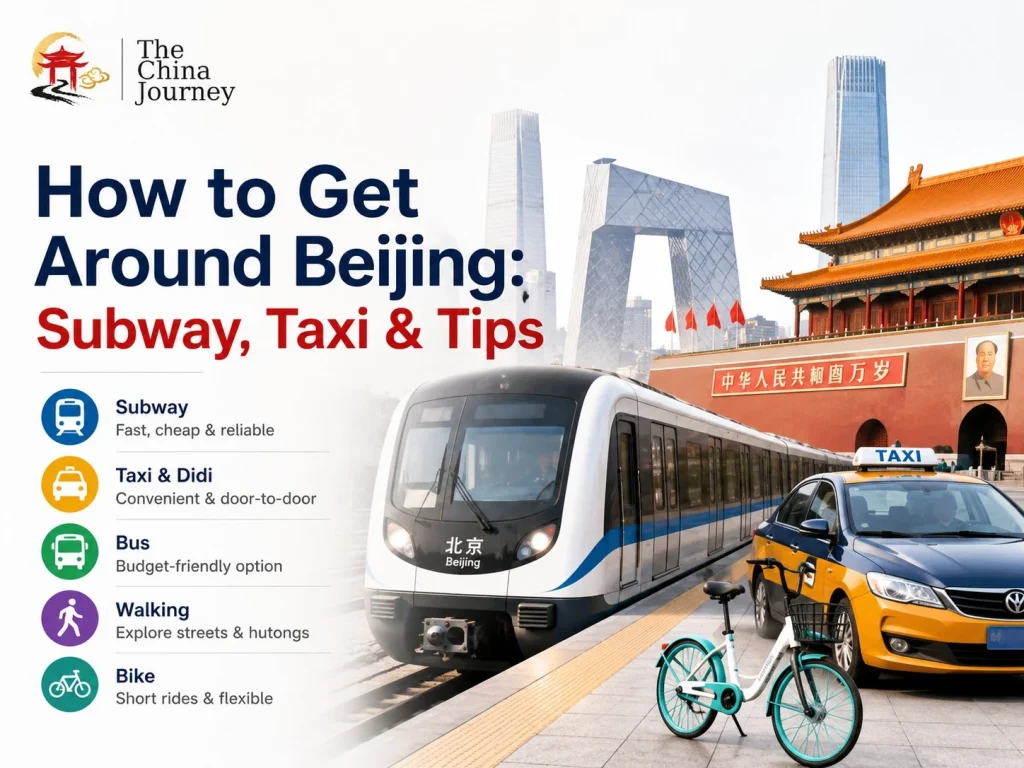
How to Get Around Beijing: Subway, Taxi & Tips

How to get around Beijing by subway taxi Didi bus walking and bike - How to Get Around Beijing: Subway, Taxi & Tips 2026 - The China Journey - How to Get Around Beijing: Subway, Taxi & Tips 2026 - The China Journey
Learn how to get around Beijing by subway, taxi, Didi, bus, walking, and bike, with payment tips, rush-hour advice, and airport transfer guidance.
How to get around Beijing by subway taxi Didi bus walking and bike - How to Get Around Beijing: Subway, Taxi & Tips 2026 - The China Journey - How to Get Around Beijing: Subway, Taxi & Tips 2026 - The China Journey

In This Guide

Quick Answer: How Do You Get Around Beijing?

Beijing is large, spread out, and heavily affected by traffic, so the best way to get around is not one single method. For most visitors, the subway should be the backbone of your trip, with taxis or Didi for luggage, late nights, bad weather, and last-mile transfers. Walking is essential inside major sights and hutong areas, but it is not practical for moving between distant attractions.

  • Best overall way: Subway + taxi or Didi + walking.
  • Best for visitors: Subway, because it is cheap, clear, predictable, and avoids traffic.
  • Best for long cross-city trips: Subway, especially during rush hours.
  • Best for short distances: Walking or shared bike, especially around hutongs, parks, and subway exits.
  • Best for late night or heavy luggage: Taxi, Didi, or a pre-arranged car.
  • Biggest warning: Do not judge distance by the map alone. Beijing blocks are huge, and surface traffic can be slow.
  • Main rule: Use the subway as your main system, then add taxis, Didi, bikes, or walking based on distance, weather, luggage, and time of day.

For a broader city overview, start with our Beijing Travel Guide.

Beijing transportation infographic comparing subway taxi Didi bus walking bikes payments airport transfers and travel tips - How to Get Around Beijing: Subway, Taxi & Tips 2026 - The China Journey
Beijing transportation infographic

Beijing Transportation at a Glance

Beijing has many ways to move around, but tourists should not use them equally. The most efficient strategy is to choose transport by situation: subway for distance and reliability, taxis or Didi for special needs, and walking or cycling for short local movement.

Transport OptionBest ForCost LevelTime ReliabilityTourist FriendlinessMain Limitation
SubwayMost sightseeing routes, cross-city trips, rush hours$HighHighCrowded at peak times; some transfers and exits involve long walks
TaxiHeavy luggage, families, late nights, direct hotel transfers$$Medium to lowMediumTraffic delays, language barrier, and possible queues
Ride-hailing / DidiApp-based taxi rides, transparent pricing, last-mile transfers$$Medium to lowMediumNeeds mobile data, payment setup, and correct pickup point
BusLow-budget trips and areas not well covered by subway$Low to mediumLowRoute complexity, traffic delays, and harder stop recognition
WalkingHutongs, large sights, short local movementFreeLowHighBeijing is too large for long-distance walking between sights
Shared bikeShort rides from subway stations, parks, riverside areas$MediumMediumRequires app/payment setup and legal parking areas
Airport ExpressAirport-to-city transfer with light luggage$$HighHighOnly connects airports with selected transfer stations
Private car / chartered serviceBusiness trips, families, heavy luggage, custom routes$$$MediumHighExpensive and still affected by road traffic

Getting Around Beijing by Subway

Modern subway station in Beijing Clean and spacious platform of Beijing Line 17 subway with route map and glass doors. - How to Get Around Beijing: Subway, Taxi & Tips 2026 - The China Journey
Modern subway station in Beijing

The Beijing subway is the most reliable way for most visitors to get around the city. It covers major sights, shopping areas, transport hubs, and many hotel zones. It is cheap, avoids road traffic, and has English station names and announcements. The main challenges are rush-hour crowds, long transfer walks, security checks, and choosing the correct exit.

SituationIs Subway Recommended?WhyWatch Out For
Cross-city travelYesFastest and most predictable for long distancesTransfers can take longer than expected
Peak hoursYes, but crowdedStill better than road trafficLines 1, 2, 4, 5, 10, and 13 can be extremely busy
Sightseeing daysYesCovers many major tourist areasSome sights still require walking after exit
Airport/train station connectionOften yesAirport Express and station subway links are reliableHeavy luggage makes transfers harder
Heavy luggageSometimesUseful if the route is directAvoid complex transfers during rush hour
Late nightUsually noMost lines stop around late eveningCheck the last train time for your exact line
  • Best for: Long-distance city movement, major sightseeing routes, airport or train station transfers with light luggage, and rush-hour travel.
  • Cost and payment: Beijing subway fares are distance-based, starting at about ¥3. Many central trips are around ¥4–¥6, while longer rides stay relatively low-cost. The easiest payment method is the Beijing subway ride code in Alipay or WeChat. A Beijing transportation card is a useful backup, and single-ride tickets work in emergencies.
  • How to use it: Plan routes with Baidu Maps or Amap before leaving. Enter the station, pass the bag security check, scan your code or ticket, follow the line signs, and check the exit before you leave the platform area.
  • Rush-hour experience: Weekday rush hours are roughly 7:30–9:30 and 17:00–19:30. Trains can be packed, especially on major commuter lines. If you have flexibility, travel outside these windows.
  • Transfers and exits: Large stations such as Xizhimen, Dongzhimen, and Guomao can involve 5–10 minutes of walking inside the station. Beijing stations also have many exits, so choosing the wrong one can add a long street-level walk.
  • Luggage and accessibility: Most stations have escalators or elevators, but not every exit is convenient. With large suitcases, avoid peak hours and look for elevator signs before exiting.
  • Best practical tip: In my experience, “subway + walking” is usually more predictable than a taxi for daytime sightseeing. Check the subway route, choose the nearest exit, and leave extra time for security, transfers, and walking from the station to the entrance.

For wider transport planning before arrival, read our How to Get to Beijing guide.

Getting Around Beijing by Taxi and Ride-Hailing

Licensed Beijing taxi with blue license plate parked on city street - How to Get Around Beijing: Subway, Taxi & Tips 2026 - The China Journey
Licensed Beijing taxi

Taxis and ride-hailing are useful in Beijing, but they should not be your default daily transport. Use them when the subway is inconvenient: late at night, with luggage, in bad weather, with family, or for the last mile from a station to your hotel or attraction.

  • Best for: Late-night trips, airport or train-station transfers with luggage, family travel, small groups, bad weather, and short last-mile rides.
  • Taxi basics: Beijing taxis start at about ¥13 for the first 3 km, then charge by distance. Night rides cost more, and slow traffic or waiting time is also counted.
  • Ride-hailing / Didi: Didi is the main ride-hailing option. You can use the app or mini-programs, and the international version may support overseas phone numbers and international cards. Test your setup before the trip.
  • Payment: Most taxis and ride-hailing rides support WeChat Pay or Alipay. Keep some RMB cash in case a taxi payment device does not work.
  • Language and address: Save your hotel and destination in Chinese. Most drivers will not understand English hotel names well.
  • Traffic warning: During weekday rush hours, rain, snow, and major events, taxis and Didi can become slow, expensive, or hard to book.
  • What to avoid: Do not accept rides from drivers who approach you at airports, train stations, or tourist exits. Use official taxi queues or app-based ride-hailing.
  • Best practical tip: Use “subway + short taxi or Didi” as your main strategy. Take the subway across the city, then use a short ride for the final stretch.

Getting Around Beijing by Bus

Beijing has a huge bus network and low fares, but buses should not be the main choice for most first-time foreign visitors. They are slower than the subway, harder to understand, and strongly affected by road traffic.

  • Best for: Very low-budget travel, flexible schedules, short local connections, or places not well served by subway.
  • Not ideal for: First-time visitors who do not read Chinese, tight sightseeing days, rush-hour travel, or routes where the subway works well.
  • Cost and payment: Many routes start at about ¥2, and transport cards or ride codes may give discounts. Some buses accept cash, but there is no change.
  • Boarding and exiting: Some buses require scanning or tapping when boarding and again when exiting. If you forget the exit scan, you may be charged more.
  • Language issue: Stop names, route changes, and announcements are less tourist-friendly than the subway. English may not be clear enough to rely on.
  • When to use it: Use it only when your map app shows a bus as the clearest option, such as for certain outer-area destinations or a specific route like the Badaling-bound 877 bus.
  • Practical rule: Keep Baidu Maps or Amap open during the ride and set a stop reminder.

Walking Around Beijing

Walking is essential in Beijing, but only in the right places. It is great for exploring large sights, hutongs, parks, and historic neighborhoods. It is not a good way to connect distant attractions across the city. Beijing looks walkable on a map, but the blocks are large, crossings can require detours, and a “nearby” place may still take far more energy than expected.

  • Best for: The Forbidden City, Temple of Heaven, Summer Palace, Old Summer Palace, hutongs, historic lanes, parks, and the final walk from a subway exit to an entrance.
  • Not ideal for: Moving between distant attractions. Walks such as Tiananmen to Wangfujing or Temple of Heaven to Qianmen may look simple, but they can be tiring, especially in bad weather.
  • City scale warning: Beijing blocks are large, road crossings can be far apart, and underpasses or pedestrian bridges may add extra distance.
  • Sightseeing fatigue: A normal Beijing sightseeing day can easily pass 20,000 steps, especially if you visit large palace, temple, or garden sites.
  • Weather impact: Summer can be hot and exposed, while winter is cold, dry, and windy. Comfortable shoes, sun protection, water, or warm layers matter more than style.
  • Practical tip: Use walking navigation in Baidu Maps or Amap, not straight-line distance. It will show the real route, crossings, detours, and walking time.

Cycling and Shared Bikes in Beijing

Shared bikes can be useful in Beijing, but they are not for every visitor or every area. They work best for short connections, such as riding from a subway station to a park gate, moving around flatter hutong areas, or taking a short ride near riverside paths and large open zones. They are not a good choice for nervous riders, heavy traffic, bad weather, or crowded tourist entrances.

  • Best for: Short 1–3 km rides, subway-to-destination transfers, hutong areas, park surroundings, Olympic Park-style open areas, and relaxed local movement.
  • Not ideal for: Main roads, crowded scenic entrances, rush hours, rainy days, icy winter days, or travelers uncomfortable with mixed traffic.
  • How to use: Meituan bikes and Hello Bike are common. You usually scan the bike through WeChat or Alipay mini-programs, but setup may require a China phone number, real-name verification, and a working payment method.
  • Cost: Prices are usually around ¥1.5 per 30 minutes, but the exact fee depends on the platform and current pricing.
  • Parking rules: Bikes must be returned inside marked electronic parking zones or “P” areas. Parking outside the allowed zone can trigger a relocation fee.
  • Safety: Watch for cars, electric bikes, sudden door openings, delivery riders, and blocked bike lanes.
  • Weather: Spring and autumn are best. Summer heat and winter wind make longer rides less pleasant.
  • Practical judgment: Use shared bikes as a short-distance tool, not as your main Beijing transport system.

How to Pay for Transportation in Beijing

For most visitors, the easiest way to pay for Beijing transport is a phone-based system. Alipay and WeChat Pay ride codes are the best choice if you can set them up before your trip. Still, keep a small cash backup because app issues, phone battery, card problems, or network failure can happen.

Payment MethodWorks ForGood for Foreign Visitors?Main AdvantageWatch Out For
Alipay / WeChat Pay transit codesSubway, bus, some taxis, some shared bikesBest option if setup worksFast, cashless, no need to buy tickets each timeYou need to activate Beijing subway and bus ride codes separately
Beijing transportation cardSubway and busGood backupStable and simple once purchasedMay require deposit, recharge, and refund process
Subway single-ride ticketSubway onlyEmergency optionUseful if phone payment failsSlow if used every ride; must buy each time
CashSome taxis, bus fare, subway ticket machinesBackup onlyUseful when apps failBus cash payment usually gives no change; taxi drivers may lack change
International credit cardLimited transport usesDo not rely on itUseful in a few supported placesCoverage is limited and inconsistent
Didi in-app paymentRide-hailingUseful if account setup worksTransparent price and direct app paymentTest card/payment setup before relying on it

For a smooth trip, set up Alipay or WeChat Pay before arrival, activate Beijing transit codes, and carry about ¥200–¥300 in cash as backup. For a full payment setup guide, read our What Money Does China Use guide.

Best Ways to Get Around Beijing by Situation

The best transport choice in Beijing changes by situation. Use the subway for reliable long-distance movement, taxis or Didi when luggage or timing makes public transport harder, and walking or shared bikes for short local movement.

SituationBest OptionWhy It WorksWatch Out For
First-time visitorsSubway + walkingClear, cheap, predictableChoose the correct exit to avoid extra walking
Main sightseeing areasSubway + walkingCovers most major attractionsSome entrances are still far from the station
Morning/evening rush hourSubwayRoad traffic can be very slowTrains can be packed
Late-night return to hotelTaxi or DidiSubway may have stoppedPrices and waiting times can rise
Heavy luggageTaxi, Didi, or airport railReduces stairs and transfersConfirm pickup point clearly
Family / elderly / childrenTaxi/Didi + off-peak subwayFewer tiring transfersAvoid crowded rush-hour lines
Tight budgetSubway + bus + walkingLowest-cost combinationBus routes are harder for visitors
Rain, snow, or extreme weatherSubway or taxi/DidiLess exposure to weatherRide-hailing demand can surge
Cross-city movementSubwayMost reliable over long distancesTransfers may involve long walks
Hotel to airport/train stationAirport Express/subway or taxiDepends on luggage and timeLeave extra buffer for traffic or security
Hutong or old-city short distancesWalking or shared bikeFlexible and immersiveRide slowly and park only in allowed zones

Getting Around Beijing from Airports and Train Stations

After arriving in Beijing, choose your city transfer based on luggage, arrival time, and hotel location. With light luggage in daytime, subway or airport express is usually the most reliable choice. With family, late-night arrival, or large suitcases, taxi, Didi, or a pre-booked pickup is easier.

Arrival PointBest City TransferBest ForApproximate Time / CostWatch Out For
Beijing Capital International Airport (PEK)Capital Airport Express, taxi, Didi, airport busLight luggage, daytime arrivals, hotels near Dongzhimen, Sanyuanqiao, or northeast BeijingAirport Express to Dongzhimen takes roughly 30 minutes and costs about ¥25T3 is large. Taxi and Didi can be slow during peak traffic. Check same-day operating hours.
Beijing Daxing International Airport (PKX)Daxing Airport Express, taxi, Didi, airport busLight luggage, southern Beijing, Caoqiao transfer, or hotels near Line 10Daxing Airport Express to Caoqiao takes roughly 20 minutes; ordinary seat is about ¥35PKX is far from central Beijing. Taxi costs are higher than from PEK.
Beijing South Railway StationSubway Lines 4 and 14, taxi, DidiMost high-speed rail arrivals from Tianjin, Shanghai, Nanjing, Hangzhou, and southeast routesSubway to central areas often takes about 20–30 minutesHuge crowds during holidays. Didi pickup areas may be hard to find.
Beijing West Railway StationSubway Lines 7 and 9, taxi, DidiArrivals from Xi’an, Chengdu, Guangzhou, Shenzhen, and west or south routesSubway to central-west areas often takes about 15–25 minutesStation layout is busy. Check north/south exit and pickup point carefully.
Beijing Chaoyang Railway StationTaxi, Didi, subway/bus connectionArrivals from northeast routes such as Shenyang, Harbin, and ChengdeTaxi to Sanlitun or Guomao may take roughly 30–60 minutesCity access is less convenient than Beijing South or West, especially with luggage.

Use a map app before arrival to check the exact route from your airport or station to your hotel. Save your hotel name and address in Chinese. If you arrive late, travel with children, or carry large bags, do not force a complex subway transfer just to save money.

Beijing Traffic, Rush Hours, and Travel Time Reality

Beijing travel time is often longer than it looks on a map. The city is huge, roads can slow down quickly, and large subway transfers take time. In my experience, Beijing is manageable if you plan by real travel time, not by straight-line distance.

  • Morning and evening rush hours: Weekday morning rush hour is usually around 7:30–9:30. Evening rush hour is around 17:00–19:30 and can extend toward 20:00.
  • Road traffic: Taxis, Didi, buses, and private cars are affected most. A short-looking drive across central Beijing can become slow and expensive.
  • Subway rush hour: Popular lines such as Lines 1, 2, 4, 5, 10, 13, and other commuter-heavy sections can be packed. You may need to wait for more than one train.
  • Weekend and holiday pressure: Areas around major sights, shopping districts, stadiums, and event venues can stay crowded for much of the day.
  • Weather impact: Rain, snow, fog, and heavy pollution days can reduce road speed and make ride-hailing harder.
  • Transfer time: Large subway stations such as Xizhimen, Dongzhimen, and Guomao can require 5–10 minutes of walking during transfers.
  • Airport and train station buffer: For domestic flights, arrive at the airport about 2 hours early. For international flights, allow about 3 hours. Add more road buffer during peak traffic.
  • Practical rule: Add at least 30%–50% to map driving estimates when timing matters. For example, a taxi from the Forbidden City area to the Bird’s Nest may look reasonable on the map, but during evening rush hour it can take far longer than a subway-based route.

Plan nearby sights together on the same day. Avoid crossing the city too often, especially when you have timed tickets, museum reservations, or a flight or train to catch.

Common Mistakes When Getting Around Beijing

  • Looking only at straight-line distance: Beijing blocks are large, crossings can require detours, and “nearby” places may still take 30–45 minutes. Use real map navigation, not visual distance.
  • Taking taxis across the city during rush hour: This can waste both time and money. During weekday peaks, check the subway first.
  • Underestimating subway transfers and exits: Big stations may require long walks, and the wrong exit can add another 10–15 minutes. Check the exit before leaving the platform area.
  • Not setting up Alipay or WeChat Pay: Transport is much easier with mobile payment. Set up Beijing subway and bus ride codes before your first full day.
  • Not saving Chinese addresses: Drivers may not understand English hotel or attraction names. Save the Chinese name, full address, and phone number.
  • Following unofficial drivers at airports or stations: Ignore people who approach you offering rides. Use official taxi queues or app-based ride-hailing.
  • Relying only on Google Maps or international apps: Some international tools may not work smoothly in mainland China. Prepare Baidu Maps or Amap.
  • Taking complex subway transfers with large luggage: It can be exhausting and slow, especially during rush hour. Use taxi, Didi, airport rail, or a pre-booked transfer when needed.
  • Arriving late at night without a transport plan: Subway service may have ended. Arrange taxi, Didi, hotel pickup, or private transfer in advance.
  • Ignoring attraction closures, reservations, security checks, or entry queues: Good transport planning still fails if you underestimate ticket checks or entrance lines.
  • Walking or cycling too much in extreme weather: Beijing summers can be hot and exposed, while winters are cold and windy. Use subway or taxi more when weather is harsh.

Practical Beijing Transportation Tips for First-Time Visitors

  • Use Baidu Maps or Amap before leaving: Check routes, subway exits, traffic, and walking distance before each move.
  • Save Chinese names and addresses: Keep your hotel, attractions, and key destinations in Chinese for taxi or Didi drivers.
  • Set up transit codes early: Activate Beijing subway and bus ride codes in Alipay or WeChat Pay before your first full day.
  • Carry small cash backup: Keep about ¥200–¥300 in small notes in case your phone, app, card, or network fails.
  • Add buffer time for transfers: Large subway stations and exits can add 10–20 minutes, especially with luggage or during peak hours.
  • Use the subway during rush hours: From about 7:30–9:30 and 17:00–19:30, the subway is usually more reliable than road traffic.
  • Use Didi or taxis after subway hours: Once the subway stops running, app-based ride-hailing or official taxis are the safest practical options.
  • Reduce transfers with luggage: Big suitcases make subway stairs, security checks, and long station walks much harder.
  • Carry a power bank: Your phone handles maps, payment, translation, ride-hailing, and tickets.
  • Prepare reliable mobile data: Without mobile data, getting around Beijing becomes much harder. For a full pre-trip checklist, see our China Packing List.

Final Thoughts: Best Way to Get Around Beijing

There is no single perfect way to get around Beijing. The city is too large and traffic conditions change too much. For most visitors, the subway should be the main structure of the trip because it is cheap, reliable, and not affected by road congestion.

Use taxis or Didi for late nights, luggage, bad weather, and last-mile transfers. Walk inside major sights and hutong areas. Use buses and shared bikes only when they clearly fit the situation. The real key is flexibility: choose transport based on distance, time of day, weather, luggage, group needs, and payment setup. Leave buffer time, keep your phone charged, and do not plan Beijing travel by straight-line distance.

FAQs About Getting Around Beijing

What is the best way to get around Beijing?

For most visitors, the best way to get around Beijing is subway first, with taxis, Didi, and walking as support. The subway handles long-distance movement better than road traffic. Taxis and Didi are better for luggage, late nights, bad weather, or the final short ride from a station.

Yes. Beijing Subway is one of the easiest transport options for foreign visitors because station names, maps, and announcements include English. The main challenges are rush-hour crowds, long transfers at major stations, security checks, and choosing the correct exit. Use Baidu Maps or Amap before entering the station.

Yes, but cash is less convenient than mobile payment. You can buy subway single-ride tickets with cash at many stations. Some buses accept cash, but they normally do not give change. Taxis usually accept cash, but drivers may not have small change. Alipay or WeChat Pay is much smoother.

Yes, Didi is useful for late nights, luggage, family travel, bad weather, and short last-mile transfers. Set up the app, payment method, mobile data, and Chinese destination addresses before using it. At airports, stations, and malls, check the assigned pickup point carefully because it may be in a parking area.

During weekday rush hours, use the subway and avoid long taxi or Didi rides across the city. Morning rush hour is usually around 7:30–9:30, and evening rush hour is around 17:00–19:30. Plan meals, hotel breaks, or nearby sights during peak road-traffic periods.

With light luggage in daytime, airport express or subway is usually the most reliable and cheapest option. With heavy luggage, children, elderly travelers, or late-night arrival, taxi, Didi, hotel pickup, or a pre-booked transfer is easier. Always save your hotel’s Chinese name, address, and phone number.

Interesting Articles for You

Martial Arts at Mount Song Shaolin monks practicing martial arts at Mount Song surrounded by nature showcasing the spiritual connection between kung fu and the surrounding landscape - Dengfeng, Home of Shaolin Temple and Song Mountain 2026 - The China Journey - How to Get Around Beijing: Subway, Taxi & Tips 2026 - The China Journey
City

Dengfeng

Explore Dengfeng, home to Shaolin Temple and the majestic Song Mountain, a UNESCO World Heritage site. Discover its rich martial arts history, ancient temples, and scenic landscapes.

Starbucks Coffee shop in Beijing shopping mall Well lit Starbucks storefront with seating area and digital ordering signage. - How Much Is a Cup of Coffee in Beijing? 2026 - The China Journey - How to Get Around Beijing: Subway, Taxi & Tips 2026 - The China Journey
FAQs

How Much Is a Cup of Coffee in Beijing?

A cup of coffee in Beijing typically costs between ¥10 and ¥100 (US$1.40–$14), depending on where you buy it, the type of coffee, and the overall experience.

Expansive view of the Three Gorges Dam with water release and surrounding mountains pc banner background - Three Gorges 2026 - The China Journey - How to Get Around Beijing: Subway, Taxi & Tips 2026 - The China Journey
Attraction

Three Gorges

Explore the breathtaking beauty of the Yangtze River’s Three Gorges, a scenic marvel blending natural landscapes, rich history, and cultural heritage.

happy tourists exploring city map diverse travelers sitting in park checking map and planning urban sightseeing route - How to Get Around Beijing: Subway, Taxi & Tips 2026 - The China Journey

Plan Your China Trip with Our Experts

Share your travel ideas, and we’ll help you plan a smooth, personalized trip across China.

 
travelers planning route with map group of international tourists reading map outdoors with backpacks and guide - How to Get Around Beijing: Subway, Taxi & Tips 2026 - The China Journey
happy tourists exploring city map diverse travelers sitting in park checking map and planning urban sightseeing route - How to Get Around Beijing: Subway, Taxi & Tips 2026 - The China Journey

Work with Us as a Local Guide in China

travelers planning route with map group of international tourists reading map outdoors with backpacks and guide - How to Get Around Beijing: Subway, Taxi & Tips 2026 - The China Journey

We’re looking for experienced, part-time local guides to serve international travelers.

Requirements:

• Fluent in at least one foreign language
• 3–5 years guiding international visitors
• Able to operate in multiple regions in China
• Competitive and reasonable pricing
• Proven customer reviews or testimonials
• Professional, reliable, and responsive
• Flexible availability for custom trips

Hi there!

Just a quick heads-up — a helpful user named Volker let me know that some of the non-English content on this site may not be accurate.

This site is a one-person project I run part-time. I research and publish all the content myself, and the translations are currently done by machine (Google Translate). Balancing accuracy and accessibility across multiple languages is a real challenge.

If you spot any errors, I recommend switching to the English version using the button at the bottom left. I’ll continue working to improve the translations over time.

I truly appreciate your understanding. And if you have any suggestions, feel free to leave a comment — it means a lot to me.

— Anthony 2025.6.18

Xian long image for popup form - How to Get Around Beijing: Subway, Taxi & Tips 2026 - The China Journey

Planning a Trip to China?

Changzhou Skyline at Dusk The Changzhou skyline illuminated at dusk, with city lights reflecting on the water and buildings glowing in the evening light. - How to Get Around Beijing: Subway, Taxi & Tips 2026 - The China Journey
Do any of these sound familiar from your past trips?
Let our trusted partner travel agency handle the details.
👉 Get a custom plan within your budget and enjoy the best of China — stress-free.