
 Written by
Anthony
Written by
Anthony

Perched along the shores of the Yellow Sea, Qingdao is a romantic blend of sea breeze and storybook charm.
This coastal city effortlessly merges mountain and ocean views with layers of rich cultural history.
Its signature red-tiled roofs, shaded by green trees, stand in harmony with both Gothic spires and traditional Chinese eaves—a visual symphony that reflects its unique identity.

Once a humble fishing village, Qingdao became a German concession in the late 19th century.
That legacy remains in its Bavarian-style churches, Baroque mansions, and the city’s famed beer culture.
Today, Qingdao is often called the “Switzerland of the East” for its European flair and scenic coastlines, and the “Beer Capital of China” for its century-old brewing tradition.
Wander the cobblestone lanes of the old town, gaze over the sea from colonial villas, and you’ll feel both the echoes of history and the pulse of a modern port city—alive, layered, and utterly captivating.

In Qingdao, you don’t need a passport to tour the world’s architecture.
The Badaguan Scenic Area features over 20 styles of global architecture—Russian, British, French, German, and more—lined along ten charming streets.
In autumn, golden ginkgo trees on Juyongguan Road frame the European villas like a storybook fairytale.
Huashi Villa’s granite walls draped in ivy offer timeless photo ops, while the rotating viewing platform atop Signal Hill Park delivers a 360° panorama of red-tiled rooftops fading seamlessly into the blue expanse of the Yellow Sea—a skyline unique to Qingdao.

The sea is Qingdao’s most generous gift. Zhanqiao Pier extends like a postage stamp onto the Yellow Sea, crowned by the iconic Huilan Pavilion.
Golden Sand Beach, with powdery-soft sand, is perfect for swimming in summer or watching sunsets in fall.
For a more dramatic encounter, head to Laoshan—dubbed “the First Mountain on the Sea.”
Ride a cable car over granite cliffs and ancient pines, where mountains and ocean merge into breathtaking scenery worthy of legends.

Qingdao’s flavors are shaped by both land and sea.
Nothing beats fresh seafood paired with local beer: spicy stir-fried clams, tender abalone with chili oil, and a chilled bag of draft beer with foam on your lips—it’s the taste of contentment.
Locals love mackerel dumplings, their juicy fish filling bursting through delicate wrappers.
After your feast, sip a cup of Laoshan green tea with its light bean aroma to refresh and reenergize.
From street-style bagged beer to century-old brewery tours, from seafood stalls to refined Shandong cuisine, every bite in Qingdao tells a delicious story of its oceanfront heritage.
To see how Qingdao compares with other top destinations nationwide, refer to Best Places & Cities to Visit in China.
Qingdao wears a different face with each passing season—fresh and gentle in late spring, crisp and golden in autumn, vibrant and festive in summer, and serene in winter.
Time your visit right, and you’ll discover the version of Qingdao that speaks to your soul.

Late spring is one of Qingdao’s most pleasant times, with temperatures hovering around 20–25°C.
The air is fresh with ocean moisture, perfect for a slow stroll through the ivy-covered German villas of the Old Town or the blooming peach and crabapple trees of Badaguan.
On Shaoguan Road, pink blossoms reflect off red-tiled rooftops, turning the cobblestone streets into a pastel dream.
While the sea might still be a bit chilly for swimming, walking along Zhanqiao Pier or Xiaomaidao Park and listening to the waves and seabirds brings peaceful joy.
Best of all, this season avoids the peak summer crowds—ideal for relaxed sightseeing and seafood feasts.

Autumn in Qingdao is a crisp masterpiece.
Clear blue skies and gentle sunshine filter through the yellowing ginkgo and plane trees of Badaguan, casting golden shadows on European façades.
The sea remains warm enough for coastal walks or beach lounging—especially at Golden Sand Beach, where sunsets paint the water in fiery hues.
Fewer tourists mean more space to breathe, and the seafood is at its plumpest—crabs and mantis shrimp are in season.
Pair it with freshly brewed Tsingtao beer, and you’ve got a taste of Qingdao at its finest.

Each August, Qingdao transforms into a beer lover’s paradise.
The International Beer Festival—centered in Laoshan District—features massive tents pouring German dark lagers and fresh local brews, with sizzling squid and spicy clams adding to the aroma.
Live bands, beer-chugging contests, and roaring crowds turn the city into one big party.
But be prepared: temperatures soar above 30°C, venues are packed, and hotel rates spike.
It’s the ultimate experience for travelers who thrive on energy and excitement.
For a nationwide seasonal comparison, see Best & Worst Time to Visit China.
Whether you’re flying or taking the train, reaching Qingdao is convenient and efficient.
Choosing the right mode of transportation based on your itinerary helps kick off your trip with ease.
For a system-level overview of how to travel between cities and regions in China, see our China Transportation Guide.

Qingdao’s former Liuting Airport is now closed.
The city is served by Qingdao Jiaodong International Airport, located in Jiaozhou.
Although it’s about an hour from downtown, transit connections are smooth and reliable.
Best Option: Take Metro Line 8 directly from the airport to downtown Qingdao. The ride takes approximately 1 hour, passing key stations like Qingdao North and May Fourth Square.
Other Options:
Airport Shuttle Bus: Several lines run to key city areas, including Qingdao Railway Station.
Taxi: A more direct option for groups or late-night arrivals. For the latest schedules and routes, check the official Jiaodong Airport website.

Located near the Old Town, this historic station is ideal for travelers wanting to explore landmarks like Zhanqiao Pier, the Catholic Church, and Badaguan.
Just a 10-minute walk from the pier, it’s the best choice for starting your sightseeing right away.
The station itself is a century-old German-style building worth photographing.
It connects to Metro Lines 1 and 3, making it easy to get to May Fourth Square and other parts of the city.

Situated in Licang District, this is a major hub with more frequent high-speed rail service—especially from northern cities.
It’s linked to Metro Line 3, offering a 30-minute ride to May Fourth Square.
The area also has plenty of dining and lodging options, making it a good overnight stop if you arrive late.
For routes, tickets, and how to use trains across China, see China’s High-Speed Rail (HSR).
Qingdao offers a variety of transportation options to suit different travel styles.
Whether you’re after efficiency, scenic views, or local immersion, there’s a mode of transport for every kind of traveler.

Qingdao’s expanding subway network—including Lines 1, 2, 3, 4, and 8—connects all major parts of the city.
It’s the most efficient and punctual way to get around, unaffected by street-level traffic.
For instance, you can reach May Fourth Square from Qingdao Railway Station in just about 10 minutes via Line 3.
Many stations are conveniently located near major attractions, making the subway a great choice for visitors who want to explore multiple sites quickly and easily.

Qingdao’s extensive bus network reaches nearly every corner of the city.
Some routes—like the 26 and 316 buses—run along the coastline, offering panoramic views of landmarks like Zhanqiao Pier, Badaguan, and May Fourth Square.
Riding the bus feels like a slow-moving city tour, where the sea meets the skyline.
It’s also a wonderful way to explore Qingdao’s hidden gems: winding through the city’s older neighborhoods and alleyways, you might stumble upon charming local shops, quiet tea houses, or off-the-beaten-path eateries that bring you closer to the local lifestyle.

For travelers with large luggage, traveling in groups, or unfamiliar with public transit, taxis and ride-hailing apps (like Didi) are ideal.
They offer direct, door-to-door service without transfers.
Most taxis in Qingdao are clean and reliable, while ride-hailing platforms are easy to use and widely available—just a few taps on your phone and you’re on your way.

Ferries and boats offer a unique way to see Qingdao.
The ferry between the Old Town and Huangdao cuts across Jiaozhou Bay, reducing a land journey of 84 km to just 20–30 minutes on water.
Along the way, you can enjoy open bay views and fresh ocean air.
Several docks—like the Laiyang Road Ferry Terminal and Zhongyuan Sea Plaza Pier—offer sightseeing cruises too.
These trips take you past Little Qingdao, Lu Xun Park, and Taiping Cape, or even out to small offshore islands like Zhucha Island and Dagong Island. It’s a refreshing and scenic way to experience Qingdao’s coastal beauty.
Before diving into what to see and do, it helps to understand how Qingdao fits into a broader China travel route—especially for first-time visitors choosing coastal or north China itineraries. For an overview of China’s major travel regions, route combinations, and planning logic, see our China Travel Guide.

Zhanqiao is Qingdao’s most iconic landmark—a century-old sea pier that stretches into the Yellow Sea like an outstretched arm.
At its end stands Huilan Pavilion, an elegant octagonal structure with red pillars and green-tiled roofs, offering views of Little Qingdao and its white lighthouse.
From November to March, the area becomes a haven for thousands of seagulls, creating an enchanting scene of nature and city in harmony.
Visit at sunrise or dusk for fewer crowds and postcard-worthy views of red rooftops against the sparkling sea.

Qingdao’s most striking Gothic structure, this twin-spired cathedral rises 56 meters into the sky.
Its rose window casts colorful rays across the nave, while intricate stone carvings adorn its façade like lacework.
The square outside is a favorite wedding photography spot—white gowns set against red bricks and pointed towers feel straight out of a romantic European film.
Visitors can enter the church on weekends from 9:00 to 11:00 AM, where the solemn atmosphere and pipe organ music offer a moment of reflection.
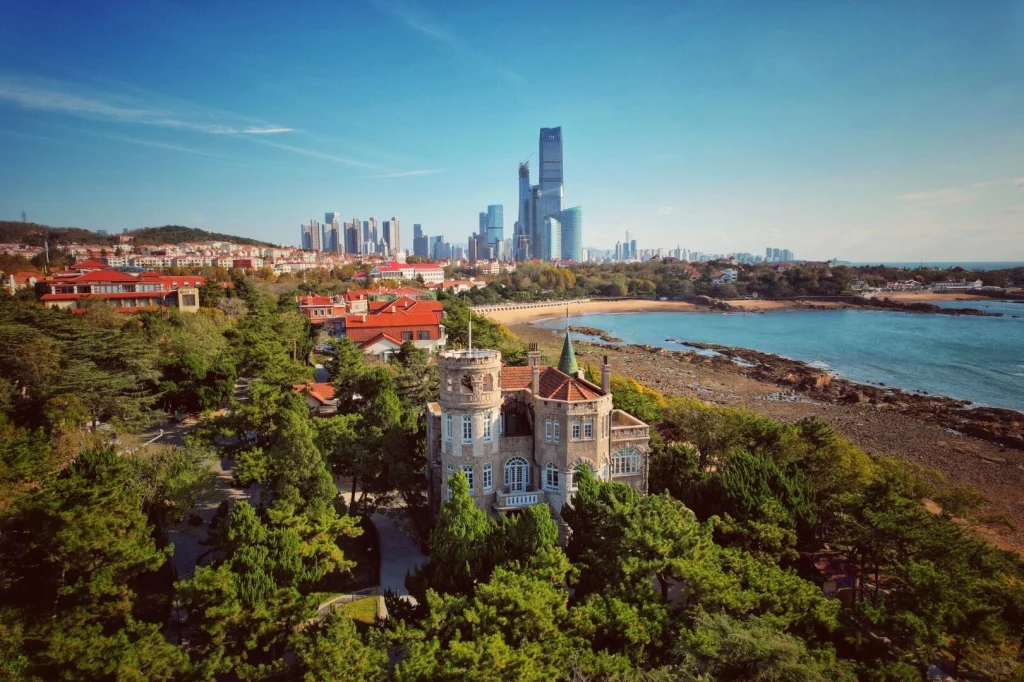
Dubbed “A Street, A World,” Badaguan blends more than 20 architectural styles across 10 tree-lined roads named after ancient Chinese mountain passes.
Russian villas framed by pink peach blossoms, French mansions set beneath golden ginkgo trees—each corner reveals a different postcard scene.
Notable buildings include Princess House with its Nordic fairy-tale spire and Huashi House, whose granite walls are draped in ivy.
Walking on its leafy paths feels like stepping back in time, with every rustling leaf whispering stories from a bygone era.

For the best panoramic view of Qingdao’s old town, climb the 98-meter Signal Hill.
Its gently rotating observation deck provides a 360° sweep of the city’s signature red-tiled rooftops seamlessly blending into the yellow-blue horizon of the sea.
The twin spires of St. Michael’s Cathedral and the outline of Zhanqiao Pier are clearly visible from here.
The park’s three red-domed pavilions add a vintage charm to photos, making it a favorite “person-in-scenery” shot spot.
At only 15 RMB, it’s one of the best-value viewpoints in the city.

A symbol of modern Qingdao, May Fourth Square is marked by its striking red spiral sculpture, The May Wind, standing boldly beside the sea.
It represents youth and vitality, glowing under sunlight by day and ablaze like fire with city lights by night.
Just a 10-minute walk east along the seaside promenade takes you to the Olympic Sailing Center, where white sailboats line the docks and masts rise like a “forest at sea.”
As dusk falls, the lighthouse shines with a warm glow, standing watch over the harbor.

A social media favorite in recent years, this cliffside park offers winding wooden boardwalks perched above the deep blue Yellow Sea.
Waves crash below, sending up white spray, while lighthouses and cargo ships dot the distant horizon.
On sunny days, the grassy lawns fill with picnickers savoring coffee and sea breezes.
But the real magic is at sunset, when the sky turns tangerine-orange and every photo looks like it’s been filtered by nature itself—pure “tropical island vibes” in Qingdao.

A street where romance is etched into every corner.
Stretching between Little Qingdao and Luxun Park, Qinyu Road is lined with red-roofed villas and artsy cafés, with the shimmering sea just steps away.
At the end lies Little Qingdao Island, where a white lighthouse peeks through the greenery.
Though the island is small, it offers a full 360° ocean view.
As the sun sets and streetlamps light the way, the entire path glows with soft golden hues—a dreamlike coastal stroll.

Nicknamed Qingdao’s “green lung,” Xiaomaidao is a circular sea-surrounded island that looks like an emerald gem floating offshore.
With manicured lawns perfect for tents, kites, or simply lying down to watch the sky, it’s a haven of relaxation.
The panoramic sea views are unmatched: skyscrapers to the east, old-town rooftops to the west, a lighthouse to the north, and endless ocean to the south.
At twilight, the sky blushes purple and pink, and even the breeze carries a touch of romance.

Located in Huangdao District, Golden Beach is dubbed the “No.1 Beach in Asia.”
Its fine golden sand feels soft as flour beneath your feet, and the crystal-clear sea beckons for a splash.
Summer brings high energy—jet skis, sailboats, and beach volleyball echo with laughter—while autumn quiets the crowds, making it ideal for serene seaside walks.
Watch the sunset turn the waves golden and feel the stress melt away.
Just a 30-minute metro ride through the undersea tunnel from downtown brings you from city rooftops to soft sands.

Step into a century-old brewery where the scent of hops lingers in the air.
Set inside historic red-brick buildings, the Tsingtao Beer Museum takes you through the entire brewing process—from malt to fermentation to bottling—with vintage machinery and steampunk vibes.
The highlight?
A free tasting of freshly brewed beer. Sample the rich, slightly bitter original brew or the crisp draft beer, best paired with crunchy beer beans for a true local experience.
Don’t miss the gift shop, where beer-bottle-shaped ice cream and hoppy soap make for quirky souvenirs.

Known as “the most famous mountain by the sea,” Laoshan lives up to its legendary status with dramatic coastal cliffs, ancient Taoist temples, and breathtaking sea views.
The Taiqing Palace, hidden among trees, hums with incense and mysticism—it’s said immortals once practiced here.
Take a cable car up through Yangkou Scenic Area, where jagged peaks meet the boundless ocean in a scene that feels straight from a Chinese ink painting.
In Beijiushui, a valley of waterfalls and mossy rocks, babbling streams cool the air—especially magical after summer rains.

Step into a frosty blue dream unlike the open sea just outside.
At Polar Ocean World, you’ll meet penguins waddling around, polar bears playfully rolling on ice, and gentle beluga whales blowing bubbles at guests.
The dolphin show is a crowd favorite, featuring leaping dolphins dancing to music and interacting with trainers.
The park also recreates a true polar climate—walk through an “ice house” at -10°C before stepping back out into Qingdao’s sun-soaked coast.
It’s a whimsical, family-friendly escape perfect for kids (and kids at heart).
Qingdao’s food scene is a delicious blend of ocean freshness and local flavor.
From spicy clams to piping hot dumplings and cold beer in plastic bags, this city offers a culinary journey you won’t forget.
Qingdao is famous for its incredibly fresh seafood.
The local favorite stir-fried clams (gala) are tossed with chili, garlic, and scallions, bursting with briny juices in every bite.

Abalone with hot oil is another standout—thinly sliced and drizzled with sizzling scallion oil to enhance its tender, bouncy texture.

In fall, steamed crabs are a seasonal highlight: female crabs with rich roe and male crabs with creamy meat, best dipped in ginger vinegar.

For a local experience, head to Yingkou Road Market, where you can pick your own seafood fresh from the stalls and have it cooked on the spot at nearby restaurants—for just ¥10–20 per dish.
Steamed, stir-fried, or grilled—your seafood feast is ready in minutes.
Try Spanish mackerel dumplings, a Qingdao specialty made with finely minced fish wrapped in thin, chewy dough.

Don’t skip Qingdao’s old-style yogurt, served in ceramic bowls with a thick milk skin on top. It’s rich, creamy, slightly tangy, and easy to find at small street shops.


Tsingtao Beer is more than a brand—it’s a lifestyle.
You’ll see locals strolling the streets with draft beer in plastic bags, still frothy and cold.
The unfiltered raw beer is more robust, with a smooth bitterness and rich malt flavor.
You can sample both at the Tsingtao Beer Museum or local beer houses—best enjoyed with a plate of spicy seafood for the ultimate pairing.
See also: What to Eat in Qingdao
Taidong Pedestrian Street: A snack lover’s paradise. From sizzling grilled squid to crispy car wheel cakes filled with red bean or taro, and sweet osmanthus rice cakes—every bite tells a story. Walk, eat, repeat.


A top spot for seafood dumplings. Don’t miss the squid ink dumplings, strikingly black and bursting with umami.
The classic Spanish mackerel dumplings are equally beloved.
The stylish, ocean-themed décor adds to the experience—perfect for both family meals and foodie adventures.

A local favorite for traditional Jiaodong dishes.
Must-tries include braised pork with kelp, fall-apart tender with a rich glaze, and steamed seafood platters stacked with scallops and clams.
Don’t leave without trying the cheesy sticky rice cake—crispy on the outside, gooey inside, and utterly addictive.

Located near May Fourth Square, this elegant seafood restaurant boasts its own fishing fleet and aquaculture base.
Their signature braised sea cucumber is slow-cooked with local green onions for deep umami flavor, while fresh-caught fish from Laoshan Bay is prepared in traditional fisherman style for a truly authentic taste of Qingdao.
Whether you’re looking for skyline views, beachfront serenity, or a stay in the city’s most iconic skyscraper, Qingdao offers top-tier accommodations that blend comfort, convenience, and spectacular scenery.

Perched on the 58th to 78th floors of the iconic Haitian Center Tower 2, The St.
Regis Qingdao offers guests panoramic ocean views in the heart of the city.
This five-star hotel features 231 elegant rooms, most with unobstructed vistas of the Yellow Sea.
Enjoy a quiet coastal escape just steps away from bustling shopping districts.
With a grand three-floor banquet space and the exquisite Yan Ting Chinese restaurant, the hotel is ideal for both high-end events and fine dining experiences.

Located in Haitian Center Tower 1 (Ground to 31st floor), this expansive hotel offers 501 nature-inspired rooms with sweeping views of the sea, mountains, and cityscape.
It’s home to the largest grand ballroom in Qingdao’s downtown—2,600 square meters with a ceiling height of 10.8 meters—perfect for major international and national events.
From the floor-to-ceiling windows, watch the waves crash on the rocks below and the endless blue sea stretch beyond the horizon.

Nestled along Shilaoren Beach, Hyatt Regency is an ideal choice for travelers seeking both luxury and location.
Just minutes from Polar Ocean World and the Qingdao International Conference Center, the hotel features 435 spacious rooms with stunning sea or mountain views.
Guests can unwind in five on-site restaurants and bars, or relax with a swim in the heated indoor pool or a soothing spa treatment—perfect after a day of sightseeing.
See also: Where to Stay in Qingdao
Qingdao isn’t a city to rush through — it deserves to be savored.
In just three days, you can wander among century-old European buildings, stroll along coastal paths, indulge in fresh seafood, and sip local beer.
Here’s how to unlock the best of Qingdao, day by day.

Theme: German architecture, classic landmarks, and vintage charm
Start your day at Zhanqiao Pier (9:00 AM), Qingdao’s postcard-perfect symbol.
Watch the morning sun reflect off the octagonal Huilan Pavilion at the pier’s end.
In winter, thousands of seagulls fill the skies — a serene spectacle.
Then stroll 10 minutes to St. Michael’s Cathedral (10:30 AM), where red bricks and twin Gothic spires shine under blue skies.
If visiting on a weekend, step inside to hear the organ’s echoes in a solemn atmosphere.
Head to Zhongshan Road for a local meal at Haibin Canteen.
Order mackerel dumplings and spicy stir-fried clams (gala), paired with a cold Tsingtao beer — the real taste of Qingdao.
Explore Badaguan Scenic Area (1:30 PM), famous for its fusion of over 20 global architectural styles.
Rent a bike to ride through lush streets lined with ginkgo trees, passing Princess Mansion and Huashi Villa.
At 4:00 PM, climb Signal Hill Park for a 360° panoramic view of the old town — red-tiled roofs, church spires, and the sparkling sea all in one frame.
Stop by University Road for a slow, poetic break. Snap a photo at the famous red wall and relax at Bu She Zhou Ye Café with a latte while the sunset filters through the plane trees.
Head to Yingkou Road Market to handpick live seafood — crabs, prawns, scallops — and have it cooked at a nearby restaurant.
Add a bag of fresh draft beer, and enjoy a full seafood feast for around ¥80 per person.

Theme: Scenic seaside walks and modern landmarks
Start your day at Xiaomaidao Park (9:00 AM).
Lay out a picnic mat, soak up the sun, and enjoy 360° ocean views dotted with lighthouses and ships.
At 10:30 AM, walk to Yan’erdao Hill Park and follow the cliffside boardwalk as waves crash below.
Don’t miss the photogenic sea cave — a favorite among local influencers.
Recharge at Ship Song Dumpling House in MixC Mall.
Try the signature squid ink dumplings and seaweed buns, paired with a bowl of seafood soup.
Visit May Fourth Square (2:00 PM) and take a photo with the bright red “May Wind” sculpture.
Follow the coastal trail to Olympic Sailing Center and admire the rows of white yachts. Try a sailing trip for a dose of sea breeze adventure.
At 4:30 PM, head to Qinyu Road for a sunset walk.
Find a cozy seaside café, order a drink, and watch the sun melt into the ocean — the lighthouse of Little Qingdao glowing in the twilight.
Dine at Old Qingdao Restaurant near the Olympic Marina.
Signature dishes like oil-poured abalone and steamed grouper pair perfectly with harbor views and night lights.

Theme: Taoist legends, nature’s grandeur, and beer-fueled fun
Take Metro Line 11 to Laoshan Scenic Area (7:30 AM). Get the all-inclusive ticket with sightseeing bus and cable car.
Visit Taiqing Palace, a millennia-old Taoist temple nestled between mountains and sea.
Then ride the cable car up the Yangkou route — dramatic cliffs and ocean views await at what many call Qingdao’s most breathtaking viewpoint.
Enjoy a local farmhouse meal near Laoshan.
Try chicken stewed with Laoshan mushrooms, seaweed buns, and a cup of green tea — fresh, hearty, and soul-soothing.
Return to the city to visit the Tsingtao Beer Museum (2:30 PM).
Discover over 100 years of brewing history, explore vintage equipment, and sample unfiltered beer with crunchy beer nuts.
Don’t forget to grab beer-themed souvenirs from the gift shop.
At 4:30 PM, head to Taidong Pedestrian Street for street food delights: grilled squid, wheel cakes, plum blossom cakes, and the beloved old-school yogurt in ceramic jars.
For a grand finale, dine at Qiaoji Fish Restaurant.
Feast on braised sea cucumber and steamed crab, paired with a chilled glass of original Tsingtao brew — a perfect way to end your trip.
To compare daily travel costs across different Chinese cities, see Cost of Travel in China.
Be Careful with Seafood Restaurants: Avoid dining near major tourist spots like the train station, Zhanqiao Pier, or May Fourth Square — some seafood places may overcharge or short-weigh portions. Instead, buy fresh seafood at local markets like Yingkou Road or Tuandao, and have it cooked at clearly priced restaurants. Always confirm processing fees in advance.
Double-Check Beer Prices: Qingdao beer comes in many types — draft (散啤), unfiltered (原浆), and fresh (纯生). Some eateries may charge premium prices for standard beer. Always ask about the beer type and price before ordering. For bagged street beer (3–5 RMB), stick to stalls frequented by locals.
Use Legitimate Taxis or Apps: Near train or bus stations, beware of unlicensed taxis or scam rides. These may refuse meters or take longer routes. Use ride-hailing apps or hail official taxis — look for a rooftop “出租车” sign and posted fare charts in the window.
For broader first-time travel advice, see China Travel Tips: The Best Guide You Can Find.
Looking to extend your Qingdao adventure?
Just a short train ride away, you’ll find three coastal gems—Yantai, Weihai, and Rizhao—each offering a perfect blend of natural beauty and cultural charm.

Located northeast of Qingdao, Yantai is reachable in just over an hour by high-speed rail.
The city is known for its soft golden beaches, perfect for seaside walks and sun-soaked relaxation.
Yantai Hill Park, a peaceful green oasis in the city center, offers panoramic sea views from its historic lighthouse, while showcasing a blend of colonial architecture and maritime relics.
Yantai also boasts a rich historical legacy.
Visit the legendary Penglai Pavilion, perched atop a seaside cliff, which shares its fame with China’s Four Great Towers.
Steeped in mythology, it’s said to be the place where the Eight Immortals once crossed the sea.

Situated at the eastern tip of the Shandong Peninsula, Weihai is about 1.5 hours from Qingdao by train.
With its crystal-clear waters and soft beaches, the Weihai International Bathing Beach is ideal for a coastal escape.
Nature lovers will adore Liugong Island, often called a “fairyland at sea” thanks to its lush forests and scenic trails.
But it’s also a place of deep historical significance — the island hosts the Sino-Japanese War Museum and numerous preserved relics from the First Sino-Japanese War, making it a moving tribute to China’s naval history.

Just an hour south of Qingdao by train, Rizhao charms visitors with its clear waters, clean beaches, and gentle coastal vibe.
Wanpingkou Scenic Area is a popular beach known for its soft sands and crystal-clear shallows, ideal for relaxation and wedding photography.
Climb Rizhao Rock for sweeping views of the coastline.
While Rizhao may not have grand historical monuments, it offers a glimpse into the coastal folk culture of eastern Shandong.
Dongyi Ancient Town, a newly built cultural village, recreates traditional architecture and offers regional street food, boutique inns, and artisan shops, making it a great place to soak in the local flavor.


Find the best areas to stay in Dalian for first-time trips, sea views, city walks, and stopovers, with practical hotel picks and real traveler logic.

Traditional Chinese calligraphy with elegant, flowing brushstrokes, showcasing precise technique and artistic expression.

Heilongjiang, known for its winter wonderland, is a top ice-snow tourism destination with iconic sites like Harbin Ice Festival and China Snow Town. It also boasts stunning natural beauty.

The Earth Monkey corresponds to the years 1908, 1968, and 2028 (Nayin “Great Earth”). In the Five Elements system

Explore Ürümqi, the vibrant gateway to China’s Silk Road, blending Uyghur culture, stunning landscapes, and bustling bazaars in a unique fusion.

Explore China’s top 10 stunning waterfalls—from hidden Tibetan gorges to cross-border cascades. A guide to epic landscapes and seasonal travel tips.
WhatsApp us

Share your travel ideas, and we’ll help you plan a smooth, personalized trip across China.

Share your travel ideas, and we’ll help you plan a smooth, personalized trip across China.
We’re looking for experienced, part-time local guides to serve international travelers.
Requirements:
• Fluent in at least one foreign language
• 3–5 years guiding international visitors
• Able to operate in multiple regions in China
• Competitive and reasonable pricing
• Proven customer reviews or testimonials
• Professional, reliable, and responsive
• Flexible availability for custom trips
Hi there!
Just a quick heads-up — a helpful user named Volker let me know that some of the non-English content on this site may not be accurate.
This site is a one-person project I run part-time. I research and publish all the content myself, and the translations are currently done by machine (Google Translate). Balancing accuracy and accessibility across multiple languages is a real challenge.
If you spot any errors, I recommend switching to the English version using the button at the bottom left. I’ll continue working to improve the translations over time.
I truly appreciate your understanding. And if you have any suggestions, feel free to leave a comment — it means a lot to me.
— Anthony 2025.6.18


