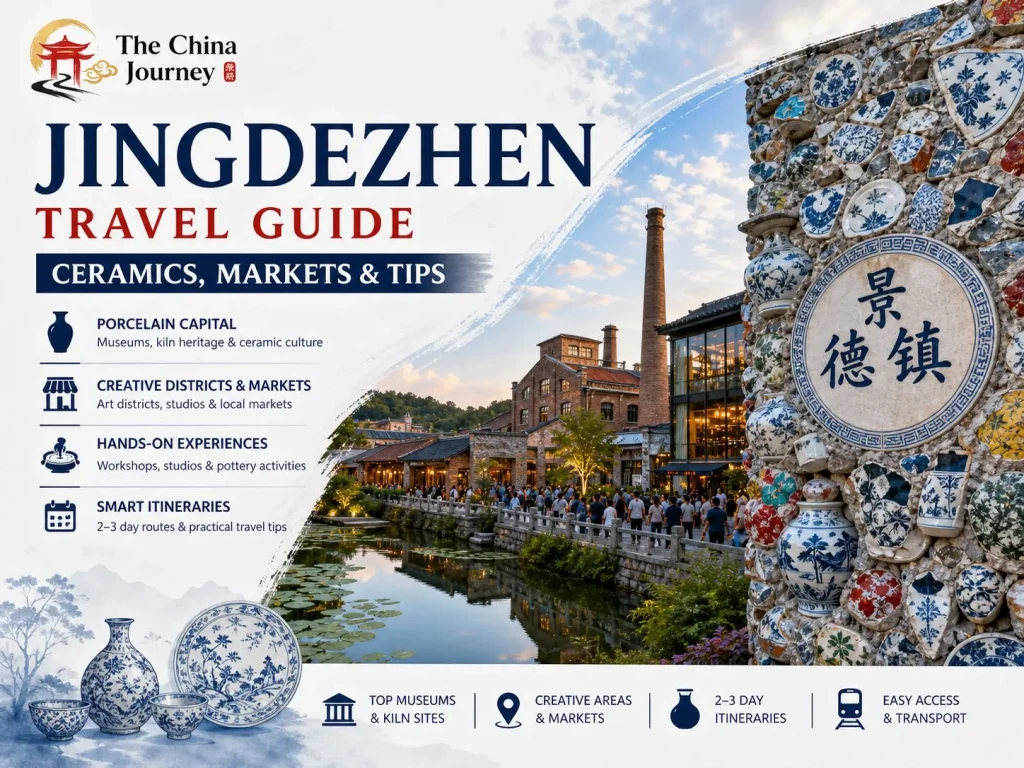
Jingdezhen is not a typical all-round city break. It is a destination built around porcelain culture, where the real value comes from understanding how history, craft, design, and daily life still connect through ceramics.
This guide helps you decide whether Jingdezhen is worth a dedicated trip, how many days to stay, what to prioritize, and how to fit it into a wider Huangshan, Wuyuan, or East China route.
| Field | Quick take |
|---|---|
| Chinese name | Jingdezhen (景德镇) |
| Province role | A distinctive cultural city in northeastern Jiangxi, known more for porcelain heritage than big-city sightseeing |
| Best first-time role | A focused culture-led stop for travelers who want one clear theme rather than a general city break |
| Best known for | Porcelain, kiln heritage, ceramic museums, creative districts, and studio culture |
| Best trip length | 2 days for a strong first trip; 3 days for a more complete and relaxed experience |
| Best time to visit | Spring and autumn, when walking, market browsing, and short extensions feel most comfortable |
| Best for | Travelers interested in ceramics, craft, design, museums, and slower cultural exploration |
| Travel style | Arrive by rail or air, stay in the right district, and combine a museum, kiln heritage, creative areas, market browsing, and one optional extension |

Jingdezhen sits in northeastern Jiangxi and links especially well with Huangshan, Wuyuan, and Nanchang. That makes it both a strong dedicated 2–3 day destination and an easy cultural stop within a wider East China route.

Jingdezhen works best for travelers whose style matches the city’s strengths: one clear cultural theme, real depth, and a slower 2–3 day rhythm.

This is the knowledge core of a first trip and the best place to start if you want a clear framework before exploring the rest of the city. It suits almost every first-time visitor, especially anyone interested in history, museums, and Chinese material culture. In your route, it helps explain why Jingdezhen matters before you move into kiln sites and creative areas. If time is tight, keep this and build the rest of the day around it. It is one of the clearest first-priority stops in the city.

This is the heritage and craft core of Jingdezhen. It works best for travelers who want to move beyond display cases and understand how porcelain was actually made, fired, and passed down. In a first itinerary, it pairs naturally with the ceramics museum because together they create a strong “context plus process” structure. If you only have one full day, this is one of the best places to protect. Skip lower-priority add-ons before cutting this.

Taoxichuan is the modern creative core and one of the clearest signs that Jingdezhen is not only about the past. It is best for younger travelers, design-minded visitors, market browsers, and anyone who likes creative districts with shops, exhibitions, cafés, and night atmosphere. In your route, it usually works best in the late afternoon or evening after museums earlier in the day. If you want to understand Jingdezhen as a living creative city, not just a historical one, this is a top-tier stop.

This is the royal-history layer of the city and a strong choice for visitors interested in imperial production, archaeology, and architecture. It adds a more focused and refined dimension than the broader ancient kiln experience. In your route, it works well as a second major heritage stop, especially if you want to deepen the historical side of the trip. If time is limited, choose this for royal history or skip it in favor of more creative studio time.

This is the market and creator-ecosystem layer. It is best for travelers who enjoy wandering through workshop areas, seeing where creators work, and browsing more grounded, less polished commercial spaces. In a first trip, it adds texture after the museum-and-heritage core and helps you see Jingdezhen from a more everyday creator perspective. It is especially useful on a second day. If your schedule is short, keep Taoxichuan first and treat this as the secondary creative stop.

Sanbao is the slower artistic atmosphere layer and suits travelers who want a quieter, more spacious contrast to the urban ceramic districts. It suits travelers who enjoy light walking, tea, studio stops, and a softer pace. In your route, it works best after you already understand Jingdezhen’s main ceramic story, because it is more about mood and environment than essential first-step orientation. If you only have one day, this is usually easier to cut than the museum, kiln, or Taoxichuan core.

This is the interaction layer and one of the best ways to turn the trip from observation into participation. It suits couples, families, craft-curious travelers, and anyone who wants a memorable activity rather than only site visits. In a first itinerary, it usually fits best on Day 2, after you have already seen both the historical and creative sides of the city. If your time is very limited, this is optional, but on a 2–3 day trip it often becomes one of the most memorable parts.

Yaoli Ancient Town is the best outer extension if you have enough time to add one quieter day beyond the city’s main ceramic core. It is best for travelers who want some old-town texture, a slower landscape setting, and a gentler final layer after museums, kilns, and markets. In your route, it usually belongs on Day 3, not inside a packed 2-day trip. If you are trying to protect the strongest first-time structure, keep the urban ceramic core first and add Yaoli only when time allows.

Porcelain Palace is a low-priority add-on rather than a core first-time stop. It may appeal to travelers who like unusual architecture, visual oddities, or social-media-friendly detours, but it does not carry the same interpretive value as the museum, kiln, or main creative districts. In your route, it belongs only after the essential ceramic experience is already covered. If time is short, cut this first.

For most first-time visitors, Jingdezhen works best as a focused cultural stop rather than a rushed pass-through. The right trip length depends on how fully you want to experience the city’s porcelain theme.
It also helps to decide How Long to Spend in China before fixing the cultural part of your wider route.

Who it’s for
Travelers with limited time who still want a meaningful first look at Jingdezhen, not just a quick stop for one photo or one shop.
Route logic
Keep the structure tight: start with context, move into heritage, and end with the city’s contemporary creative side. Do not try to cover outer extensions.
Main stops
Morning: Jingdezhen China Ceramics Museum.
Afternoon: Ancient Kiln and Folk Customs Museum.
Evening: Taoxichuan Ceramic Art Avenue.
Why this itinerary works
It covers the city’s strongest “past to present” sequence in the shortest realistic format. The museum gives you the knowledge core, the kiln site shows how porcelain was made, and Taoxichuan adds the modern creative layer. It is still selective rather than complete, but it gives first-time visitors a clear and memorable structure instead of a scattered day.

Who it’s for
Most first-time visitors. This is the most mature and balanced answer for travelers who want a complete introduction without overloading the schedule.
Route logic
Day 1 builds the historical and cultural foundation. Day 2 shifts into the creator ecosystem, slower atmosphere, and one interactive layer.
Main stops
Day 1: Jingdezhen China Ceramics Museum, Ancient Kiln and Folk Customs Museum, Taoxichuan in the evening.
Day 2: Sculpture Porcelain Factory area, Sanbao, and one hands-on ceramic experience.
Why this itinerary works
This is the clearest version of Jingdezhen’s best first-trip structure: museum, kiln history, creative district, market or studio layer, and participation. It gives you enough time to understand both the city’s long ceramic history and its living artistic scene. For most travelers, this is the point where the city feels complete without becoming repetitive.
Who it’s for
Travelers who want a slower pace, deeper studio time, or one meaningful extension beyond the main urban ceramic core.
Route logic
Keep the 2-day core intact, then use Day 3 either for an outer extension or for a more immersive creative day. The extra day should add depth, not just more stops.
Main stops
Day 1: Jingdezhen China Ceramics Museum, Ancient Kiln and Folk Customs Museum, Taoxichuan.
Day 2: Sculpture Porcelain Factory area, Sanbao, and a hands-on ceramic experience.
Day 3: Yaoli Ancient Town, or a slower creative day with more studio time and a longer workshop.
Why this itinerary works
Three days lets Jingdezhen breathe. You are no longer forced to choose only the core layers, and you can add either a quieter old-town extension or deeper involvement with the city’s studio culture. This version suits travelers who care about atmosphere and process, not just coverage.

Who it’s for
Travelers combining culture and scenery across East China, especially those already visiting Huangshan, Wuyuan, or nearby Jiangxi destinations.
Route logic
Use Jingdezhen as a focused 2-day cultural block inserted between more nature-led or countryside-led stops. It works best as contrast, not as an afterthought.
Main stops
Typical pairing: Huangshan, then Jingdezhen for 2 days, then Wuyuan or another Jiangxi stop. In Jingdezhen, keep the core structure: museum, kiln-history layer, creative district, and one market, studio, or hands-on stop.
Why this itinerary works
Jingdezhen adds craft, museums, and living creative culture to routes that might otherwise lean too heavily on mountains or villages. It gives the wider trip more variety and a stronger cultural center.
If you are shaping a bigger route as well, it helps to align this with How to Plan a China Trip.
Jingdezhen is visitable year-round, but some seasons are much easier than others. For most first-time visitors, spring and autumn are the safest choices because walking is more comfortable, creative districts feel better at a slower pace, and outer extensions such as ancient-town trips are easier to enjoy. For a broader national comparison, see Best Time to Visit China.

Spring is one of the most balanced times to visit. The weather is usually mild enough for museum-and-walking days, and areas such as Taoxichuan and Sanbao feel active without the heavier summer discomfort. Rain is still a factor, so the best approach is to keep some flexibility in the plan. It is also a good season for an ancient-town extension, since longer outdoor stretches feel easier.

Summer is the hardest season for most visitors. Jingdezhen becomes hot, humid, and wetter, which makes long outdoor walking less pleasant. Creative districts and markets still work, but they are usually better in the late afternoon or evening than in the middle of the day. Museums and indoor studio stops matter much more in this season. If you add Yaoli or another outer extension, expect the day to feel slower and more weather-dependent.

Autumn is usually the best overall season. Walking comfort is stronger, humidity is lower, and both the old kiln areas and the creative districts are easier to enjoy for longer periods. This is also one of the best seasons for market browsing, city strolling, and adding a calmer ancient-town day. If you want Jingdezhen at its clearest and easiest, autumn is the safest answer.

Winter is workable, but it can feel colder and damper than some travelers expect. The city is still good for museums, kiln history, and shorter urban routes, but outdoor wandering is less comfortable than in spring or autumn. Creative districts remain visitable, though they may feel quieter. Ancient-town extensions are still possible, but they work better with modest expectations and a lighter pace.
Jingdezhen is easier to reach than many first-time visitors expect, especially if you are already moving through East China. In practical terms, high-speed rail is one of the most important ways to enter the city, because it fits naturally into wider routes through Huangshan, Wuyuan, and Nanchang. For a broader overview, see China Transportation Guide.

Flying is possible and can make sense if you are coming from farther parts of China or trying to save time on a longer domestic route. It works best when Jingdezhen is a clear destination in its own right rather than one stop inside a tightly connected East China overland route. For most first-time East China routes, air is possible but usually not the best default.

Rail is often the cleaner and more practical answer. Jingdezhen connects especially well with Huangshan, Wuyuan, and Nanchang, which makes it very easy to insert into a broader cultural route. For many travelers, this is the most efficient way to reach the city without breaking the rhythm of the trip. If you are already moving across East China, high-speed rail is usually the best choice.
Jingdezhen works especially well as the cultural stop in a Huangshan–Wuyuan–Jingdezhen route, or as part of a broader Jiangxi and East China plan. That is where the city makes the most sense: not as an isolated transport challenge, but as a well-placed thematic destination. If you are already traveling by rail through the region, Jingdezhen is easy to insert before or after mountain and countryside stops.
Jingdezhen is not difficult to move around, but it is important to understand that the main areas are spread out. Some individual districts are good for walking once you arrive, but the city as a whole is not a purely walkable sightseeing destination. In practice, most first-time visitors rely on taxis or ride-hailing for clean cross-town moves, then walk inside the specific zone they are exploring.
| Route | Best way to travel | What to know |
|---|---|---|
| station / airport ↔ city center | Taxi / ride-hailing | Usually the simplest choice with luggage. Public transport exists, but taxis are easier for first arrival or departure. |
| city center ↔ museum / kiln core | Taxi / ride-hailing | This is one of the easiest core transfers. The museum and major kiln-history stops are manageable, but not best treated as one long walking chain from downtown. |
| city center ↔ Taoxichuan / Sculpture Factory | Taxi / ride-hailing | Both are easy urban moves. Once you arrive, each area is better explored on foot. |
| city center ↔ Sanbao | Taxi / ride-hailing | Sanbao is not a casual walking extension from downtown. Treat it as a dedicated half-day block. |
| city center ↔ Yaoli / farther extensions | Private car, taxi / ride-hailing, arranged transport | These outer extensions need separate planning and should not be treated like normal city hops. |
| creative zones ↔ each other | Taxi / ride-hailing, limited walking inside each zone | Taoxichuan, the Sculpture Factory layer, and Sanbao are all worth linking, but the transfers between them are better by car rather than on foot. |
The main rule is simple: walk within districts, ride between them. Taoxichuan and the Sculpture Factory area work well on foot once you arrive, while Sanbao and Yaoli need more deliberate transport planning.

See also: Where to Stay in Jingdezhen

Food in Jingdezhen is part of the local texture, but it is not the main reason to come. The city’s real draw is still porcelain culture. What the food adds is a useful flavor layer: quick local snacks, everyday noodle stops, and one or two more rooted regional dishes that fit naturally between museums, kiln sites, and creative districts.
Jingdezhen food works best as a supporting layer rather than the trip’s defining core. The city is strongest in snacks, noodles, and practical everyday dishes that fit naturally into a porcelain-focused itinerary.
Focus on one or two local snack staples, one noodle-based meal, and one slower add-on meal if you spend time in Sanbao or another outer area. That is enough to add local flavor without letting food take over the porcelain-first structure of the trip.
Jingdezhen is not an especially expensive destination in itself. Core costs such as hotels, local meals, and basic city transport are usually manageable. The budget rises more noticeably when you start linking zones by taxi all day, adding hands-on workshops, or buying ceramics. Compared with a place like Huangshan, it is easier to control your base travel costs here, but the temptation to spend on porcelain is much stronger. For a broader national benchmark, see Cost to Travel in China.
| Travel style | Typical daily cost (per person) | What it usually includes |
|---|---|---|
| Budget-ish stay | RMB 300–500 | Simple hotel, local snacks and noodles, mostly ride-hailing or basic taxis, core museum/creative-district sightseeing |
| Mid-range classic stay | RMB 500–900 | Comfortable hotel, stronger food mix, regular taxi use between zones, one main paid site or basic hands-on activity |
| Comfortable creative trip with add-ons | RMB 900–1,600+ | Better hotel, frequent taxis, stronger dining, workshop experience, outer extension, and room for selective ceramic shopping |
Overall, Jingdezhen is a moderate-cost culture trip that stays reasonable until workshops, frequent cross-city rides, and porcelain purchases enter the picture.


A decision-focused guide to traveling China by theme. Compare travel styles, match your interests, and choose the right direction before planning routes or cities.

Discover Qingdao, a coastal gem blending German architecture, scenic beaches, fresh seafood, and world-famous beer—your perfect mix of culture, nature, and fun.

This page helps you plan a China trip by setting the right decision order—before choosing cities, routes, or detailed travel guides.

Ningxia, known as “Jiangnan on the Frontier,” boasts fertile lands nourished by the Yellow River, earning it the title of “Land of Fish and Rice” for its agricultural abundance.

Discover Tianjin with our complete travel guide—top attractions, local food, transport tips, and hidden gems just 30 minutes from Beijing.

A calm and steady 2026 forecast for people born in 1959, covering career, wealth, relationships, health, and guidance for a balanced and secure year.