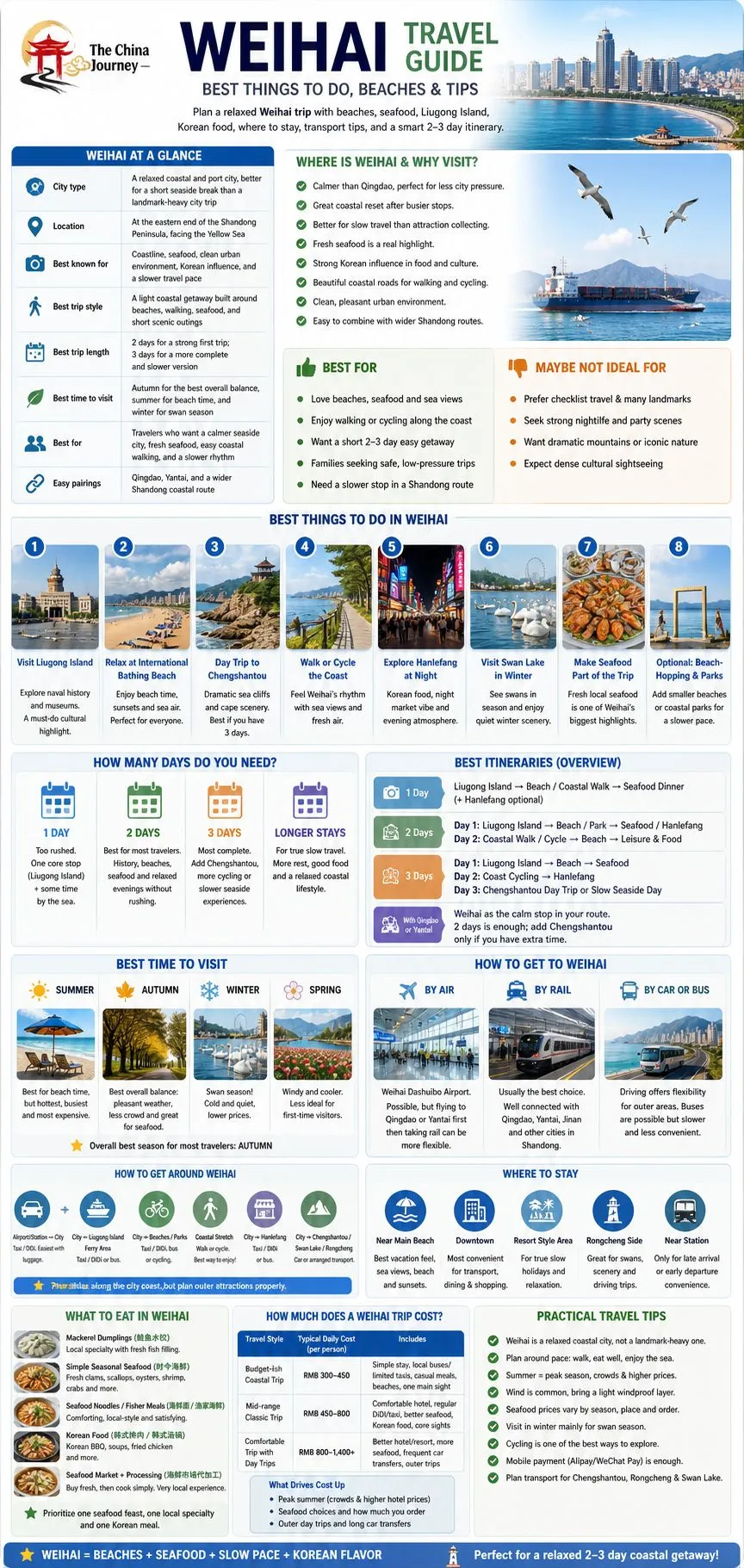
Weihai is not a blockbuster destination. It makes more sense as a relaxed coastal city, where the real appeal comes from the sea, fresh seafood, a calmer pace, and one of the cleanest urban environments on China’s coast.
This guide helps you decide whether Weihai (威海) is worth your time, how many days to stay, what to prioritize, and how to fit it into a wider Shandong coastal route with Qingdao and Yantai.
Field | Quick take |
|---|---|
City type | A relaxed coastal and port city, better for a short seaside break than a landmark-heavy city trip |
Location | At the eastern end of the Shandong Peninsula, facing the Yellow Sea |
Best known for | Coastline, seafood, clean urban environment, Korean influence, and a slower travel pace |
Best trip style | A light coastal getaway built around beaches, walking, seafood, and short scenic outings |
Best trip length | 2 days for a strong first trip; 3 days for a more complete and slower version |
Best time to visit | Autumn for the best overall balance, summer for beach time, and winter for swan season |
Best for | Travelers who want a calmer seaside city, fresh seafood, easy coastal walking, and a slower rhythm |
Easy pairings | Qingdao, Yantai, and a wider Shandong coastal route |
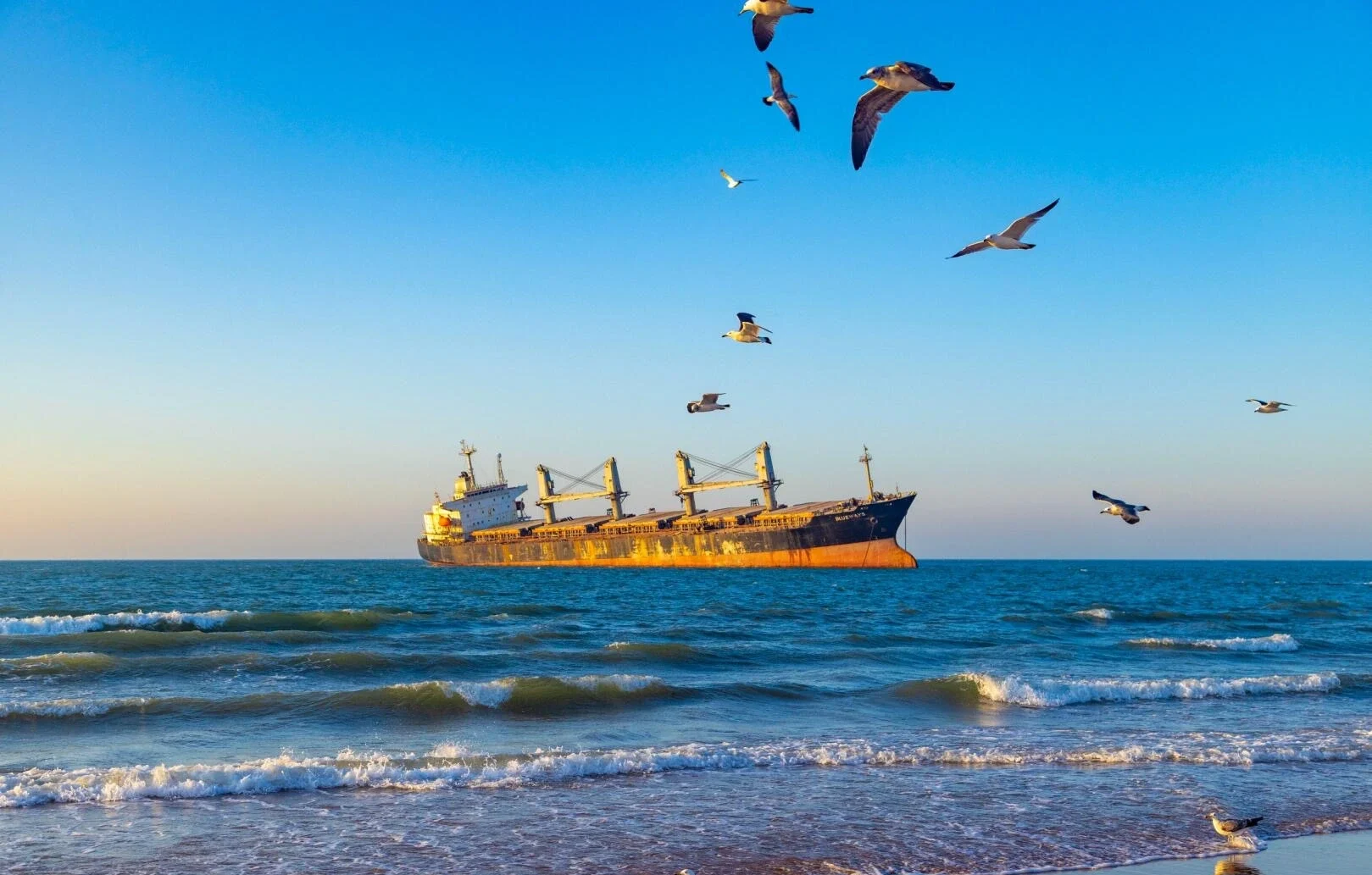
Weihai sits at the eastern end of the Shandong Peninsula, making it a natural stop in a Qingdao–Yantai–Weihai coastal route. It works especially well as the quieter, slower final stop after busier or more urban parts of the peninsula.
It feels calmer than Qingdao, which makes it a better choice if you want less city pressure and a more relaxed coastal atmosphere.
It works very well as a coastal reset, especially after busier stops, because the pace is slower and the city is easier to enjoy without rushing.
It is better for slow travel than attraction collecting, since the experience is built more around coastline, food, and daily rhythm than nonstop sightseeing.
Its seafood is a real reason to come, not just a bonus, because fresh local meals are one of the strongest parts of the trip.
Its Korean influence adds something different to the city, especially through food, shopping, and the overall everyday atmosphere in certain areas.
Its coastal roads, parks, and seafront stretches make it especially good for walking and cycling, which helps the city feel active without being tiring.
Its clean urban environment improves the whole trip, because even simple activities like strolling, sitting by the sea, or moving between areas feel more pleasant.
It combines easily with wider Shandong routes, so it works well whether you want a dedicated short break or one slower stop inside a longer peninsula journey.
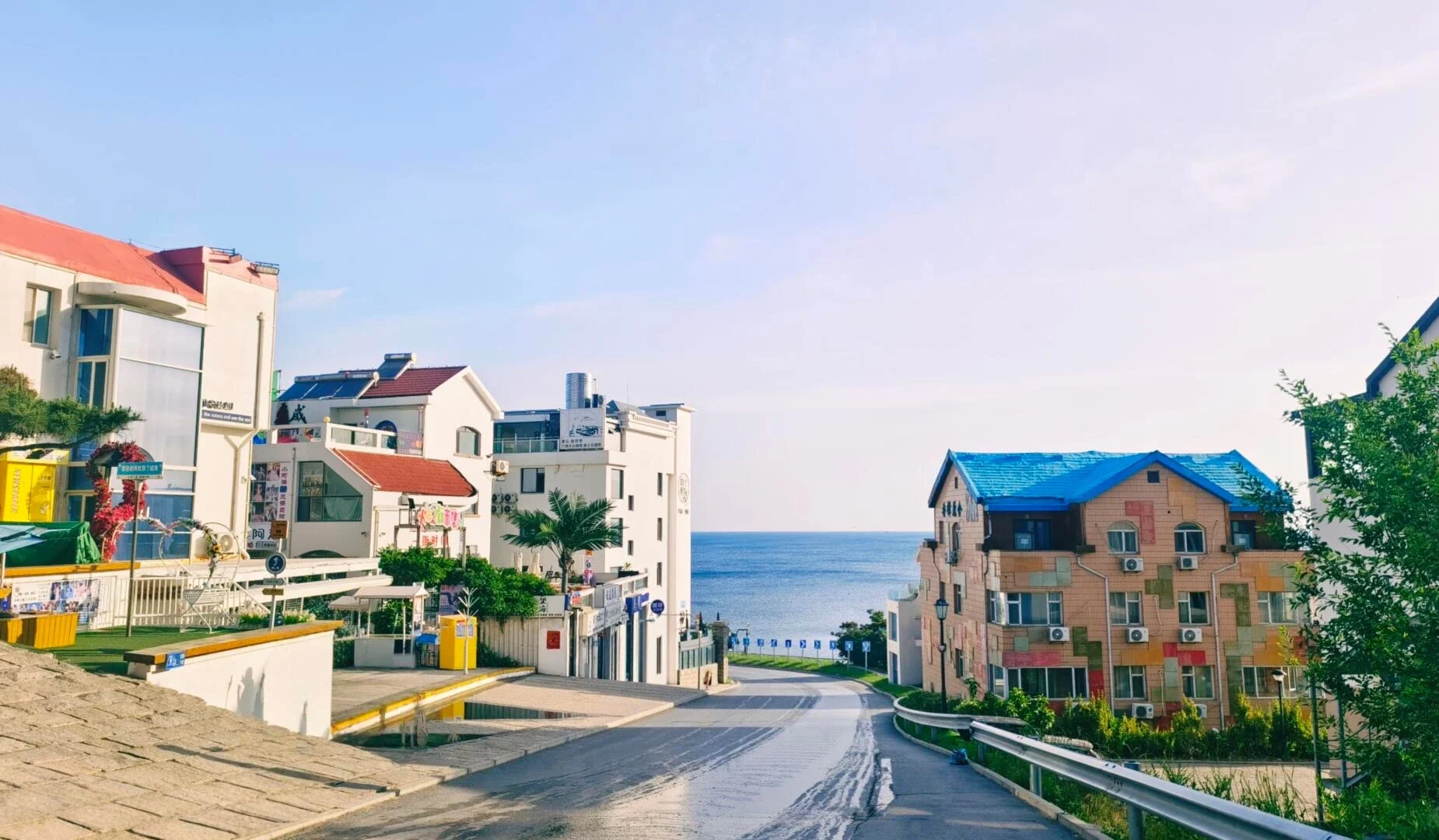
Weihai works best for travelers whose style matches the city’s strengths: a calmer coast, easier pacing, seafood, and time to enjoy the sea rather than rush between sights.
Travelers who want to slow down and enjoy a quieter coastal city instead of rushing between major sights.
Visitors who treat seafood as a real part of the trip, not just an occasional meal between attractions.
People who enjoy coastal walking or cycling and like a city where the seafront is part of the experience.
Travelers looking for a short 2–3 day getaway that feels easy to plan and easy to enjoy.
Families who want beaches, simple logistics, and a city that feels safe and low-pressure.
Travelers building a wider Shandong route and needing one slower stop between bigger or busier destinations.
You prefer checklist travel and want a long list of famous landmarks to fill every hour.
You choose destinations mainly for nightlife and want stronger evening energy than food streets and casual strolling.
You are looking for dramatic mountain scenery or truly iconic natural landscapes.
You expect dense cultural sightseeing on the level of China’s major history-first cities.

Liugong Island (刘公岛) is the history core of a first trip and the clearest single “must-do” in Weihai. It matters because it gives the city more depth than just beaches and seafood, especially through its connection to modern Chinese naval history. It is best for first-time visitors and anyone who wants at least one meaningful cultural stop in the itinerary. In the trip, it usually belongs on Day 1 and needs a half day or more. If time is short, keep this and cut lower-priority outer extensions first.

Weihai International Bathing Beach (国际海水浴场) is the coastal experience core and one of the easiest ways to understand why people like the city. It matters less as a “sight” and more as a lived experience: beach time, sea air, sunset, and relaxed pacing. It is best for almost everyone, especially families, couples, and travelers who want a proper seaside break. In the trip, it works well in the late afternoon or evening. If time is short, keep one main beach stop and cut smaller coastal add-ons first.

Chengshantou (成山头) is the strongest outer natural extension and the best option if you want bigger scenery beyond the city core. It matters because Weihai itself is more about calm coastline than dramatic nature, and Chengshantou adds a more powerful sea-cliff and cape feeling. It is best for travelers with 3 days, photographers, and people who want to widen the trip beyond city beaches. In the itinerary, it usually takes a full day. If you only have 2 days, this is one of the first major cuts.

Walking or cycling the coast is the lifestyle core of Weihai and one of the most authentic ways to experience the city. It matters because the city’s appeal is not only where you go, but how it feels to move through it. This is best for travelers who like sea views, light exercise, and a slower rhythm rather than fixed sightseeing blocks. It fits well on either day of a short trip, especially in the morning or near sunset. If time is short, keep a short coastal walk and skip the longer cycling plan.

Hanlefang (韩乐坊) is the evening food and Korean-influence layer of the city. It matters because Weihai’s connection with Korea is one of its clearest points of difference from many other Chinese coastal cities, and this area makes that easy to feel. It is best for food-focused travelers, casual evening wanderers, and anyone curious about Korean dining in China. In the trip, it works best at night after a lighter daytime schedule. If time is short, keep this only if food and Korean atmosphere matter to you.
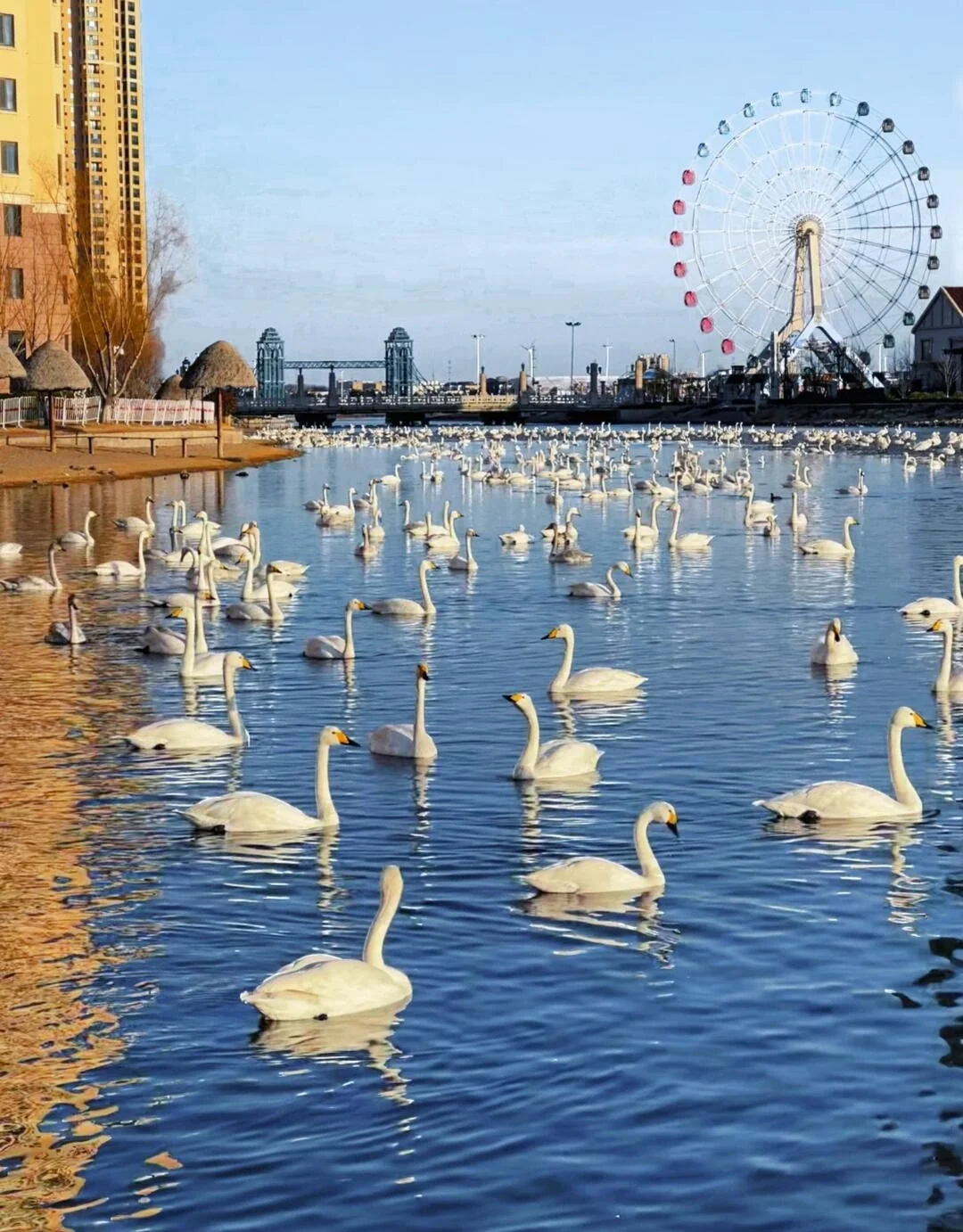
Swan Lake (天鹅湖) is the seasonal winter layer and only becomes a priority if you visit in the colder months. It matters because it gives Weihai a real winter identity beyond just being a quiet seaside city in the off-season. It is best for winter travelers, photographers, birdwatchers, and anyone already planning a Rongcheng-side extension. In the trip, it works as a half-day or day trip rather than a city-center stop. If you are not visiting in swan season, skip it entirely and do not force it into the plan.
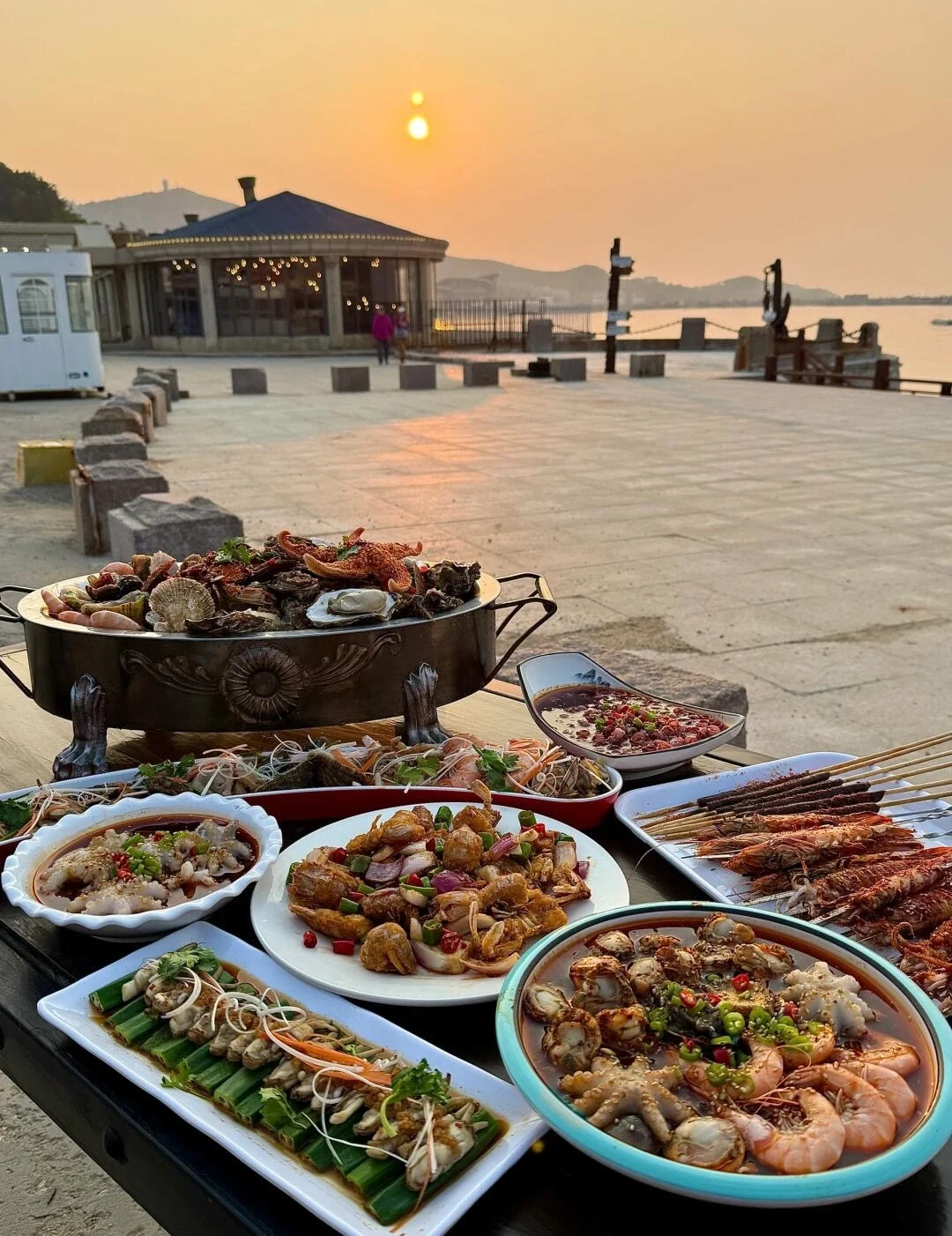
Seafood is one of the trip-defining experiences in Weihai, not just a meal choice. It matters because fresh local seafood is one of the clearest ways to feel the city’s coastal identity. It belongs throughout the itinerary, especially at dinner. If time is short, do not cut this. A strong seafood meal often matters more than one extra minor stop.
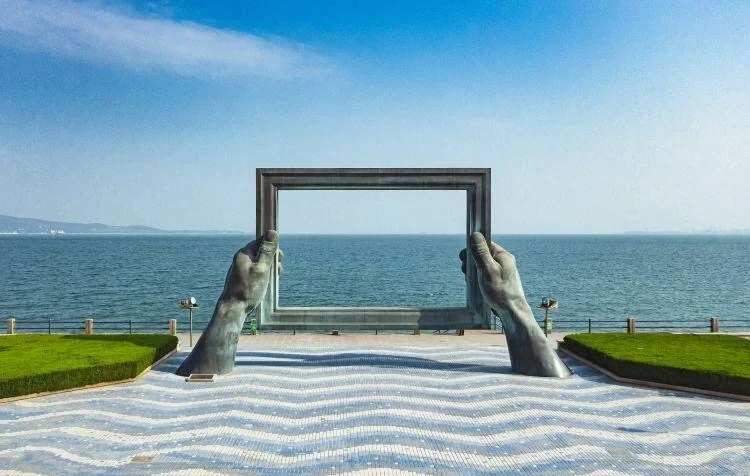
Slow beach-hopping or smaller seaside parks are flexible add-ons rather than trip foundations. They matter because they let you enjoy Weihai’s clean coastal environment without forcing every hour into a formal attraction. This is best for travelers with 3 days, repeat visitors, or anyone who values mood over checklist efficiency. In the itinerary, these work best as open-ended afternoon blocks. If time is short, cut these first and protect Liugong Island, one main beach, and your seafood-and-coast core.
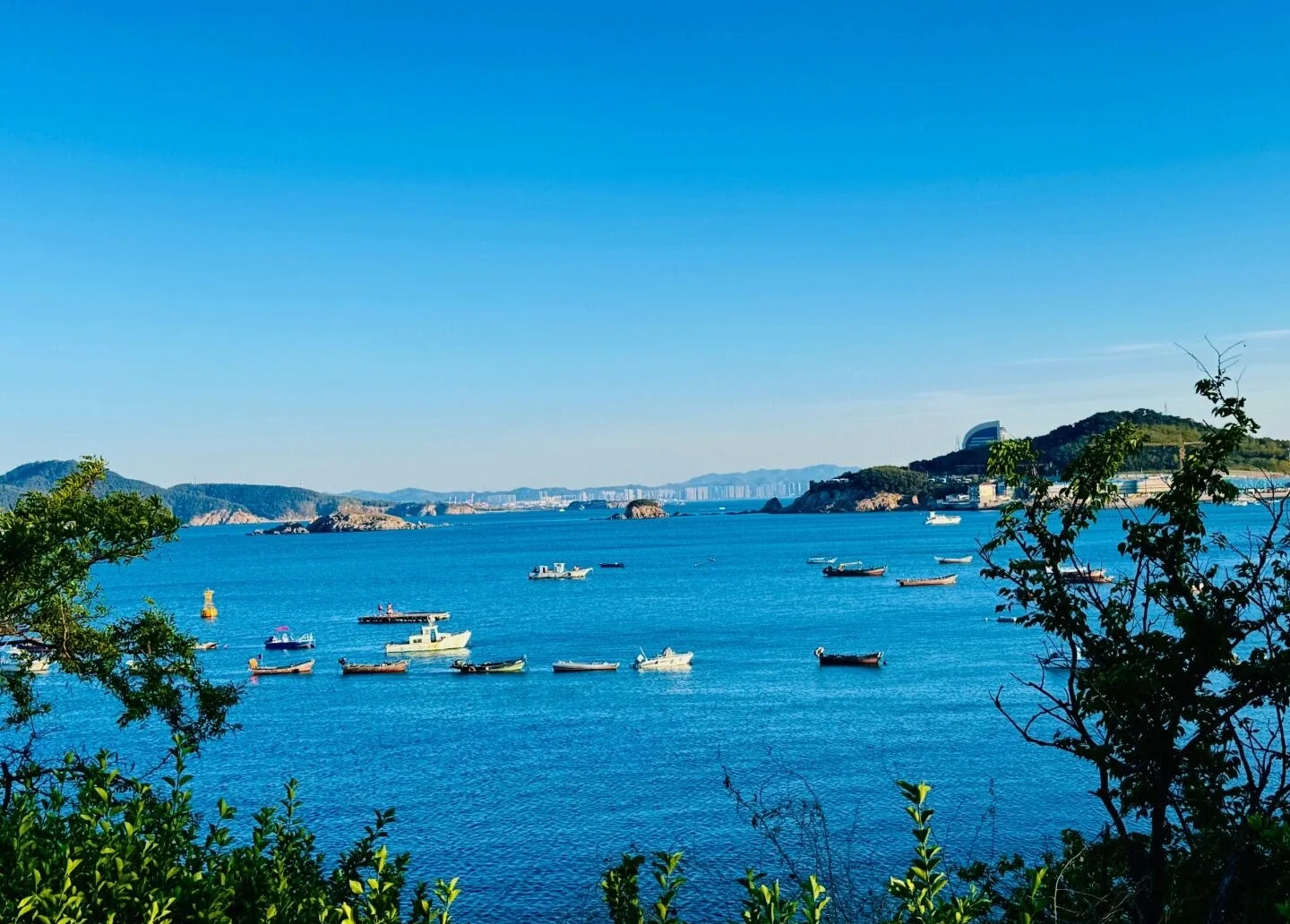
Weihai works best when you give it enough time to slow down. This is not a city that rewards cramming, because much of its value comes from sea views, seafood, walking, and a calmer pace rather than nonstop attraction-hopping.
1 day: Too rushed for most first-time visitors. You can see one core stop such as Liugong Island and spend a little time by the sea, but the trip will feel more like a quick sample than a real coastal break.
2 days: The best first answer for most travelers. This gives you enough time for the core structure: one history anchor, one beach or coastal stretch, strong seafood meals, and a relaxed evening layer without turning the trip into a checklist.
3 days: The most complete option if you want a slower pace or one meaningful extension. This is the best length for adding Chengshantou, more coastal cycling, or a more relaxed version of the city’s main rhythm.
Longer stays: Best for genuine seaside slow travel rather than more sightseeing pressure. Extra time works well for travelers who want to rest, eat well, move lightly along the coast, and let Weihai feel like a proper short escape.
It also helps to decide How Long to Spend in China before fixing the coastal part of your wider route.
Who it’s for
Travelers with very limited time who still want one meaningful look at Weihai rather than a purely logistical stop.
Route logic
Keep the day simple: one history core, one coastal break, and one good evening food layer. Do not try to add outer extensions.
Main stops
Morning to early afternoon: Liugong Island.
Late afternoon: Weihai International Bathing Beach or a coastal walk.
Evening: seafood dinner, with Hanlefang as an option if Korean food appeals to you.
Why this itinerary works
It gives you the clearest first impression of Weihai in the shortest realistic format. Liugong Island adds depth, the coast adds the seaside layer, and dinner anchors the city’s food strength. It is still rushed, but the structure is right.
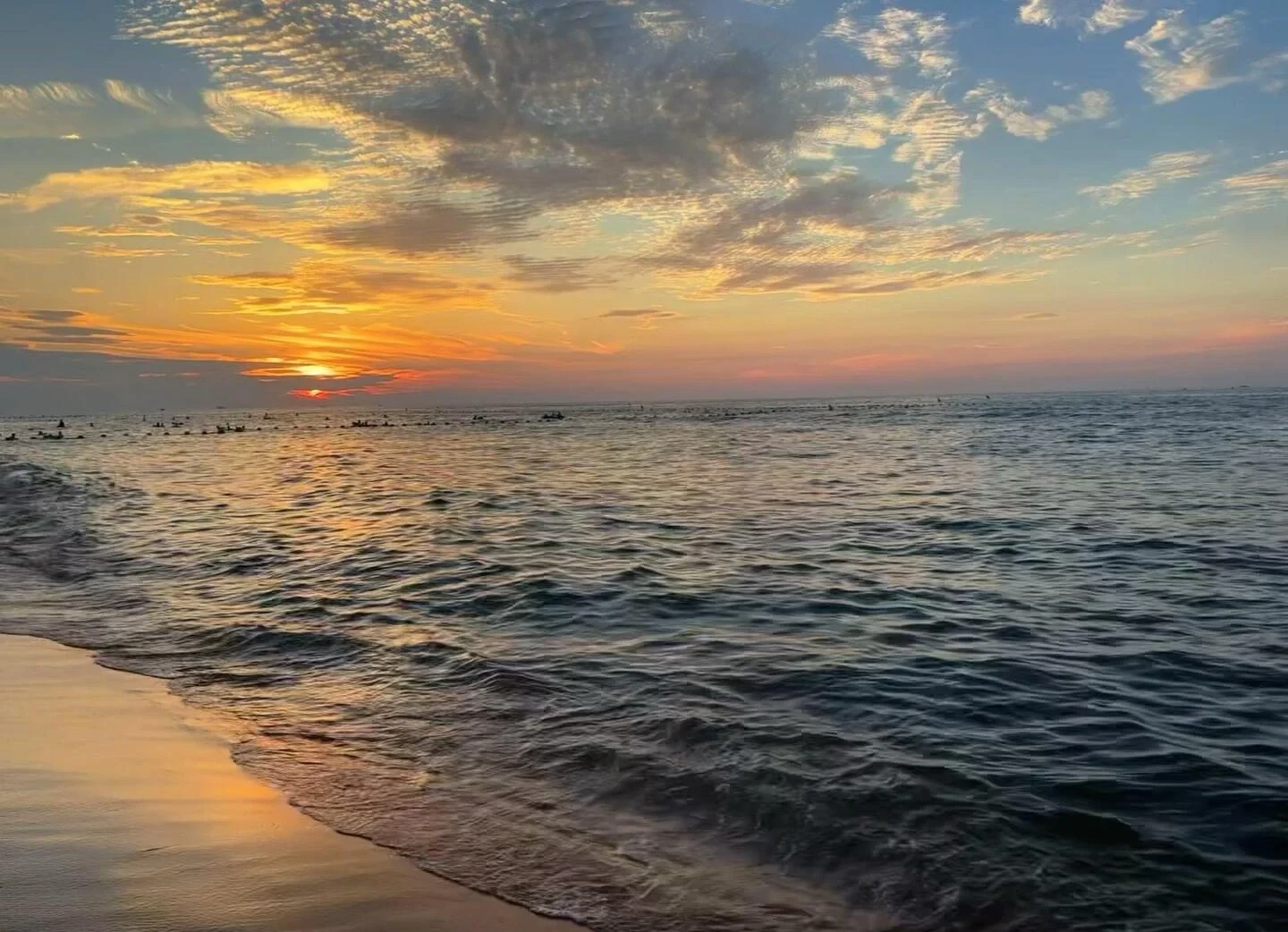
Who it’s for
Most first-time visitors. This is the most mature and balanced answer for travelers who want to understand what Weihai does well without forcing too much into the schedule.
Route logic
Day 1 focuses on the city’s history core and seaside identity. Day 2 shifts into lifestyle: coast, slower movement, and food.
Main stops
Day 1: Liugong Island, then a relaxed beach or coastal park stretch, followed by seafood or Hanlefang in the evening.
Day 2: coastal walking or cycling, another beach or seaside park, a flexible seafood-focused afternoon, and a slower final evening.
Why this itinerary works
This is the clearest first-trip structure: history core, beach or coast, seafood, evening atmosphere, and no unnecessary rushing. It lets Weihai feel like the relaxed coastal city it is, rather than forcing it into a landmark-heavy city-break model. For most travelers, 2 days is the strongest first-trip answer.

Who it’s for
Travelers who want a deeper coastal rhythm, a day trip beyond the city core, or simply more breathing room.
Route logic
Keep the 2-day foundation, then use Day 3 for a stronger outer extension or a slower, more spacious coastal experience.
Main stops
Day 1: Liugong Island, then a seaside walk or beach stop, followed by seafood in the evening.
Day 2: coastal cycling or walking, beach time, and Hanlefang or another food-focused night.
Day 3: Chengshantou as the main extension, or a slower day built around smaller coastal stops and more open time.
Why this itinerary works
Three days lets Weihai feel more complete. You keep the city’s core structure intact, but gain enough time for a more dramatic outer landscape or a more restful seaside pace. This is the best option if you want both the city’s relaxed coastal identity and one stronger scenic extension.
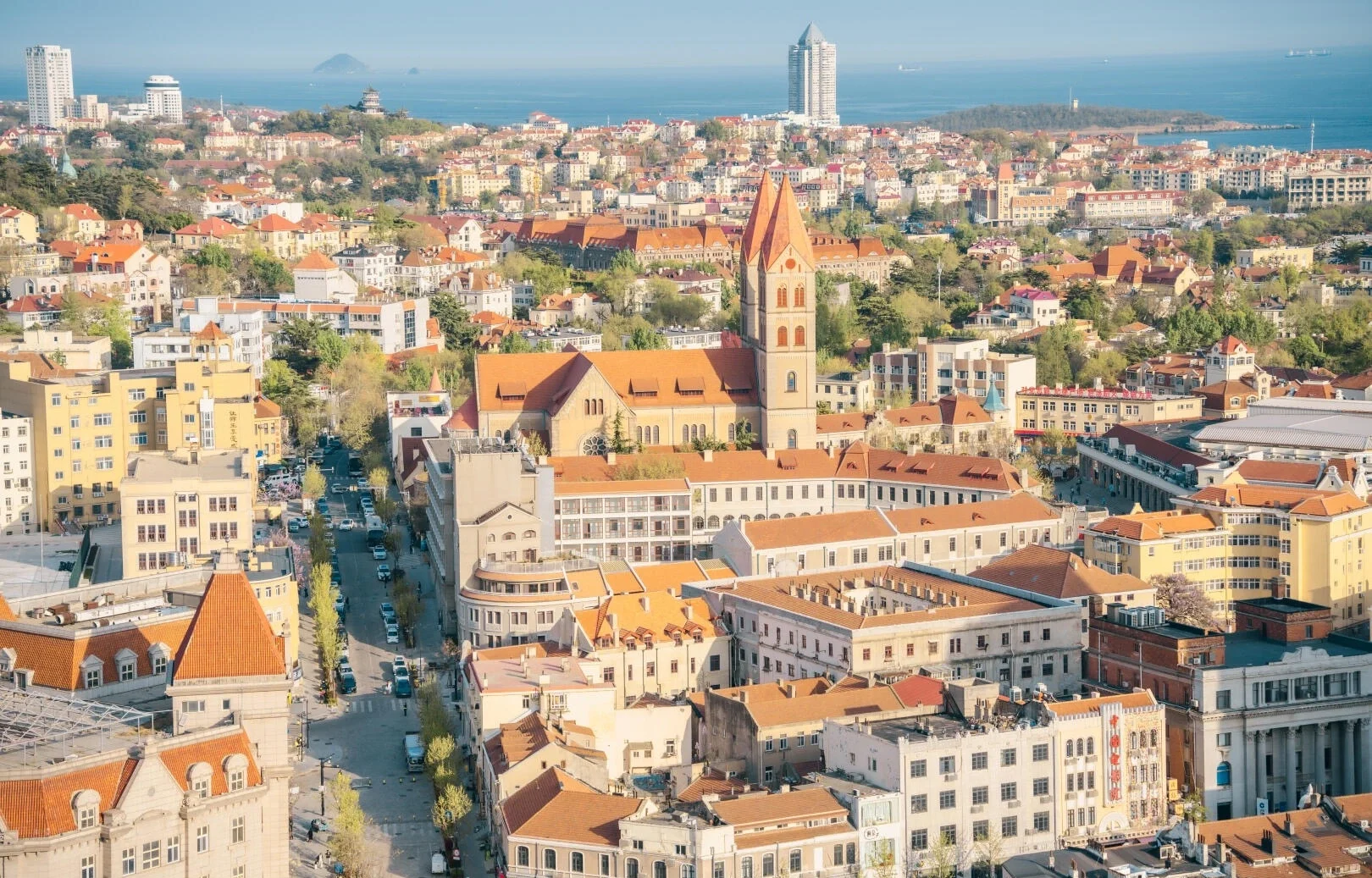
Who it’s for
Travelers building a wider Shandong coastal route and wanting Weihai to play the role of the calmer, slower stop.
Route logic
Use Weihai as the quieter counterpoint to Qingdao or as the softer finish after Yantai. Keep the city focused rather than overloading it.
Main stops
Most travelers only need 2 days here: Liugong Island, one good beach or coastal stretch, strong seafood, and one evening layer such as Hanlefang. Add Chengshantou only if you have extra time and want a full 3-day Weihai segment.
Why this itinerary works
Weihai is strongest when it is allowed to be the relaxing coastal leg of a broader route, not the busiest one. It adds cleaner seafronts, a slower pace, stronger seafood logic, and a calmer urban mood than Qingdao.
If you are shaping a bigger route as well, it helps to align this with How to Plan a China Trip.
Weihai can be visited year-round, but each season creates a different kind of trip. The best time depends less on temperature alone and more on what you want from the coast: swimming, seafood, walking, photography, or winter swan viewing. For a broader national comparison, see Best Time to Visit China.
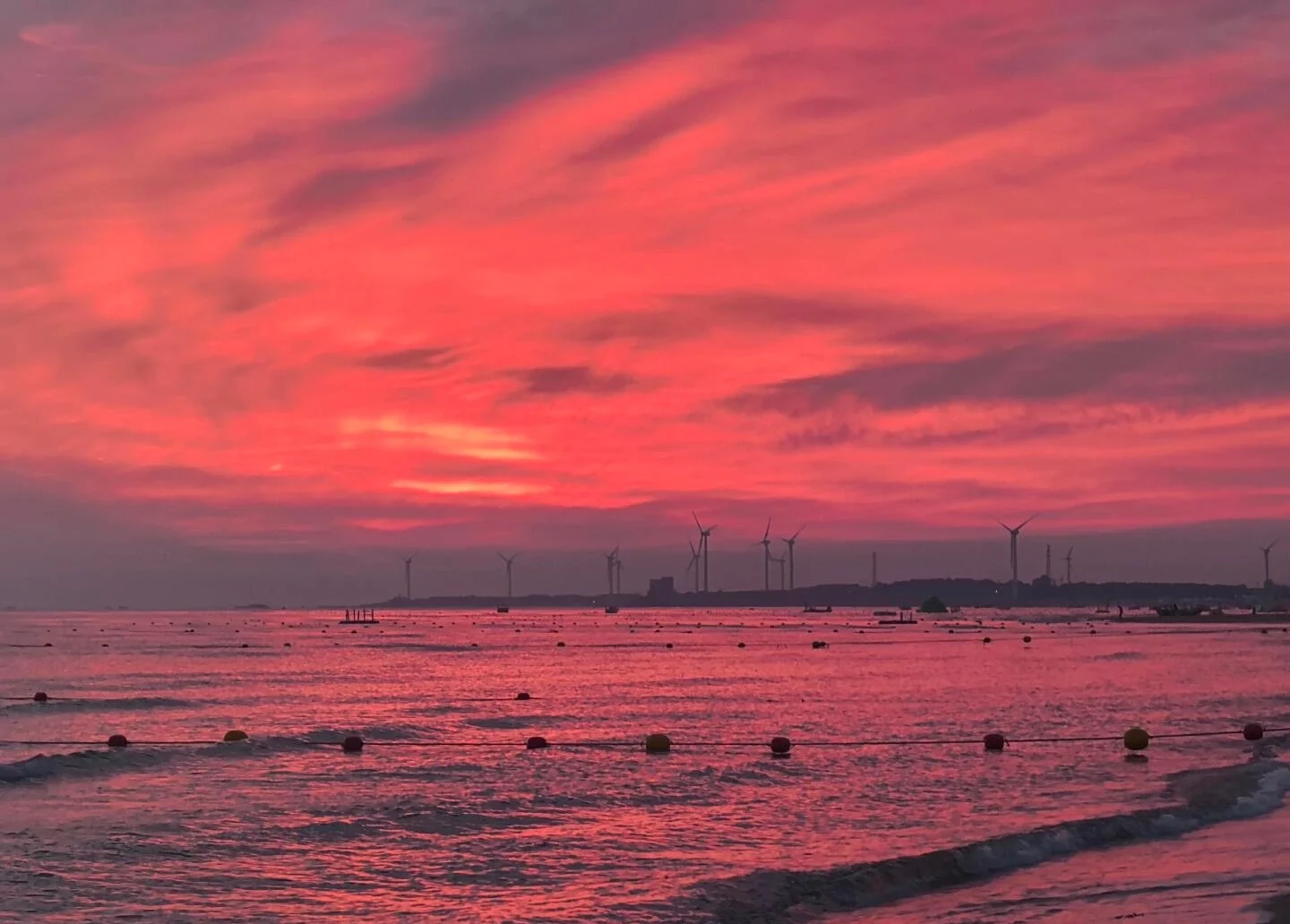
Summer is the peak beach season and the most obvious time to visit if swimming and seaside relaxation are your priorities. This is when the city feels most like a classic coastal holiday stop, especially around the main beaches. The trade-off is clear: higher hotel prices, more weekend crowds, and a busier overall atmosphere. It is great for beach time, but less ideal if you want the city at its calmest.
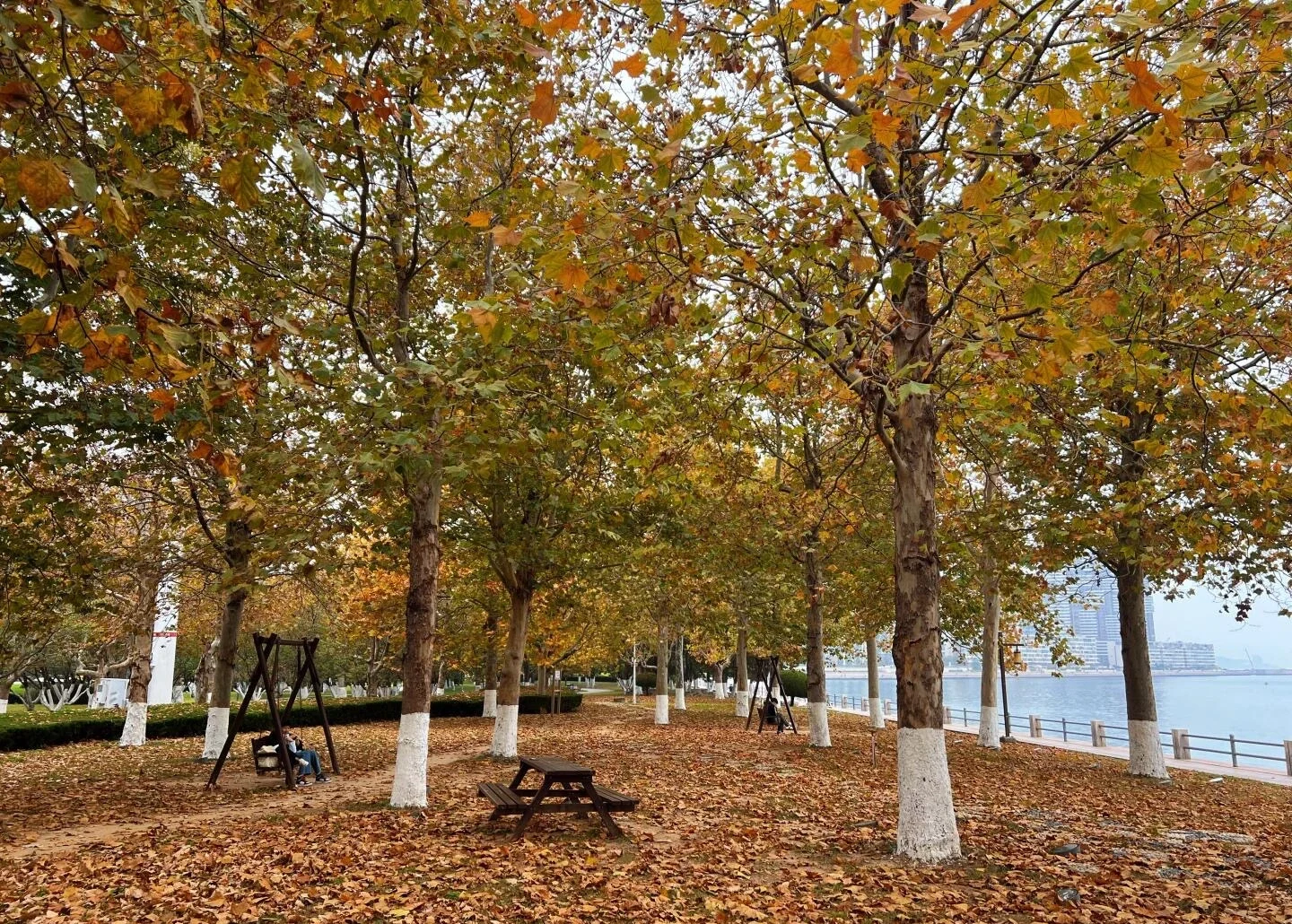
Autumn is usually the best overall balance. The weather is more comfortable for walking and cycling, the coast is still attractive, and the city feels easier to enjoy without peak-summer pressure. It is also one of the best seasons for seafood, especially after the sea reopens and fresh catches become a bigger part of the travel experience. For many first-time visitors, this is the safest and strongest answer.

Winter is not beach season, but it has its own reason to come: swan season. If you want to see Swan Lake and do not mind cold wind and a quieter coastal mood, winter can be surprisingly rewarding. Hotel prices are usually lower, and the city feels less crowded. This is more about seasonal wildlife, atmosphere, and photography than classic seaside leisure.

Spring is workable, but usually the least ideal season for a first trip. The city can be windy, the sea is still cold, and the beach side of Weihai is less satisfying than in summer or autumn. It can still work for quieter walking and lower crowd levels, but it is not the strongest first-trip season.
Summer is the best season for beach time, but also the busiest and most expensive.
Autumn is the best overall choice for first-time visitors.
Winter is worth considering mainly for swan season and a quieter coastal mood.
Spring is less ideal because of wind and cooler sea conditions.
For walking, cycling, seafood, and overall balance, autumn is usually the strongest answer.
Weihai fits naturally into the transport logic of the Shandong Peninsula, which is why it works well as part of a wider coastal route rather than as a difficult standalone destination. For most first-time visitors, train is the best choice. For a broader overview, see China Transportation Guide.

Flying directly to Weihai is possible, but it is not always the smartest first option. In many cases, flying into Qingdao or Yantai and then transferring by rail can be more flexible and sometimes more convenient, especially if you are already planning a wider peninsula route. This is especially useful when direct Weihai flight schedules are limited.
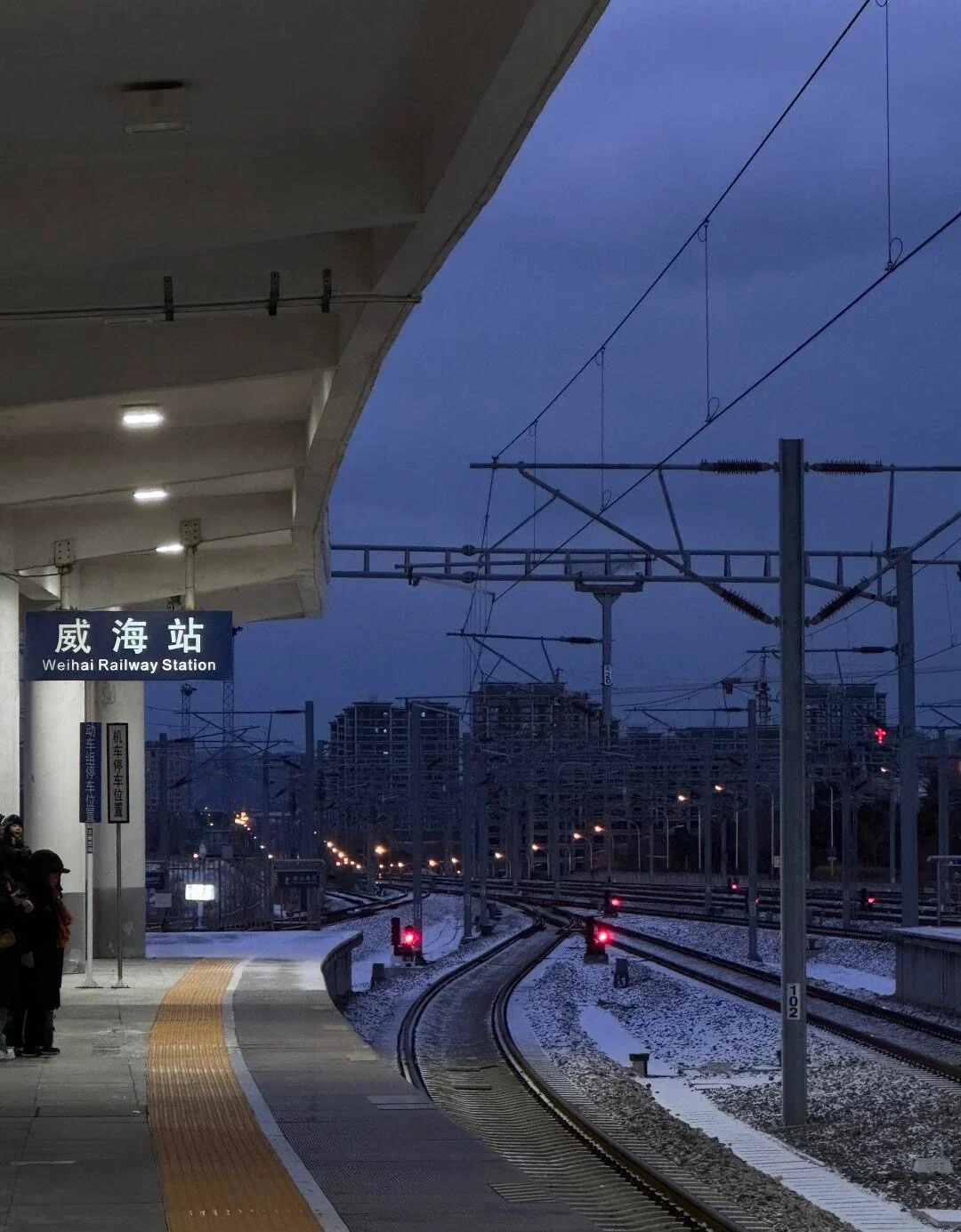
Rail is usually the best choice for most travelers. Weihai connects well with Qingdao, Yantai, Jinan, and other cities in the province, and the peninsula’s rail network makes the city easy to insert into a larger Shandong trip. If you are already moving between coastal cities, train is usually the cleanest and most natural way to arrive.
Driving can work well if you want more flexibility, especially for reaching outer coastal areas or linking multiple stops in the peninsula. Buses are possible too, but they are generally less attractive for first-time visitors unless cost matters more than speed and simplicity. For most travelers, rail remains the simplest answer.
Weihai is easy enough to move around once you understand the difference between the city core and outer extensions. The city coast is pleasant and easy for slower movement, but places like Chengshantou, Swan Lake, and Rongcheng need more deliberate planning.
Route | Best way | What to know |
|---|---|---|
Railway station / airport ↔ city center | Taxi / DiDi | Usually the easiest option with luggage. Airport transfers are longer and more worth planning in advance. |
City center ↔ Liugong Island ferry area | Taxi / DiDi or bus | Easy urban transfer. Bus works, but taxi or DiDi is simpler if you want to save time. |
City center ↔ main beach / coastal parks | Taxi / DiDi, bus, or cycling | This is one of the most pleasant parts of Weihai to explore. Once you arrive, walking or cycling works well. |
Coastal stretch within the city | Walking or cycling | One of the best ways to feel the city’s pace. This is where Weihai is most enjoyable without rushing. |
City center ↔ Hanlefang | Taxi / DiDi or bus | Straightforward urban move, especially in the evening. |
City center ↔ Chengshantou / Swan Lake / Rongcheng | Car, taxi, or arranged transport | These are outer extensions, not casual city hops. Public transport is possible but slower and less convenient. |
The simple rule is this: relax along the city coast, but plan outer attractions properly.
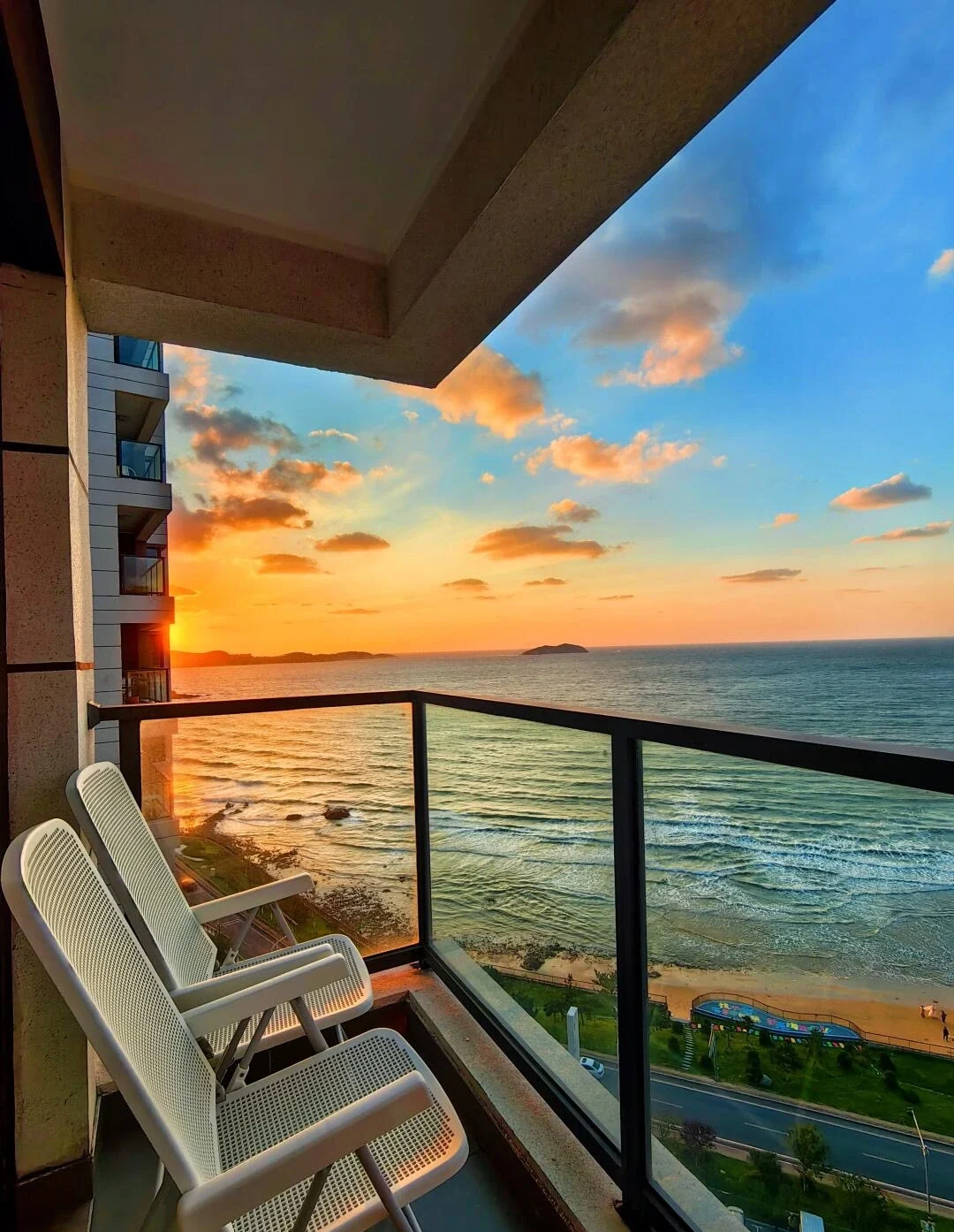
Stay near the main beach area if… you want the strongest vacation feel. This is the best base for travelers who care most about sea views, beach time, sunset walks, and an easy coastal rhythm. It is the most natural choice for a relaxed first trip focused on the seaside rather than city convenience.
Stay downtown if… you want the broadest overall convenience. Downtown is the easiest base for transport, daily dining, shopping, and getting to places like the Liugong Island ferry area. It is the most practical choice if you want city convenience first and still want reasonably easy access to the coast.
Stay in a resort-style area only if… you are treating Weihai as a true slow holiday rather than a city trip. These areas work best for travelers who want to stay in one comfortable place, spend more time resting, and keep sightseeing light. They are better for mood and comfort than for efficient city coverage.
Stay near Rongcheng-side coastal resorts if… you are driving, planning a deeper coastal trip, or visiting in swan season. Areas linked with Rongcheng, Naxianghai, or the Swan Lake side make more sense for travelers who want outer coastal scenery rather than the main Weihai city rhythm. They are less convenient for standard first-time city sightseeing.
Stay near the station only if… Weihai is mainly a functional stop with a late arrival or early departure. This area works for timing, but it is not the best first-choice base for atmosphere, seaside access, or overall trip character.
See also: Where to Stay in Weihai
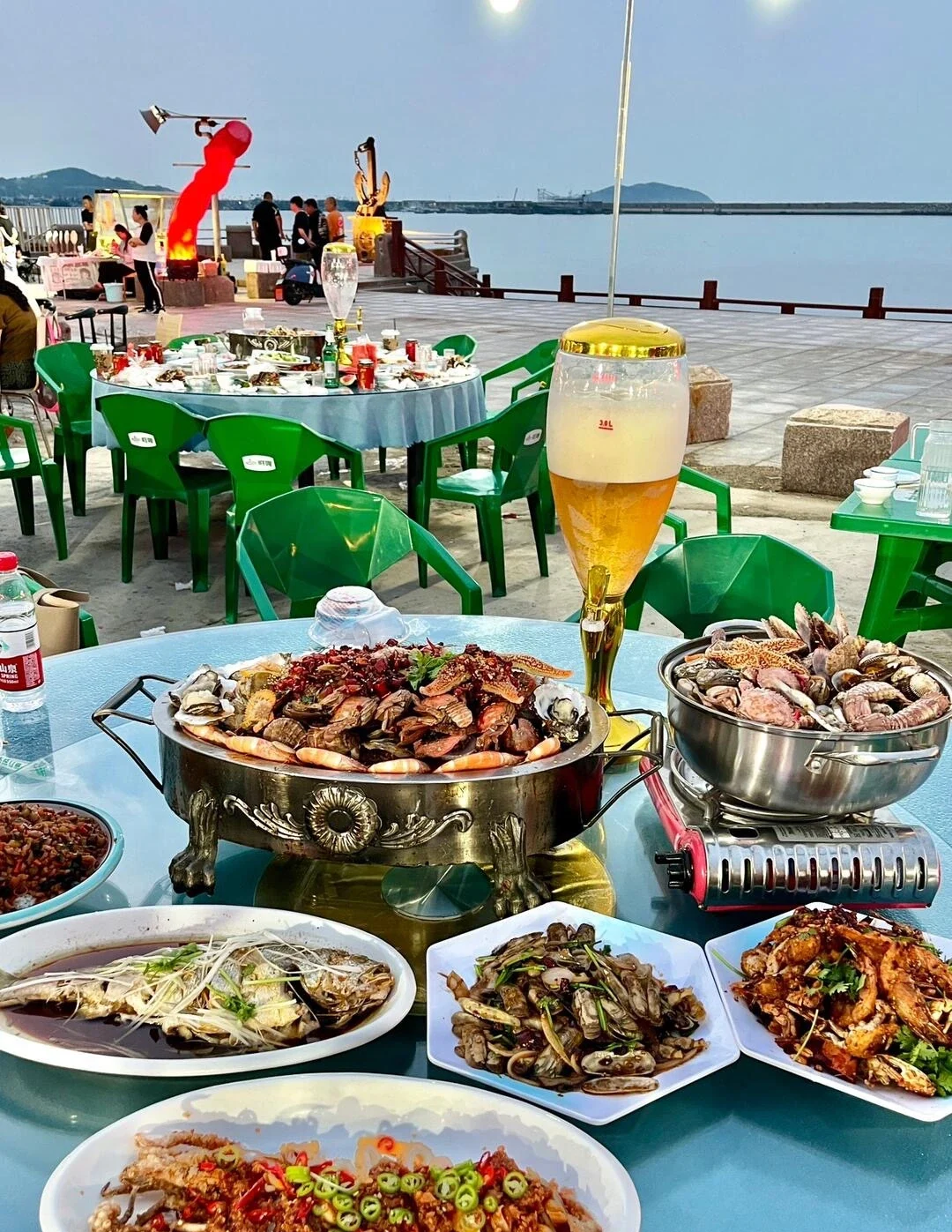
Food is one of the clearest reasons to enjoy Weihai. The city is strongest when you keep meals simple and local: fresh seafood, a few regional specialties, and one Korean meal if that side of Weihai appeals to you.
Mackerel dumplings (鲅鱼水饺) — one of Weihai’s best-known local specialties, with a soft wrapper and a fresh, savory fish filling. This is one of the easiest dishes to remember after the trip and a very good place to start.
Simple seasonal seafood (时令海鲜) — the real strength of eating in Weihai is freshness rather than complicated cooking. Focus on what is in season: clams, scallops, oysters, shrimp, crabs, mantis shrimp, and other shellfish prepared as simply as possible.
Seafood noodles or fisher-style seafood meals (海鲜面 / 渔家海鲜) — these are a good middle ground between a full seafood feast and a quick meal. They fit well into a relaxed travel day and often feel more everyday and local than formal seafood restaurants.
Korean barbecue and Korean soups (韩式烤肉 / 韩式汤锅) — Weihai’s Korean food is a real bonus, not just a random extra. If you want a break from seafood, Korean barbecue, soups, fried chicken, and casual Korean comfort food are all strong choices.
Seafood market plus simple processing (海鲜市场代加工) — if you are comfortable with a more local, practical style of dining, this can be one of the most memorable food experiences. You buy fresh seafood first, then have it cooked simply nearby.
Prioritize one strong seafood meal, one local specialty such as mackerel dumplings, and one Korean meal if that part of the city interests you. The goal is not to eat everything, but to understand Weihai through freshness, simplicity, and its coastal-Korean mix.
Weihai is generally a moderate-cost coastal city, especially compared with bigger-name seaside destinations. A simple 2-day trip can be controlled fairly well outside peak season, but summer hotel prices, seafood choices, and outer day trips can change the budget quickly. For a broader national benchmark, see Cost to Travel in China.
Travel style | Typical daily cost (per person) | What it usually includes |
|---|---|---|
Budget-ish coastal trip | RMB 300–450 | Simple hotel or guesthouse, local buses or limited taxis, casual meals, beaches, and one main paid sight if chosen carefully |
Mid-range classic Weihai trip | RMB 450–800 | Comfortable hotel, regular DiDi or taxi use, better seafood meals, Korean food, and core sightseeing such as Liugong Island |
Comfortable seaside trip with day trips | RMB 800–1,400+ | Better beach hotel or resort stay, more seafood spending, frequent car transfers, and outer trips such as Chengshantou or Rongcheng-side areas |
Weihai itself is usually not expensive; the city becomes pricier mainly when you chase peak-summer beach stays.
Summer hotel prices can rise sharply, especially near popular beach areas and on weekends.
Seafood is one of the biggest cost variables, because a simple local meal and a larger fresh-seafood feast can sit in very different price ranges.
Outer day trips, especially those needing longer car transfers, raise the budget more than city-center sightseeing.
Outside peak season, a 2-day trip is usually easy to keep within a reasonable mid-range budget.
Overall, Weihai is easy to keep moderate in cost unless you travel in peak summer, book beach hotels late, or build the trip around seafood splurges and outer day trips.
Do not expect a blockbuster city with nonstop landmark sightseeing. Weihai works better as a relaxed coastal break than as a high-density attraction trip.
Plan around pace, not attraction count. Weihai works best when you leave time for walking, seafood, and slower coastal movement.
Summer is peak season for both crowds and hotel prices, especially near the main beaches and on weekends.
Wind matters more here than many first-time visitors expect, so a light windproof layer is useful even outside winter.
Seafood pricing varies a lot by season, place, and what you order, so do not assume every seafood meal will be equally affordable.
Winter only makes strong travel sense if swan season genuinely interests you. Otherwise, the colder wind and quieter coast may feel underwhelming.
Cycling is one of the best ways to feel Weihai’s rhythm, especially along the city’s more pleasant coastal stretches.
Mobile payment is enough for most visitors, and in practice it is the easiest way to handle daily spending.
Do not treat outer places like Chengshantou or Rongcheng as casual city hops. They need more time and transport planning than the city coast itself.
It also helps to review broader China Travel Tips and plan What to Pack for China before finalizing the route.


Plan your first Gansu trip with the best routes, timing, transport, and practical tips for Lanzhou, Dunhuang, and beyond.

China uses the Renminbi, or yuan. Learn RMB, CNY, cash, cards, Alipay, WeChat Pay, and money tips for travelers in China.

Beijing covers about 16,410 square kilometers (6,335 sq mi) and is home to over 21.83 million people. Its massive scale reflects not only size, but also its national and global importance.

Plan one perfect day in Wuhan with a practical first-time route, food stops, river views, costs, transport tips, and what to skip.

Chinese noodles are a beloved staple with 4,000+ years of history, offering diverse shapes, flavors, and cooking styles across regions—from hand-pulled to rice noodles.

Find the best area to stay in Changchun for first-time trips, food, city sightseeing, modern comfort, and practical rail stopovers.