
 Written by
Anthony
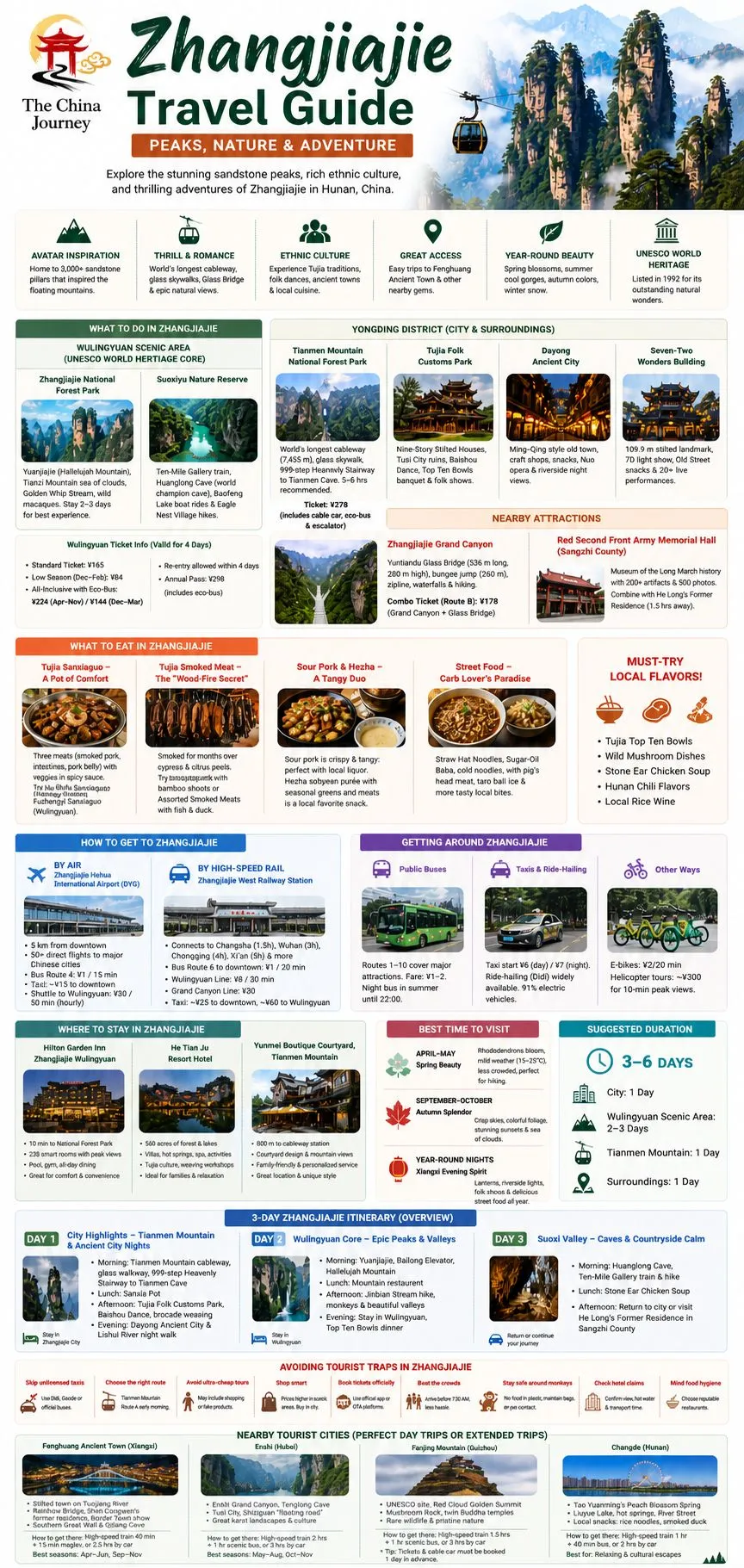
Nestled in the heart of the Wuling Mountains in northwest Hunan, Zhangjiajie City spans Yongding District, Wulingyuan District, Cili County, and Sangzhi County, shining like a jewel of western Hunan. Serving as the gateway to Xiangxi, it links the sandstone peak forest wonderland of Wulingyuan with the lively riverside streets of the Lishui River, and connects to nearby cultural landmarks like Fenghuang Ancient Town and Furong Town.

Famous for its breathtaking “sea of peaks” and rich ethnic heritage, Zhangjiajie is home to over 20 ethnic groups, including the Tujia, Miao, and Bai. Here, stilted wooden houses, the rhythm of the Baishou Dance, and the soulful Crying Marriage Song weave together a vivid cultural tapestry. Both a masterpiece of nature and a living museum of folk traditions, Zhangjiajie is an unmissable first stop for exploring northwest Hunan and the wider Xiangxi region.
See the world’s only quartz sandstone peak forest – Over 3,000 towering pillars in Wulingyuan, often shrouded in mist, inspired Avatar’s floating mountains.
Experience both thrill and romance – Ride the world’s longest cableway at Tianmen Mountain, walk the glass skywalk, cross the record-breaking Zhangjiajie Glass Bridge, or enjoy a peaceful boat ride on Baofeng Lake.
Immerse in Xiangxi’s ethnic culture – Taste Tujia “San Xia Guo” hotpot, watch Baishou and Maogusi dances, and hear the soulful Crying Marriage Song in traditional stilted houses and ancient towns.
Enjoy easy access to nearby highlights – From Zhangjiajie, reach Fenghuang Ancient Town or Furong Town within two hours for a perfect peaks + culture + river adventure combo.
Visit any season of the year – Spring blossoms, summer cool gorges, autumn colors, and winter snow make Zhangjiajie stunning year-round.
Explore a UNESCO World Natural Heritage Site – Listed in 1992 and praised as a “rare window into Earth’s evolution,” offering an awe-inspiring encounter with nature.
To see how Zhangjiajie compares with other top destinations nationwide, refer to Best Places & Cities to Visit in China.

The heart and soul of Wulingyuan, this park showcases the finest quartz sandstone peak forest landscapes. At Yuanjiajie, the world-famous “Hallelujah Mountain” (formerly the Southern Sky Column) rises from the mist, resembling the floating peaks in Avatar. Tianzi Mountain offers awe-inspiring sea-of-clouds views after rain, where thousands of stone pillars emerge like isolated islands. Golden Whip Stream, a crystal-clear waterway that flows year-round, winds through lush valleys where wild macaques roam—perfect for a refreshing morning hike. Eco-friendly shuttle buses connect major sites, and a 2–3 day stay is ideal for in-depth exploration. Consider staying in guesthouses at Yuanjiajie or Tianzi Mountain for crowd-free sunrise and sunset views.

Famed for its “symphony of mountains and waters,” this reserve is best explored on the Ten-Mile Gallery sightseeing train, passing rock formations like the “Herbalist” and “Three Sisters.” The vast Huanglong Cave, crowned “the world’s champion cave,” features a four-level labyrinth, a 1,700-meter underground river, and the 19.2-meter “Sea-Calming Needle” stalagmite—20,000 years in the making. Baofeng Lake, a 72-meter-deep alpine lake, mirrors the surrounding peaks; boat rides reveal filming spots for Journey to the West and lead to Eagle Nest Village’s cliffside trails for adventurers.
Standard Ticket: ¥165 per person (valid for 4 days; includes Zhangjiajie National Forest Park, Tianzi Mountain, Suoxiyu, and Yangjiajie).
Low Season (Dec–Feb): ¥84 per person.
All-Inclusive Ticket with Eco-Bus: ¥224 (Apr–Nov) / ¥144 (Dec–Mar), includes unlimited eco-bus rides within the 4-day validity.
Special Notes:
Re-entry allowed within 4 days.
Annual Pass: ¥298, includes eco-bus.

Only 8 km from downtown, Mount Tianmen is celebrated as the “First Sacred Mountain of Western Hunan.” Ride the world’s longest cableway—7,455 meters—soaring above clouds and the winding Lishui River, reaching the 1,518-meter summit in just 28 minutes. Once on top, brave the glass “Guigu Cliff Walkway,” with a 300-meter drop beneath your feet, or climb the 999-step “Heaven’s Ladder” to Tianmen Cave, where mist often drifts through in a phenomenon known as “Heaven’s Gate Breathing.” Highlights also include the dramatic Tongtian Avenue mountain road and the cliffside Tianmen Mountain Temple. Allow 5–6 hours for a full visit.
Ticket Price: ¥278 per person (includes round-trip cable car, eco-bus, and mountain escalator), valid for one day.
Included:
World’s longest cable car (7,455 m)
“Tongtian Avenue” eco-bus ride with 99 bends
Escalator through Tianmen Cave
Extra Charges:
Glass Skywalk shoe covers: ¥5
Tianmen Cave escalator: ¥32

A living showcase of Tujia heritage, this cultural park centers around the towering “Nine-Story Sky” stilted houses—architectural treasures of the Tujia people. By day, explore the Tusi City ruins and learn about the historic “Gaitu Guiliu” system of governance. By night, join the lively Baishou Dance bonfire party, feast on the Tujia “Top Ten Bowls” (smoked pork, hezha soup, duck blood with sticky rice, and more), and enjoy traditional performances like the Crying Marriage Song and Maogusi Dance for an immersive cultural experience.

This reconstructed old town revives the Ming–Qing era charm of the historic Dayong settlement. Cobblestone alleys lead to artisan shops selling silver jewelry and Xilankapu brocade. By day, sample Xiangxi snacks like sugar oil baba and mugwort rice cakes. By night, red lanterns illuminate the streets and reflect in the Lishui River, creating a magical backdrop for photography. At the corner stage, masked Nuo opera performances reveal the mysterious spiritual traditions of Western Hunan.

In downtown Zhangjiajie, this 109.9-meter stilt-style landmark holds the Guinness World Record as the tallest of its kind. Its central 38-meter arch frames the distant Tianmen Cave, creating a rare “double caves in sight” view. Inside, a 7D holographic show presents over 72 themed light effects, while Old Street offers regional snacks and heritage crafts. Over 20 live performances—from Tujia dances to 1930s Shanghai scenes—make it a vibrant evening destination.

Located 40 km from the city, the “Zhangjiajie Geopark Museum” is best known for the spectacular “Yuntian Du” Glass Bridge. Spanning 536 meters and suspended 280 meters above the gorge, this fully transparent bridge even features a 9D cracking effect—those afraid of heights may want to cling to the rails. Thrill-seekers can also try the world’s highest bungee jump (260 m) or a 300 m high-speed slide. Inside the canyon, waterfalls and pristine forest create a refreshing setting. Hike the “One-Line Sky” boardwalk and you might spot macaques or the rare giant salamander, making it a paradise for nature and adventure lovers.
Glass Bridge Combo (Route B): ¥178 per person (includes Grand Canyon + “Yuntiandu” Glass Bridge, advance booking required).
Standard Ticket (Route A): ¥119 (Grand Canyon only)
Glass Bridge Only: ¥100
Extra Activities:
Bungee Jump: ¥298
300 m Zipline: ¥60
Tip: Booking combo tickets via the official platform offers better value.

The only museum in China dedicated to the history of the Red Second Front Army’s Long March, this site houses over 200 precious artifacts and 500 historical photographs, vividly recreating the heroic journeys of He Long, Ren Bishi, and other revolutionary leaders who set out from Sangzhi. Life-size scenes like the “Muhuang Meeting” and “Xiangxi Campaign” bring history to life. Outside, a 21-meter monument stands like a battle flag, honoring the enduring revolutionary spirit. For a deeper connection, combine your visit with a trip to He Long’s Former Residence, 1.5 hours away, where you can see the marshal’s stilted wooden home and learn about the legendary “Two Kitchen Knives Uprising.”

Known as the “culinary signature” of Zhangjiajie, Sanxiaguo blends three types of meats—smoked pork, pork intestines, and pork belly—with vegetables like radish, tofu, and konjac, stir-fried in a tangy chili sauce before slow-braising. The result is a dry hotpot bursting with sour, spicy, and smoky notes. Try Hu Shifu Sanxiaguo (Railway Station branch), a 20-year-old favorite where wood-fired stoves impart irresistible aroma. For a milder, family-friendly version, head to Fuzhengyi Sanxiaguo (Wulingyuan), famous for its wild mushroom broth and adjustable spice levels.

Traditionally smoked for months over cypress branches and citrus peels, Tujia cured pork is firm, salty, and deeply fragrant. Laonongcun Tujia Cuisine serves a standout smoked pork with bamboo shoots, where tender spring shoots soak up the meat’s rich oils. For an indulgent feast, try Assorted Smoked Meats at Tujia Folk Park, combining pork, fish, and duck steamed with dried green beans—the scent alone fills the whole stilt house.

Sour pork is made by fermenting pork with glutinous rice flour and chili, then deep-frying until crispy outside and tangy inside—perfect with a shot of local corn liquor. At Zhaizili Bobocai, it’s stir-fried with jueba (sticky rice cakes) for an addictive sour-spicy chewiness.
Hezha, a humble soybean purée cooked with seasonal greens, surprises with depth when paired with meats and pickles. Tujia Shifu’s “Twelve-Flavor Hezha” blends ten ingredients—like smoked pork bits, shrimp, and wild chilies—into silky soy milk, earning its place as a “China Famous Snack.”

Straw Hat Noodles (Caomao Mian), a UNESCO-listed heritage dish, features springy alkaline noodles topped with minced pork sauce and pickled long beans. For the real deal, visit Xiong Zhide’s Noodles in Nanzhuangping, where queues start at 6 a.m.—pair with fresh soy milk for balance.
Don’t miss Sugar-Oil Baba, a chewy fried rice cake coated in sesame-studded syrup, best enjoyed at Dayong Ancient City. On hot days, order the local combo of cold noodles with pig’s head meat plus taro ball ice, blending heat-cutting spice with refreshing sweetness.
See also: What to Eat in Zhangjiajie
Zhangjiajie is reachable via air, rail, and road, with most travelers entering through regional transport hubs.
For a system-level overview of how to travel between cities and regions in China, see our China Transportation Guide.

Located just 5 km from downtown, this is Xiangxi’s main air hub with direct flights to over 50 Chinese cities, including Beijing, Shanghai, Guangzhou, and Chengdu. In 2024, a new Zhangjiajie–Bangkok route made it even easier for Southeast Asian travelers to arrive.
By Bus: Route 4 to the city center (¥1, 15 min, 6:00–20:30)
By Taxi: From ¥6 day rate / ¥7 night rate, about ¥15 to downtown
By Shuttle: Direct “Airport–Wulingyuan” line (¥30, 50 min, hourly 6:30–18:00)

About 10 km from downtown, this station on the Zhangjihuai HSR connects the city to:
Hunan: Changsha (1.5 hrs), Huaihua (1 hr) with 20+ daily trains
Other Cities: Wuhan (3 hrs), Chongqing (4 hrs), Xi’an (5 hrs) — Zhengzhou service launches in 2025
Transfers:
Bus Route 6 to downtown (¥1, 20 min, last bus 20:40)
Wulingyuan Line (¥8, 30 min, every 20 min 7:00–19:00)
Grand Canyon Line (¥30, every 20 min, 6:20–17:30 via Baofeng Lake & major stops)
Taxi: ~¥25 to downtown, ~¥60 to Wulingyuan
For a full overview of routes, tickets, and how high-speed rail works across China, see China’s High-Speed Rail (HSR).

The city’s 1–10 bus routes link major attractions for only ¥1–2. Route 10 circles key sites like the Tianmen Mountain Cableway, Tujia Folk Park, and popular local eateries. In summer, a night bus from Tianmen Mountain to Dayong Ancient City runs until 22:00. Nearly 90% of buses are electric, with USB charging ports and real-time stop announcements.
Taxis start at ¥6 (1.6 km) by day, ¥7 at night, with longer trips over 10 km charged at ¥3.2/km plus a 30% night surcharge. Use the “Xiangyiban” app to hail licensed taxis and check fares in advance. Ride-hailing services like Didi are widely available, with 91% of cars being eco-friendly electric vehicles.
Shared E-Bikes: 5,000 e-bikes available around hot spots like Tianmen Mountain and Dayong Ancient City (¥2/20 min)
Helicopter Tours: For a bird’s-eye view, try Tianmen Mountain or Wulingyuan flights — about ¥300 for a 10-minute aerial panorama of the peaks.

Opened in May 2025, this upscale Hilton brand blends international service with local Tujia-inspired design. Set in the heart of the Wulingyuan UNESCO area, it’s just a 10-minute drive from the National Forest Park entrance and close to Baofeng Lake and Huanglong Cave.
Highlights: All 238 smart rooms feature floor-to-ceiling windows with peak or cloud-sea views. The architecture combines stilt-house elements with modern courtyards, plus an outdoor pool, gym, and self-laundry.
Dining: The all-day restaurant serves local specialties like stone ear chicken soup and Cili rice noodles, while the lobby lounge offers mountain-view afternoon tea.
Why stay: Perfect for travelers who want reliable Hilton standards, scenic views, and concierge support for ticket bookings and custom itineraries.

A luxury eco-resort spanning 560 acres of forest and lakes, built to five-star standards and often named among “China’s Best Resort Hotels.” Located in Sangongsi Township, it’s a 15-minute shuttle ride from Wulingyuan but offers a peaceful natural escape.
Highlights: 357 villas and rooms set in lush hills, with a heated pool, forest hot springs, spa, and even a karting track and archery range for families and team events.
Cultural touch: Interiors feature Tujia brocade and batik; daily weaving workshops and “Top Ten Bowls” banquets recreate traditional wedding feasts, complete with homemade rice wine.
Why stay: Ideal for families, groups, or couples seeking privacy, rich cultural immersion, and nature-based relaxation.

A high-end boutique inn ranked No. 7 on Ctrip’s 2024 “Zhangjiajie Premium Hotels” list, famous for its Tianmen Mountain views and tailored service. Just 800 m from the cable car station, it’s walkable to the park entrance, Tujia Folk Customs Park, and Lishui River promenade.
Highlights: Courtyard architecture blends Huizhou white walls with Xiangxi wood carvings; rooms come with walnut furniture, premium audio, and some face directly toward the Tianmen Cave arch.
Family-friendly: Themed rooms with play tents, kids’ pool, crafts classes, and free ethnic costume rentals. Photography sessions are available for families or couples.
Why stay: A great pick for travelers who value personalized service, striking design, and easy access to Tianmen Mountain’s iconic sights.
See also: Where to Stay in Zhangjiajie
Zhangjiajie offers breathtaking scenery in every season, but spring (April–May) and autumn (September–October) are widely considered the most magical times to visit.

Spring brings mild temperatures (15–25°C) and fewer crowds than summer. Fresh mountain air carries the scent of blooming plants, making it perfect for hiking.
Nature’s Gift: Tianzi Mountain slopes and Yuanjiajie peaks burst into color as wild rhododendrons paint the grey sandstone cliffs in fiery red and soft pink. Jinbian Stream runs crystal-clear after spring rains, its banks lined with new willow leaves and playful monkeys.
Travel Perks: Shorter queues for eco-buses, serene sunrises at Laowuchang, and mist swirling around the Bailong Elevator create a dreamlike ascent into the clouds.

Autumn is cool, dry, and clear—ideal for photography and long days outdoors.
Autumn Splendor: The Ten-Mile Gallery in Suoxi Valley transforms into a painter’s palette with red maples, golden ginkgo, and the unchanging grey peaks. Tianzi Mountain’s “Emperor’s Brush” glows in sunset light, with occasional seas of clouds drifting through the valleys.
Evening Charm: Stroll the Lishui River promenade under glowing lanterns, enjoy the scent of barbecue and rice wine, and watch reflections of stilted houses ripple in the water. In Dayong Ancient City, lantern-lit streets, traditional opera, and street snacks create a perfect blend of culture and nightlife.

Regardless of season, Zhangjiajie’s evenings are worth savoring. In Dayong Ancient City, red lanterns sway above cobblestone lanes as craftsmen hammer silverware and weave brocade. Along the Lishui River, bridges light up in sync with music while the silhouette of Tianmen Mountain watches over the city.
For a country-wide seasonal comparison, see Best & Worst Time to Visit China.
Plan 3–6 days to explore Zhangjiajie at a comfortable pace:
City – 1 day
Wulingyuan Scenic Area – 2–3 days
Tianmen Mountain – 1 day
Surroundings – 1 day
To compare daily travel budgets across different Chinese cities, see Cost of Travel in China.

Focus: Conquer the “Gateway to Heaven” and experience Zhangjiajie’s vibrant night scene.
Morning – Tianmen Mountain National Forest Park
Getting there: 10-min taxi (~¥15) or Bus 4 direct to cable car station.
Highlights:
Ride the world’s longest passenger cableway (7.5 km, ~30 min) over the Lishui River and city skyline, often passing through drifting clouds.
Brave the west glass walkway (¥5 shoe cover) with sheer cliffs below and panoramic views all around.
Descend the 999-step Heavenly Stairway to the natural rock arch, Tianmen Cave, where sunlight or mist transforms the scene into a celestial spectacle.
Tip: Arrive before 7:30 am to skip the 10 am queues; tickets include cable car + eco-bus.
Lunch – Local Flavors
Try La Zao Tai Sanxia Pot for a hearty clay-pot mix of cured pork, pork intestine, and ribs, plus a side of pickled radish stir-fried pork. (~¥50/person).
Afternoon – Tujia Folk Customs Park (14:00–16:30)
Explore Nine-Story Diaojiaolou (largest stilted-house complex in Guinness World Records) and the historic Tusi City ruins.
At 15:00, join the Baishou Dance performance—visitors are welcome to dance along.
Bonus: Learn to weave Xilankapu (Tujia brocade) and take home your own mini creation.
Evening – Dayong Ancient City + Lishui River Walk
From 18:30, lanterns light up the ancient streets filled with silverware workshops, batik stores, and street food stalls selling haozi baba (mugwort cake) and tangyou baba (sweet fried glutinous rice).
From 20:30, stroll along the Lishui River Promenade to see stilted houses reflecting in the water with Tianmen Mountain’s silhouette in the distance.

Focus: Dive into the UNESCO World Heritage “Avatar Mountains.”
Morning – Yuanjiajie + Bailong Elevator (8:00–12:00)
Getting there: Tourist shuttle from city to Wulingyuan Entrance (~¥15, 1 hr), then eco-bus to the elevator.
Highlights:
Ride the Bailong Elevator (included in ticket) from the canyon floor to the mountaintop in 5 minutes, emerging face-to-face with the “Hallelujah Mountain.”
Hike to Mihun Tai (Enchanted Platform) and Qiankun Zhu (Sky Column) for sweeping views of the sandstone spires.
Lunch – Cliff-Side Dining
Enjoy Tujia cured-pork fried rice and kudzu noodles at a mountain-view restaurant (~¥30/person), or bring your own snacks.
Afternoon – Jinbian Stream Hike (13:30–16:30)
Eco-bus to the upper stream (Qianli Xianghui), then a 7.5 km gentle downhill walk to Shui Rao Si Men.
See crystal-clear waters, monkey families, and formations like “Split Mountain to Save Mother” and “Golden Whip Rock.”
Evening – Stay in Wulingyuan & “Top Ten Bowls” Dinner
Stay in a guesthouse near Xibu Street, ideally with a balcony view of the peaks.
Try a mini version of the Tujia Top Ten Bowls banquet (braised pork, sticky rice balls, sour fish) with local rice wine (~¥60/person).

Focus: Relax with karst caves and idyllic landscapes before departure.
Morning – Huanglong Cave + Ten-Mile Gallery (8:30–12:00)
Huanglong Cave: Boat ride along an underground river into the “Dragon Palace,” with illuminated stalactites like the Dragon King’s Throne and the insured 1-Billion-Yuan Golden Needle.
Ten-Mile Gallery: Scenic mini-train ride (¥38 one-way) past formations like the “Three Sisters” and “Medicine-Gathering Elder,” followed by a short hike for panoramic views.
Lunch – “Stone Ear” Chicken Soup
Try Shixi’er Stewed Chicken—a local delicacy using a rare wall-grown fungus—plus stir-fried kudzu greens (~¥50/person).
Afternoon – Departure or Extra Stop
Return via tourist bus to Zhangjiajie West Station (~1 hr) or Hehua Airport (~1.5 hrs).
If staying longer, visit Marshal He Long’s Former Residence in Sangzhi County (free entry) to explore revolutionary history.
Skip unlicensed taxis: Use Didi, Gaode, or official shuttle buses. Avoid “low-price rides” outside airports and stations.
Choose the right Tianmen Mountain route: Go for Route A (cable car up, bus down) early morning to avoid car-sickness and queues.
Avoid ultra-cheap tours: Many include forced shopping or fake “miracle medicine” sales. Book through licensed agencies only.
Shop smart: Prices for silver, jade, or local snacks inside scenic areas are often inflated. Buy from city supermarkets instead.
Book tickets officially: Use the “Zhangjiajie Yiji You” app or official OTA stores to avoid fake tickets.
Beat the crowds: Arrive at Tianmen Mountain or Bailong Elevator before 7:30 AM; hike Golden Whip Stream at midday to miss tour groups.
Stay safe around monkeys: Don’t carry food in plastic bags; avoid eye contact; seek help immediately if bitten or scratched.
Check hotel claims: Confirm view distance, hot water type, and transport time to scenic spots before booking.
Mind food hygiene: Choose reputable restaurants; avoid unpriced “wild vegetables” or raw dishes.
For broader, first-time travel advice beyond Zhangjiajie, see China Travel Tips: The Best Guide You Can Find.

Nestled along the Tuojiang River, Fenghuang blends stilted wooden houses, stone alleys, and the iconic Rainbow Bridge into a living watercolor painting. Explore Shen Congwen’s former residence, watch silver-ornament parades, and enjoy the live performance of Border Town. Don’t miss the Southern Great Wall and Qiliang Cave for a “mountain–water–town” landscape.
Getting there: High-speed train from Zhangjiajie West to Fenghuang (40 min) + 15 min maglev ride; 2.5 hours by car.
Best seasons: April–June (misty charm), September–November (crisp skies).

Home to breathtaking geological wonders, Enshi Grand Canyon features the 150 m “One Incense Stick” rock pillar and the cloud-filled Yunglong Rift. Tenglong Cave, Asia’s largest karst cave, hosts laser shows and Tujia dances. Experience Tusi City’s folk traditions or walk the “floating road” at Shiziguan.
Getting there: High-speed train to Enshi (2 hrs) + 1 hr scenic bus; 3 hrs by car.
Best seasons: May–August (cool hikes), October–November (autumn foliage).

A UNESCO World Natural Heritage site, Fanjing boasts the surreal Mushroom Rock, the twin Buddha temples on Red Cloud Golden Summit, and forests sheltering rare species like the Guizhou golden monkey.
Getting there: High-speed train to Tongren South (1.5 hrs) + 1 hr scenic bus; 3 hrs by car.
Tip: Tickets (RMB 100) and cable car (RMB 140 round trip) must be booked 1 day in advance via “Yima You Guizhou”.

Believed to be the setting of Tao Yuanming’s Peach Blossom Spring, Changde offers boat rides along Qin Creek through blooming landscapes. Stroll Liuyue Lake, relax in selenium-rich hot springs, or explore the nostalgic River Street for local snacks like Changde rice noodles and smoked duck.
Getting there: High-speed train to Changde (1 hr) + 40 min bus; 2 hrs by car.


The Year of the Rooster, the tenth sign in the Chinese zodiac, is represented by the Earthly Branch “You” (酉) and is associated with qualities such as honesty, vigilance, and good fortune.

A gentle and structured 2026 forecast for children born in 2023, covering learning, relationships, health, lucky elements, and emotional development guidance.

Macau ranks among the world’s top cities by GDP per capita (PPP), but whether it’s the “richest” depends on the metric and comparison set.

Explore Shenzhen, a city renowned for its technological innovation, rich cultural heritage, stunning landscapes, and exciting dining scene. Discover Shenzhen’s unique attractions and vibrant culture.

China is not fully cashless, but mobile payments dominate daily life. Apps like WeChat Pay and Alipay cover most transactions, while cash remains a backup for seniors, rural areas, and emergencies.

A gentle, structured 2026 forecast for children born in 2017, focusing on study progress, emotional balance, health, relationships, and practical guidance.

Share your travel ideas, and we’ll help you plan a smooth, personalized trip across China.

Share your travel ideas, and we’ll help you plan a smooth, personalized trip across China.
We’re looking for experienced, part-time local guides to serve international travelers.
Requirements:
• Fluent in at least one foreign language
• 3–5 years guiding international visitors
• Able to operate in multiple regions in China
• Competitive and reasonable pricing
• Proven customer reviews or testimonials
• Professional, reliable, and responsive
• Flexible availability for custom trips
Hi there!
Just a quick heads-up — a helpful user named Volker let me know that some of the non-English content on this site may not be accurate.
This site is a one-person project I run part-time. I research and publish all the content myself, and the translations are currently done by machine (Google Translate). Balancing accuracy and accessibility across multiple languages is a real challenge.
If you spot any errors, I recommend switching to the English version using the button at the bottom left. I’ll continue working to improve the translations over time.
I truly appreciate your understanding. And if you have any suggestions, feel free to leave a comment — it means a lot to me.
— Anthony 2025.6.18


