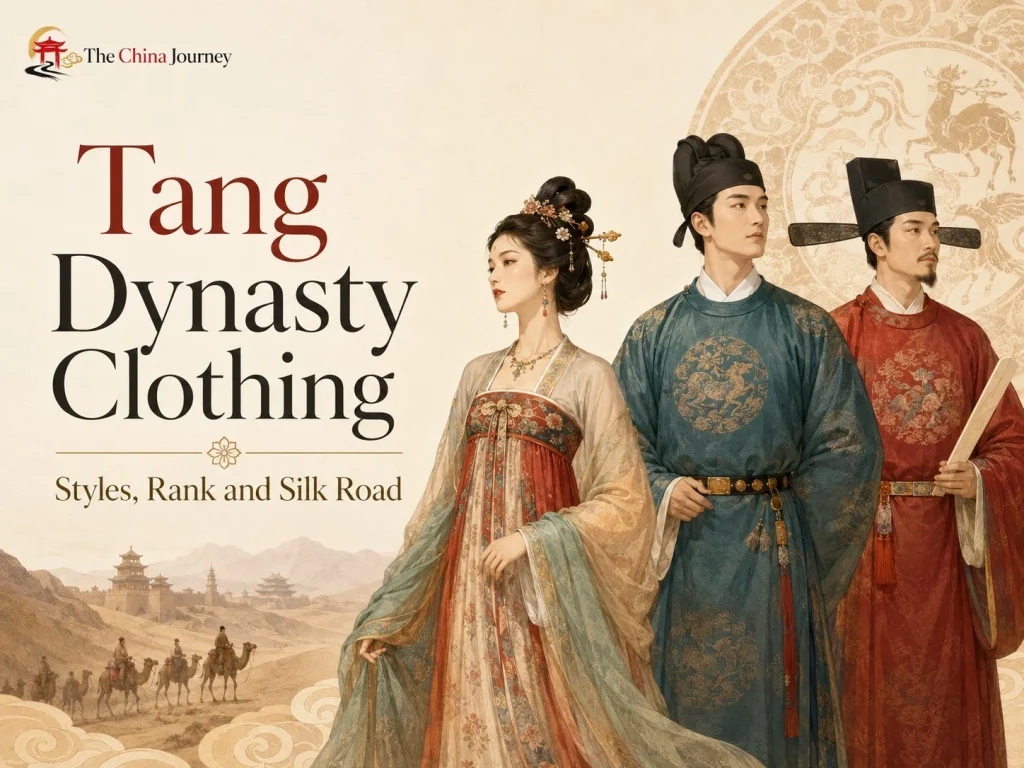
Explore Tang Dynasty clothing for women and men, official rank colors, silk fabrics, Silk Road influence, and how modern Hanfu differs.
Índice
Quick Answer: What Did People Wear in the Tang Dynasty?
Tang Dynasty clothing was not one fixed look. Between 618 and 907, dress changed with time, rank, gender, occupation, region and occasion. Women are often shown wearing a short upper garment with a long skirt, sometimes layered with a half-sleeved garment or a long silk stole. Men commonly wore round-collar robes, trousers, belts, boots and different forms of headwear. Officials also followed dress regulations that used robe colors and belt fittings to distinguish rank, although those rules changed during the dynasty.
Mulheres: Ru or shan upper garments with long qun skirts, plus optional banbi and pibo layers.
Materials: Silk and hemp-based textiles were central; wool and imported cotton textiles also appeared in more limited contexts.
Cultural character: Tang fashion combined established Chinese dress traditions with forms, materials and motifs connected to Central Asian, Sogdian, Turkic and Iranian networks.
The most recognizable surviving images include high-tied skirts, flowing silk stoles, round-collar robes and futou. None of these, however, should be treated as a uniform worn by everyone throughout all 289 years of Tang rule.
Modern television, costume exhibitions and commercial “Tang-style Hanfu” often reduce almost three centuries of dress to one formula: a chest-high skirt, a low neckline and enormous floating sleeves. The historical record is much less uniform. Early seventh-century tomb figures do not look exactly like eighth-century court images, and neither can automatically represent farmers, merchants or residents of distant frontier regions.
This article separates three kinds of evidence: excavated objects, official dress regulations and modern reconstructions. That distinction matters because a mural can show a silhouette without revealing its full pattern, while a legal text can describe what officials were expected to wear without proving that everyone followed the rule in daily life.
How Do We Know What Tang Dynasty Clothing Looked Like?
Tomb Murals, Figurines and Surviving Textiles
Tang tomb murals and painted earthenware figures preserve an unusually broad visual record. Murals associated with Princess Yongtai and Crown Prince Zhanghuai in Shaanxi show attendants, officials, riders and court settings. More than 270 Tang-period caves at Dunhuang contain images of donors, performers, religious figures and ordinary participants in ritual life. These sources help scholars compare collars, sleeve widths, skirt lines, headwear and the way garments were layered.
Images are not sewing patterns. An artist might simplify folds, enlarge a fashionable feature or use a visual convention appropriate to a tomb or Buddhist cave. Excavated textiles therefore provide a different kind of evidence. Finds from the Astana and Karakhoja cemeteries near Turfan are especially valuable because the dry environment preserved textile fragments, shoes and other organic materials. Surviving Tang silks in museum collections reveal weave structures, embroidery and motifs that painted figures cannot fully explain.
Written Dress Codes and Their Limits
A Old Book of Tang: o New Book of Tang e o Tang Huiyao record court dress, official colors, belts and restrictions on clothing. They are essential for understanding rank, but they describe rules rather than a complete wardrobe for every Tang subject. Local practice, wealth, occupation and access to trade all affected what people actually wore. The Tang fashion system also included imitation, gifts of higher-status dress and attempts to evade sumptuary rules.
Later paintings require similar care. A work traditionally attributed to a Tang artist may survive only as a later copy, and a modern museum display may combine archaeological research with contemporary tailoring decisions. It is safer to ask what each source can prove than to label every attractive reconstruction “authentic.”
Tang Dynasty Women’s Clothing
A modern museum reconstruction of a Tang-inspired high-tied skirt ensemble, not an excavated complete garment.
Ru, Shan and Long Skirts
A common women’s ensemble joined an upper garment to a long skirt. Ru (pinyin: rú; Chinese: 襦) generally refers to a shorter upper garment or jacket, while shan (pinyin: shān; Chinese: 衫) often refers to a lighter, unlined upper garment. Historical usage was not perfectly standardized, so “ru equals jacket” and “shan equals long blouse” should be treated as convenient translations rather than universal construction rules.
The lower garment was the qun (pinyin: qún; Chinese: 裙), a long skirt that could be made from multiple panels and tied at different heights. Tomb figures and paintings show skirts worn around the waist, above the waist and high on the torso. The height, fullness, fabric and color changed with fashion and circumstance.
Garment
Basic role
What the evidence can show
Principal cuidado
Ru 襦
Shorter upper garment
Collar, sleeve and layering in figures and murals
The term did not describe one fixed Tang pattern
Shan 衫
Usually a lighter upper garment
Changing necklines, sleeve widths and outer layers
Length and construction varied
Qun 裙
Long skirt
Waist height, fullness, stripes and color combinations
Paintings rarely reveal the entire fastening method
Were Chest-High Skirts Typical Tang Clothing?
High-tied skirts are supported by Tang visual evidence, but the modern label qixiong ruqun (pinyin: qíxiōng rúqún; Chinese: 齐胸襦裙) can suggest more certainty than the evidence allows. “Chest-high skirt ensemble” is a useful modern description; it is not a clearly established official Tang garment name.
Murals, figurines and transmitted paintings show women with skirts tied high on the torso, including figures connected with elite households. This proves that the silhouette existed. It does not establish one universal construction method or show how common it was among women whose clothing was rarely represented in elite tomb art. Modern one-piece and two-piece qixiong skirts are reconstructions, and their historical support is not identical.
Banbi, Pibo and Wide-Sleeved Outer Garments
A modern interpretation of banbi layering; its cut should not be treated as a surviving Tang pattern.
A banbi (pinyin: bànbì; Chinese: 半臂) was a short- or half-sleeved upper garment worn in several configurations. Tang sources and images connect it with women, men and court attendants. It could be layered over another upper garment, but surviving representations do not support one mandatory pairing with a chest-high skirt.
A pibo (pinyin: pībó; Chinese: 披帛) was a long stole or scarf draped over the shoulders and arms. It created the sweeping lines familiar from Tang art and was primarily decorative, although materials, length and draping varied. It should not be confused with a tailored jacket.
A modern wide-sleeved reconstruction. Not every broad-sleeved Tang garment was called daxiushan.
Wide-sleeved outer garments appear in formal and elite imagery, especially in later Tang visual culture. Daxiushan (pinyin: dàxiùshān; Chinese: 大袖衫) literally means a large-sleeved upper garment, but using it as a catch-all label for every broad sleeve erases differences in construction, status and occasion.
Women in Riding Dress and Hufu
Some Tang women are represented in fitted robes, trousers, boots and riding dress. These images are among the clearest signs that fashion at court and in major cities drew from several cultural traditions. Hufu (pinyin: húfú; Chinese: 胡服) means “Hu clothing,” but it was never one standardized outfit. The term could encompass forms associated with different northern and Central Asian communities.
Women riding horses, playing polo or serving elite households appear in tomb art wearing practical garments. These scenes show that women could adopt clothing associated with mobility and masculine dress. They do not prove that all Tang women dressed this way or that clothing alone measured women’s legal and social freedom.
Tang Dynasty Men’s Clothing
Modern Tang-style round-collar robes demonstrate the silhouette but include reconstruction choices.
Round-Collar Robes and Cross-Collar Garments
A yuanlingpao (pinyin: yuánlǐngpào; Chinese: 圆领袍), or round-collar robe, became one of the most recognizable forms of Tang men’s dress. Officials, attendants and other men appear in long round-collar robes secured with belts. Early examples often have relatively narrow sleeves and a close silhouette, while other representations show more generous proportions.
The form developed through centuries of interaction before and during the Tang. Calling it either purely “foreign” or purely unchanged Chinese tradition misses that history. Cross-collar, right-closing garments also continued in ritual, domestic and everyday contexts. Round collars did not replace every earlier form.
Trousers, Belts, Boots and Futou
A museum display comparing headwear forms; the rigid winged shape is more strongly associated with later periods.
Trousers and boots were useful for riding, military service, travel and work. They were widespread, but footwear and materials varied greatly: a court official, cavalryman and agricultural laborer did not share one standard boot.
Belts secured robes and could carry practical objects. For officials, the material and number of belt plaques also communicated rank. The futou (pinyin: fútóu; Chinese: 幞头) developed from a wrapped headcloth into increasingly structured forms. Its inner frame and projecting ties changed over time. The long, rigid horizontal “wings” familiar from Song official portraits should not be projected onto all Tang men.
Court Dress, Official Rank and Social Status
Imperial and Ceremonial Clothing
The emperor did not wear one “imperial robe” for every activity. Tang regulations distinguished major ritual dress, court dress, riding dress and regular wear. Mianfu (pinyin: miǎnfú; Chinese: 冕服) was part of the highest ritual system and combined a formal robe with a ceremonial crown. It belonged to sacrifices and major state rites rather than ordinary administration.
The familiar statement that “only the emperor could wear yellow” is too broad. The New Book of Tang records restrictions connected with the emperor’s ochre-yellow and red-yellow regular robes, yet it also records yellow and white garments for people outside the ranked bureaucracy in other contexts. Shade, garment type, date and legal category all matter.
Official Robe Colors and Belt Ornaments
Tang official dress was repeatedly revised. One later codified scheme recorded in the New Book of Tang assigned purple to third rank and above, deep and light scarlet to the fourth and fifth ranks, deep and light green to the sixth and seventh, and deep and light blue-green to the eighth and ninth. Belt plaques changed with rank as well.
Rank in the later recorded scheme
Robe color
Belt fittings
Important qualification
Third and above
Roxo
Gold and jade; thirteen plaques
Granted purple could allow exceptions
Fourth
Deep scarlet
Gold; eleven plaques
Earlier rules were not identical
Fifth
Light scarlet
Gold; ten plaques
Granted scarlet also existed
Sixth and seventh
Deep or light green
Silver; nine plaques
Shade distinguished the grades
Eighth and ninth
Deep or light blue-green
Brass-like alloy; eight plaques
Translations of qing vary
This table is not a timeless chart for 618–907. Earlier regulations differed, and emperors could grant purple or scarlet robes to officials whose formal grade did not normally qualify. A robe color in a painting is therefore evidence, not an automatic identification card.
What Did Commoners and Workers Wear?
Most surviving elite art tells us more about courts and tomb patrons than about farmers or workshop laborers. Written rules and scattered images suggest that practical short upper garments, robes, trousers and skirts were common, with hemp-based cloth and plainer silks serving different budgets and tasks.
“Nobles wore silk; commoners wore hemp” is still too simple. Silk existed in many grades and circulated as tax, payment and exchange. The New Book of Tang lists silk and cloth among materials available to unranked officials, commoners, dependents and servants while limiting status-specific colors and ornaments. Law, affordability and actual practice did not always align.
Fabrics, Colors and Decorative Motifs
A modern textile display inspired by historic motifs; surviving Tang textiles provide the firmer evidence.
Silk, Hemp, Wool and Cotton
Material
Uses and context
What not to assume
Seda
Robes, skirts, gauzes, compound twills, embroidery, tax and trade
Silk was not one uniformly luxurious fabric
Hemp and other bast fibers
Durable everyday cloth across several social levels
These fibers were not merely “poor-quality linen”
Wool
Cold-weather, military and trade-related textiles, especially in northern and western settings
Use was regionally uneven
Algodão
Known through imported and frontier textiles
It was not yet the empire-wide everyday staple it became later
For a broader explanation of fiber production and weaving, see our guide to seda chinesa.
Dyes, Weaving, Embroidery and Patterns
Tang textiles used complex silk weaves, gauze, embroidery, painting and several resist-dyeing methods. Many dyes came from plant materials, but “natural dye” does not mean Tang clothing was dull. Excavated textiles and written descriptions preserve strong reds, greens, blues, yellows and purples.
Popular designs included floral medallions, paired birds or animals, pearl roundels, lotus forms and composite “treasure flowers.” A late eighth- to early ninth-century floral-medallion textile at the Metropolitan Museum of Art uses a structured pattern linked to West and Central Asian artistic traditions. An early eighth-century embroidered silk with confronted birds combines a motif transmitted through Silk Road exchange with lotus forms rooted in Buddhist art. These were adapted designs, not simple copies.
How the Silk Road Influenced Tang Fashion
A modern illustration of Tang hufu; historical hufu covered multiple garments and cultural sources.
Central Asian, Sogdian, Turkic and Iranian Connections
Tang China was connected to communities across Inner Asia through trade, diplomacy, migration, warfare and entertainment. Chang’an hosted Sogdian merchants, Central Asian performers, envoys and residents from many backgrounds. Pointed caps, lapel-fronted robes, fitted sleeves, trousers, boots, decorated belts and roundel-patterned textiles appear within this connected world.
It is more accurate to name those networks than to call every non-Chinese-looking feature “Western.” Sogdian communities were important transmitters of Iranian and Central Asian visual culture. Turkic and other steppe societies shaped riding dress and military practice. Artisans in China also worked with imported models and materials.
Adaptation Rather Than Simple Copying
Tang wearers did not passively replace Chinese dress with foreign fashion. They combined new collars, motifs and accessories with existing robe systems, court rules and local production. The round-collar robe itself reflects a long process of exchange and localization that began before the Tang.
Fashion also did not turn inward overnight after the An Lushan Rebellion. Political conflict changed attitudes toward some foreign-associated styles, but people, objects and designs continued to move. The later Tang record shows shifting preferences, not a complete disappearance of cross-cultural dress.
How Tang Clothing Changed From Early to Late Tang
Transmitted paintings and museum reproductions are valuable but must be dated and compared with excavated evidence.
There is no single official fashion periodization, and a new style did not replace every older garment in one year. The following divisions are a practical way to compare broad visual tendencies.
Approximate period
Broad tendencies in surviving evidence
Principal cuidado
Early Tang, 618–712
Many relatively narrow silhouettes; strong continuities with Sui and northern-dynasty dress; fitted riding garments and high skirt lines appear
“Modest” is a modern value judgment, not a garment type
High Tang, 713–755
Greater variety in elite imagery; vivid textiles, fuller skirts, decorative stoles and cosmopolitan styles are prominent
Elite court images cannot represent the whole population
Middle and Late Tang, 756–907
Some elite images favor broader sleeves, fuller layering and changing proportions; official regulations and regional styles continue to evolve
There was no complete or uniform “return to conservatism”
Body ideals in art changed too. The fuller court figures familiar from later Tang-style painting belong to particular elite visual traditions. They should not be treated as proof that every woman was expected to share one body type or wardrobe.
Tang Dynasty Clothing vs Modern Tang-Style Hanfu
Modern Tang-style clothing can communicate a silhouette while still containing speculative construction.
Hanfu is now a useful umbrella term for historical and historically inspired clothing associated with Han Chinese traditions. Modern “Tang-style Hanfu,” however, is a reconstruction category. Tang people did not organize their wardrobes using today’s online-store labels.
Evidence-led reconstruction
Commercial or stage interpretation
Names a date, tomb, painting or surviving textile
Uses a general “Tang princess” or “Dunhuang fairy” theme
Explains where pattern pieces are certain or inferred
Presents modern fastenings and polyester drape as historical facts
Matches fabric, motif and layering to a documented context
Combines features from different centuries for visual effect
Labels modern safety or comfort changes
Calls every attractive reconstruction “authentic”
The garment marketed as hezi (pinyin: hēzǐ; Chinese: 诃子) requires particular caution. Later texts connect the name with stories about Yang Guifei, but no complete Tang garment establishes the familiar modern strapless, corset-like pattern. Modern hezi styling relies heavily on interpretations of paintings and later descriptions. It should not be presented as a proven Tang corset or a universal undergarment.
Where Can You See Tang Dynasty Clothing Today?
Reconstruction exhibitions are useful when labels identify the artifacts and assumptions behind each outfit.
Shaanxi History Museum: Tang pottery figures and a major collection of murals from more than 20 elite tombs. Use our Shaanxi travel guide e Guia de viagem de Xi'an for regional planning.
Dunhuang Mogao Caves: More than 270 Tang-period caves preserve clothing across religious, donor and performance scenes. Start with our Dunhuang travel guide.
Turfan collections: Materials from Astana and Karakhoja provide rare evidence for textiles and organic objects in the Tang-controlled western regions. See the Xinjiang travel guide.
International museums: The Metropolitan Museum of Art and Smithsonian collections include Tang textiles and figures, although many objects are not permanently displayed.
Textiles are light-sensitive and often rotate on and off view. Confirm the current exhibition before visiting a museum for one specific object.
Common Misconceptions About Tang Dynasty Clothing
Common claim
More accurate correction
All Tang women wore qixiong ruqun
High-tied skirts are documented, but their construction, period, setting and prevalence varied.
Low necklines prove that all Tang women were socially free
Elite fashion cannot by itself measure the legal or social position of every woman.
Every yellow garment was reserved for the emperor
Ochre-yellow and related imperial colors were regulated, but shade, date and garment category mattered.
Ordinary Tang people commonly wore cotton
Cotton textiles were known, but silk and hemp-based cloth were far more central across the empire.
Hezi was a standard Tang corset
The familiar modern form lacks a complete Tang archaeological model and relies on later interpretation.
Modern Tang-style Hanfu is identical to Tang clothing
Some garments are research-led reconstructions; others combine historical inspiration with modern design.
All Tang futou had rigid horizontal wings
Tang futou changed over time; the iconic long rigid wings are more characteristic of later official dress.
Conclusão
Tang Dynasty clothing was a changing fashion system, not one theatrical costume. Women’s upper garments and skirts, men’s round-collar robes, rank-marked official dress, diverse textiles and Silk Road motifs all changed across 289 years and across different communities.
The most reliable interpretation starts by identifying the evidence: an excavated textile, a dated mural, a tomb figure, a legal rule, a later painting or a modern reconstruction. Once those categories are kept separate, Tang dress becomes more interesting—not less—because it reveals negotiation among court hierarchy, craft, commerce, personal taste and cross-cultural exchange.
FAQs About Tang Dynasty Clothing
What Did Women Wear in the Tang Dynasty?
Women commonly combined a ru or shan upper garment with a long qun skirt. Depending on time, status and occasion, an ensemble could also include a banbi half-sleeved garment, a pibo stole or a wide-sleeved outer layer. High-tied skirts and riding dress are both documented, but neither represented every woman throughout the dynasty.
What Did Men Wear in the Tang Dynasty?
Round-collar robes were prominent in men’s official and everyday dress, often worn with a belt, trousers, boots or shoes and futou headwear. Cross-collar garments also remained in use. Materials, sleeve width, accessories and color depended on rank, occupation, occasion and period.
Is Qixiong Ruqun Historically Accurate?
The high-tied skirt silhouette is historically supported. “Qixiong ruqun” is a modern classification, however, and surviving evidence does not establish one universal Tang construction. Modern one-piece and two-piece versions therefore require separate evaluation rather than a single authenticity claim.
Did Clothing Colors Show Official Rank?
Yes. Tang regulations linked official robe colors and belt fittings with rank, but the system was revised. A later recorded scheme used purple, scarlet, green and blue-green across descending grades. Granted robes and other exceptions mean that color alone cannot always identify a figure’s formal rank.
How Did the Silk Road Affect Tang Clothing?
Connections with Sogdian, Turkic, Central Asian and Iranian communities influenced collars, fitted riding garments, boots, belts, hats, weaving and decorative motifs. Tang artisans and wearers adapted those elements to local production and social rules rather than simply copying one foreign fashion.
Is Modern Tang-Style Hanfu the Same as Historical Tang Clothing?
Not necessarily. Research-led reconstructions can closely follow a dated mural, figurine or textile, but exact pattern pieces are often partly inferred. Commercial and stage garments may combine several periods, use modern materials or alter fastenings for comfort and appearance.
Sou Anthony, fundador e editor do The China Journey. Crio guias práticos, baseados em experiências, sobre viagens, gastronomia e cultura na China, com foco em ajudar viajantes internacionais a tomar decisões de planejamento mais assertivas.
Descubra a melhor área para se hospedar em Jingdezhen para quem visita a cidade pela primeira vez, para quem quer explorar a cultura da cerâmica, passear pelo centro histórico, para quem busca acomodações com design diferenciado e para quem precisa fazer escalas rápidas de trem ou aeroporto.
Planeie a sua primeira viagem a Hunan com as melhores rotas, estações do ano, opções de cidades antigas, dicas de viagem e ideias de itinerários, de Zhangjiajie a Changsha.
Planeie 10 dias na China com um itinerário realista por Pequim, Xi’an e Xangai, incluindo transportes, hotéis, custos, reservas essenciais e alternativas de rota.
O Exército de Terracota foi destruído pelas forças rebeldes durante a queda de Qin e ainda mais danificado por incêndios, saques e decadência natural ao longo de 2.000 anos.
Uma previsão estruturada para 2026 para pessoas nascidas em 1985, abrangendo carreira, finanças, relacionamentos, saúde, fatores de sorte e orientações práticas para uma ascensão constante.
Descubra o significado zodiacal do Cão de Madeira de 1994 e as previsões para 2026, incluindo personalidade, carreira, riqueza, amor, saúde, elementos auspiciosos e conselhos práticos.
Planeie a sua viagem à China com os nossos especialistas
Partilhe as suas ideias de viagem e ajudaremos a planear uma viagem fluida e personalizada pela China.
Planeie a sua viagem à China com os nossos especialistas
Partilhe as suas ideias de viagem e ajudaremos a planear uma viagem fluida e personalizada pela China.
Trabalhe connosco como guia local na China
Procuramos guias locais experientes em regime parcial para acompanhar viajantes internacionais.
Requisitos:
• Fluência em pelo menos uma língua estrangeira • 3–5 anos de experiência a acompanhar visitantes internacionais • Capacidade para trabalhar em várias regiões da China • Preços competitivos e razoáveis • Avaliações ou testemunhos comprovados de clientes • Profissional, fiável e responsivo • Disponibilidade flexível para viagens personalizadas
Um aviso rápido: um utilizador prestável chamado Volker informou-me de que algum conteúdo deste site noutras línguas poderá não estar correto.
Este site é um projeto individual ao qual me dedico em tempo parcial. Investigo e publico todo o conteúdo sozinho, e as traduções são atualmente feitas por máquina (Google Translate). Equilibrar rigor e acessibilidade em várias línguas é um verdadeiro desafio.
Se encontrar erros, recomendo mudar para a versão inglesa através do botão no canto inferior esquerdo. Continuarei a melhorar as traduções ao longo do tempo.
Agradeço sinceramente a sua compreensão. Se tiver sugestões, deixe um comentário — será muito importante para mim.
Alguma destas situações lhe é familiar de viagens anteriores?
Preocupa-se com as barreiras linguísticas?
Tem dificuldades com bilhetes de comboio ou reservas de entrada?
Não tem a certeza sobre a cultura local e possíveis burlas?
Tem pouco tempo, mas quer ver os melhores destaques?
Há demasiados guias online e não sabe por onde começar?
Deixe os detalhes a cargo da nossa agência de viagens parceira de confiança.
👉 Receba um plano personalizado dentro do seu orçamento e aproveite o melhor da China sem stress.