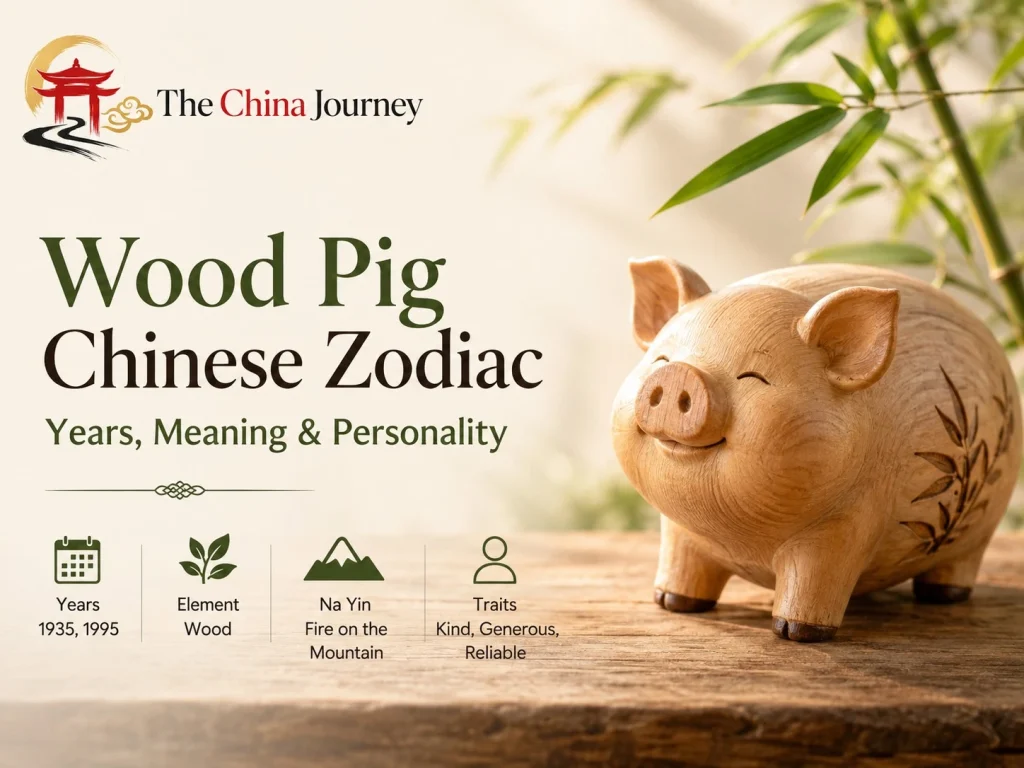

Quick Answer: What Is a Wood Pig?
A Wood Pig is someone born in a Yi-Hai (乙亥) year of the 60-year Gan-Zhi cycle. Recent Wood Pig years include 1935 and 1995, and the next will be 2055.
- Thiên can: Yi (乙) is Yin Wood and provides the “Wood” in Wood Pig.
- Nhánh đất: Hai (亥) represents the Pig and is associated with Water.
- Nạp Âm: The complete Yi-Hai pair is classified as Fire on the Mountain (山头火).
In traditional folk interpretation, Wood Pigs are associated with sincerity, generosity, cooperation, and consideration for others. Possible challenges include over-accommodating others or finding it difficult to set boundaries and say no. These are cultural associations, not fixed personality traits or scientific conclusions.
People researching the 1995 zodiac often meet three apparently conflicting labels: Wood Pig, a Water-based Pig branch and a Fire Na Yin. They are not competing answers. They come from three different classification layers within the broader 12 con giáp Trung Quốc and Five Elements tradition.
This article separates those layers, gives the exact Wood Pig birth-date ranges, and explains the traditional personality and compatibility symbolism without treating a birth year as a fixed personality test or a reliable forecast of life events.
Wood Pig Years and Exact Birth Dates
The Wood Pig returns every 60 years because the ten heavenly stems and twelve earthly branches combine into a repeating 60-pair Gan-Zhi cycle.[3] For the everyday Chinese zodiac convention, the animal year changes on Lunar New Year’s Day rather than January 1.
| Wood Pig cycle | Can chi | Lunar-year date range | Born before the start date |
|---|---|---|---|
| 1935 | Ất Hợi 乙亥 | February 4, 1935–January 23, 1936 | Mộc Tuất |
| 1995 | Ất Hợi 乙亥 | Ngày 31 tháng 1 năm 1995–18 tháng 2 năm 1996 | Mộc Tuất |
| 2055 | Ất Hợi 乙亥 | January 28, 2055–February 14, 2056 | Mộc Tuất |
These ranges follow the Gregorian–lunar conversion tables published by the Hong Kong Observatory.[1] They also correct a common problem in online zodiac pages: assigning everyone born in a Gregorian calendar year to the same animal. Someone born on January 20, 1995, for example, falls before the 1995 Lunar New Year and is a Wood Dog under the popular zodiac convention.
Two changeover rules are widely encountered:
- Lunar New Year: Used for the public zodiac, festival customs and ordinary birth-year identification. This is the rule used in the table above.
- Start of Spring: Often used by Four Pillars, or Ba Zi, practitioners to change the Gan-Zhi year at Li Chun, which normally falls around February 4.
Neither rule needs to be forced onto every context. The Hong Kong Observatory uses the first day of the first lunar month for its calendar-year changeover and notes that fortune-telling traditions may use the Start of Spring instead.[2] If your birthday falls between the two dates, state which convention you are using. The Chinese zodiac calculator can help with the public Lunar New Year convention.
What Does Wood Pig Mean in Chinese Astrology?
The Wood Pig is best understood through three separate labels: the heavenly stem element, the earthly branch element and the Na Yin of the complete stem-branch pair. Mixing them together is what produces most of the apparent contradiction.
Ất Mộc và chi Hợi
Yi-Hai combines Yi (乙), the second heavenly stem, with Hai (亥), the twelfth earthly branch. Yi is classified as Yin Wood. In traditional Wuxing, or Five Elements philosophy, Wood is associated with growth, responsiveness, continuity and the ability to develop around changing conditions. Yi Wood is commonly pictured as flexible vegetation rather than a rigid trunk, so its folk symbolism emphasizes tact, cooperation and gradual progress.
Hai is the branch represented by the Pig and is classified as Yin Water. Traditional branch theory also places Ren Water and Jia Wood among its hidden stems. Because Water generates Wood in the Five Elements productive cycle, the Yi-Hai pairing is often interpreted as an image of Wood receiving support from Water.
From that image, traditional interpreters associate the Wood Pig with empathy, trust and a preference for cooperation over confrontation. This is an interpretive metaphor, not a rule that can determine the temperament of everyone born in 1935 or 1995. A birth year also leaves out the month, day and hour pillars, as well as upbringing and lived experience. For the broader relationship between animal signs and year elements, see Chinese Zodiac Elements.
Why Is the Wood Pig’s Na Yin Fire on the Mountain?
Na Yin is a third classification system attached to complete Gan-Zhi pairs. Adjacent pairs share one Na Yin image: Jia-Xu and Yi-Hai are both assigned Fire on the Mountain (山头火). This mapping appears in the traditional Na Yin material collected in Tam minh tông hội.[4]
Fire on the Mountain evokes a fire visible across elevated ground or near the horizon. As traditional imagery, it is associated with visible influence, aspiration and expression whose strength depends partly on surrounding conditions. It does not mean that a Wood Pig should be renamed a Fire Pig. “Wood Pig” is determined by the Yi Wood stem and Hai Pig branch; Fire on the Mountain is a supplemental label for the complete pillar.
| Classification layer | Wood Pig value | What the label describes |
|---|---|---|
| Heavenly stem | Yi: Yin Wood | Source of “Wood” in Wood Pig |
| Earthly branch | Hai: Pig, Yin Water | Zodiac animal and the branch’s base element |
| Nạp Âm | Sơn Đầu Hỏa | Traditional image assigned to the complete Yi-Hai pair |
The three labels answer different questions, so Wood, Water and Fire can appear together without contradiction. A fuller explanation of the method and all 30 traditional names is available in Na Âm Ngũ Hành.
Wood Pig Personality Traits
The following traits belong to traditional zodiac interpretation. They describe symbolic tendencies, not characteristics that every Wood Pig must possess.
| Traditionally associated strength | Thách thức có thể gặp | Cơ sở biểu tượng |
|---|---|---|
| Sincere and trusting in relationships | May trust too quickly or overlook warning signs | The Pig represents openness, while Hai Water suggests receptiveness |
| Cooperative and attentive to other people | May take on other people’s responsibilities | Yi Wood favors adaptation and coordinated growth |
| Generous with time, attention or resources | May have trouble deciding where generosity should stop | Wood and Pig symbolism both emphasize support and goodwill |
| Patient with gradual progress | May delay a firm decision while seeking agreement | Yin Wood is flexible rather than forceful |
| Peace-seeking and reluctant to create unnecessary conflict | May suppress concerns until frustration accumulates | Hai Water and Yi Wood are interpreted as yielding, relationship-focused influences |
The central Wood Pig image is therefore not simply “kind.” It is kindness joined to persistence and social awareness. In a supportive setting, those qualities are traditionally read as reliability, steady cooperation and an ability to keep a group connected. Under pressure, the same flexibility may become indecision, over-accommodation or unclear boundaries.
This two-sided reading is more useful than treating strengths and weaknesses as unrelated lists. It also explains why descriptions of the general Năm con lợn overlap with Wood Pig traits but are not identical: the Pig supplies the animal symbolism, while Yi Wood changes the emphasis.
How the Five Pig Types Differ
Every Pig year has the Hai branch, but the heavenly stem changes. Over a 60-year cycle, this produces five element types. The element in each type name comes from the heavenly stem; its Na Yin is a separate classification and may belong to another element.
| Pig type | Năm ví dụ | Can chi | Nạp Âm | Traditional emphasis |
|---|---|---|---|---|
| Mộc Hợi | 1935, 1995 | Ất Hợi 乙亥 | Sơn Đầu Hỏa | Cooperation, empathy and gradual growth |
| Lợn Hỏa | 1947, 2007 | Ding-Hai 丁亥 | Ốc Thượng Thổ | Expression, warmth and decisive involvement |
| Lợn Thổ | 1959, 2019 | Ji-Hai 己亥 | Bình Địa Mộc | Practicality, steadiness and everyday responsibility |
| Lợn Kim | 1911, 1971 | Xin-Hai 辛亥 | Thoa Xuyến Kim | Clear standards, resolve and a stronger personal position |
| Lợn Thủy | 1923, 1983 | Gui-Hai 癸亥 | Đại Hải Thủy | Sensitivity, observation and adaptability |
No Pig type is traditionally “better” than another. The comparison only shows how the stem element changes the symbolic emphasis while the Pig branch remains Hai. It also prevents a frequent mapping error: the Wood Pig is Yi-Hai, not the 1959 or 2019 Ji-Hai Earth Pig, and its Na Yin is not Flatland Wood.
Wood Pig Love and Compatibility
Chinese zodiac compatibility is a traditional branch-relationship system, not a measurement of real-world relationship success. The patterns below are best read as cultural vocabulary for possible dynamics. The complete 12-sign framework is explained in the Bảng tương hợp 12 con giáp.
Phong cách quan hệ theo diễn giải truyền thống
In folk interpretation, Wood Pigs value sincerity, emotional security and a stable sense of mutual support. They are often described as willing to invest time and care in a relationship, notice a partner’s needs and prefer calm discussion to continuous confrontation. They may express affection through practical attention more readily than through dramatic displays.
The corresponding challenge is over-accommodation. A Wood Pig may avoid stating a disagreement because preserving harmony feels more urgent, or continue giving after a relationship has become unbalanced. Traditional advice therefore emphasizes communicating concerns early and treating personal boundaries as compatible with kindness rather than opposed to it.
Các con giáp hợp và khó hòa hợp theo truyền thống
| Con giáp | Quan hệ Địa chi theo truyền thống | Possible dynamic in folk interpretation |
|---|---|---|
| Hổ | Yin-Hai Liu-He, or Six Harmony | Directness and warmth are viewed as complementary; the pair may find mutual support easier |
| Thỏ và Dê | Members of the Hai-Mao-Wei San-He group | A gentler pace and attention to relationships may provide common ground |
| Rắn | Si-Hai clash | Different approaches to trust, privacy or decision-making may require clearer communication |
| Khỉ | Shen-Hai harm | Indirect misunderstandings or mismatched expectations are the traditional caution |
Harmony does not guarantee a happy partnership, and a clash or harm does not make a relationship unworkable. Compatibility based on one birth-year branch ignores both people’s complete charts, communication skills, values and circumstances. It should not be used to accept or reject a partner.
Phong cách làm việc, tiền bạc và ra quyết định
Traditional Wood Pig symbolism points toward a collaborative rather than combative working style. It favors steady projects, shared responsibility and environments where trust matters. A Wood Pig may be interpreted as the person who keeps a team connected, follows through on routine obligations and notices when another person needs support.
The same pattern has practical tensions. Maintaining harmony can turn into accepting tasks that belong to someone else. Seeking everyone’s agreement can slow decisions that require a clear personal position. Trust and generosity can also create financial vulnerability if they replace ordinary verification, written terms or a realistic budget.
These are general planning practices, not astrological remedies:
- Define responsibilities: Agree on ownership and deadlines instead of automatically absorbing unfinished work.
- Protect independent judgment: Allow time to evaluate a major decision before adapting it to other people’s preferences.
- Combine trust with verification: Check terms, costs and risks even when dealing with familiar people.
- Use a long-term plan: Build savings and make large financial commitments from evidence and affordability, not social pressure.
This page does not assign fixed “best careers” to Wood Pigs or predict salary, promotion, investment return or business success. A birth year cannot establish qualifications, interests, risk tolerance or opportunity.
Wood Pig in 2027: A Brief Cultural Context
The year 2027 is Ding-Wei (丁未), a Dê Lửa năm.[1] Wei, represented by the Goat, belongs with Hai (Pig) and Mao (Rabbit) in the traditional three-harmony grouping. That relationship explains why some folk readings describe a Goat year as socially compatible with Pig symbolism.
It does not establish whether 2027 will be lucky or unlucky for an individual Wood Pig. A complete Four Pillars reading would consider the year, month, day and hour pillars, while real outcomes depend on circumstances and decisions that a zodiac label cannot capture. Year-specific material for people born in 1995 belongs on the separate 1995 Wood Pig forecast page rather than being duplicated here.
Kết luận
The Wood Pig is Yi-Hai: Yi supplies the Yin Wood element used in the name, Hai supplies the Pig branch and its Yin Water association, and the complete pair has the Na Yin Fire on the Mountain. These labels belong to three parallel traditional classifications, so they do not conflict.
Personality, compatibility and annual interpretations remain folk symbolism. To identify the sign accurately, begin with the exact birth date and state whether you are using Lunar New Year or the Start of Spring as the changeover.
FAQs About the Wood Pig
What Years Are Wood Pig Years?
Wood Pig years recur every 60 years. The relevant cycles are 1935, 1995 and 2055. Because the zodiac year does not begin on January 1, anyone born in January or February should check the exact Lunar New Year date.
Is 1995 a Wood Pig Year?
Yes. Under the public Lunar New Year convention, the 1995 Wood Pig year ran from January 31, 1995, through February 18, 1996. People born before January 31, 1995, were still in the preceding Wood Dog year.
Why Is the Wood Pig Associated With Water and Fire Too?
The three elements describe different layers. Wood comes from the Yi heavenly stem, Water is the base element of the Hai Pig branch, and Fire comes from the Yi-Hai Na Yin, Fire on the Mountain. None replaces the others.
What Is the Wood Pig’s Na Yin Element?
The Yi-Hai Wood Pig has the Na Yin Fire on the Mountain. Na Yin classifies a complete Gan-Zhi pair through a traditional image; it does not change the standard name Wood Pig.
Which Signs Are Most Compatible With the Wood Pig?
Traditional branch relationships favor the Tiger through Six Harmony and place the Pig with the Rabbit and Goat in a Three Harmony group. This is a folk compatibility model, not a reliable test of whether two people can maintain a relationship.
Is 2027 Lucky for a Wood Pig?
There is no supportable way to label 2027 lucky or unlucky from the birth-year animal alone. Traditional Four Pillars analysis uses more birth information, and real results cannot be predicted from the Wood Pig label.
Nguồn tham khảo
[1] Hong Kong Observatory. Gregorian–Lunar Calendar Conversion Tables
[2] Hong Kong Observatory. What Year Is It Today?
[3] Hong Kong Observatory (Đài Thiên văn Hồng Kông). Heavenly Stems and Earthly Branches (Thiên can và địa chi)
[4] Wikisource. San Ming Tong Hui, Volume One