
Earth, Fire, and Wood each describe a different part of the Earth Snake classification. Start with your full birth date, then see how the three labels fit the Snake zodiac sign and its folk readings.
Earth Snake Years and Exact Chinese Zodiac Dates
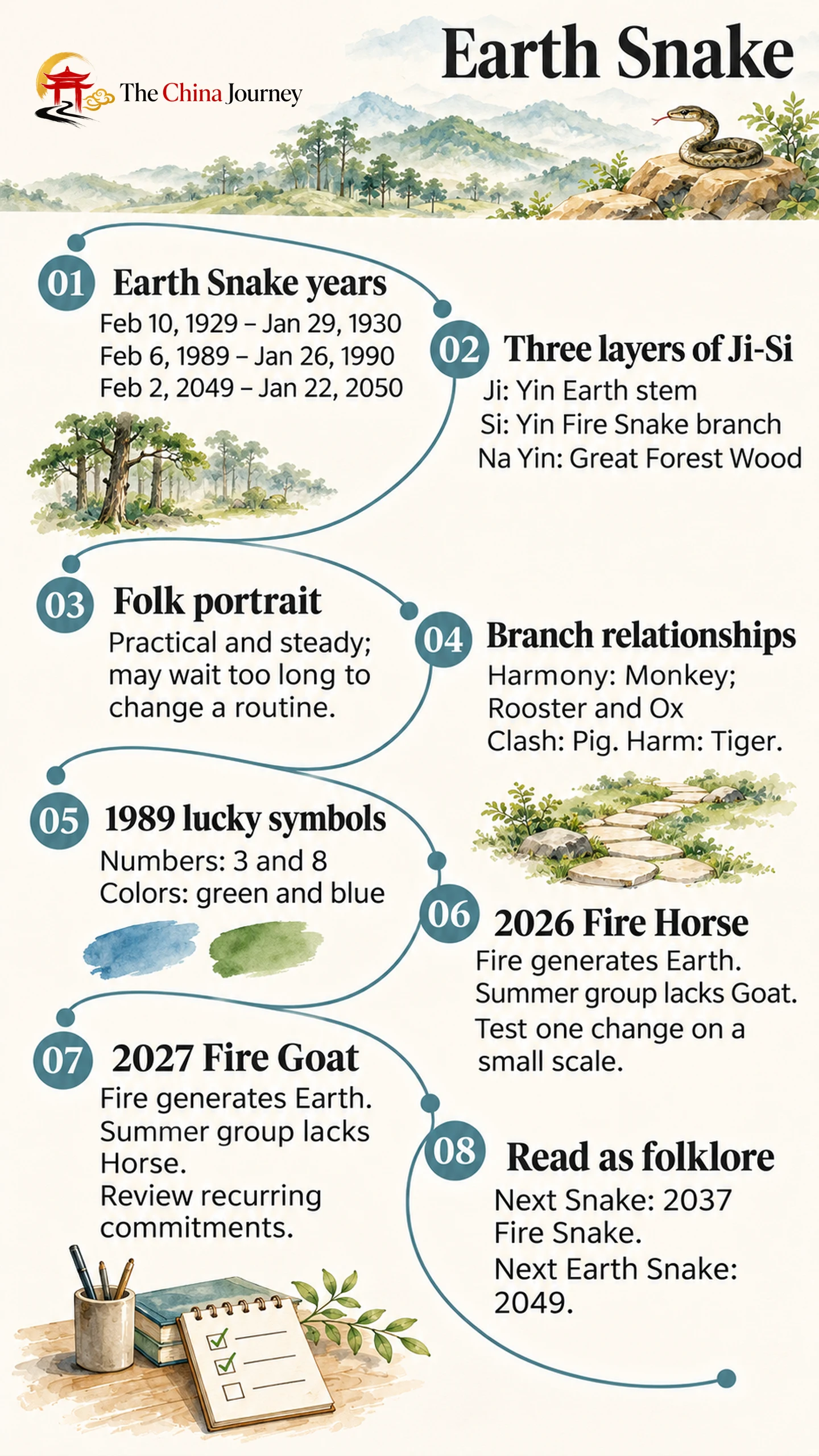
Each range begins on Lunar New Year and includes the last day shown.[1]
| Earth Snake year | First day | Last day |
|---|---|---|
| 1929 | February 10, 1929 | January 29, 1930 |
| 1989 | February 6, 1989 | January 26, 1990 |
| 2049 | February 2, 2049 | January 22, 2050 |
For example, someone born on February 5, 1989, is an Earth Dragon under this convention. Someone born on February 6, 1989, is an Earth Snake, as is someone born on January 26, 1990. The year printed on a birth certificate is only the starting point.
This guide uses the Lunar New Year convention explained in our Chinese lunar calendar guide. Some birth chart traditions switch the year at Start of Spring (立春, lìchūn), a solar term that can fall on a different date. For more on the 1989 cohort, see the 1989 Chinese zodiac guide.
Why Ji-Si Is the Earth Snake
| Layer | Ji-Si classification | What it tells you |
|---|---|---|
| Heavenly stem | Ji: Yin Earth | Why the sign is called Earth Snake |
| Earthly branch | Si: Yin Fire, Snake | Which animal the branch represents and the branch’s own element |
| Na Yin assignment | Great Forest Wood | The traditional image assigned to the full stem–branch pairing |
Ji and Si: Yin Earth and Yin Fire
Ji and Si are the two parts of one year label. The heavenly stem and earthly branch cycle pairs them once every 60 years. Ji supplies Earth, while Si supplies the Snake and retains its Fire classification.[2][3]
In the Five Elements (五行, wǔxíng) framework, Fire generates Earth. Traditional chart texts also list three hidden stems (藏干, cánggān) for Si: Bing (丙, Bǐng), Yang Fire; Geng (庚, Gēng), Yang Metal; and the Wu stem (戊, Wù), Yang Earth. This list describes the branch’s internal structure in that system. It leaves the branch’s main Yin Fire classification intact.[3][5]
Great Forest Wood: The Separate Na Yin Classification
The classical text San Ming Tong Hui groups Ji-Si with Wu-Chen (戊辰, Wù-Chén), the Earth Dragon, under Great Forest Wood. Its image is a forest of thick branches and leaves. Two years with different animals can share a Na Yin label because that system assigns one image to a pair of stem–branch combinations.[4]
Great Forest Wood describes the paired classification; it leaves Ji’s Earth and Si’s Fire in place. A Wood Snake is a different stem–branch pairing altogether. Reading Earth, Fire, and Wood as three votes for the strongest element misses what the labels are for.
Earth Snake Personality Traits in Traditional Folklore
Practical Judgment, Follow-Through, and Overcaution
The folk portrait of the Earth Snake emphasizes practical judgment and steady follow-through. It describes a character type in folklore, so readers with the same birth year may see themselves in different parts of it. A useful way to picture it is someone who watches how an arrangement works, makes one change at a time, and checks whether it helped. The same habit can keep an old routine going long after it stops serving its purpose.[6]
| Folk strength | Where it can get in the way |
|---|---|
| Checks what is feasible before committing | Waits for more certainty than the decision needs |
| Keeps track of the details that make a plan work | Keeps repairing a process that is ready to be replaced |
| Follows through on ordinary commitments | Quietly takes on work others could share |
| Prefers evidence from small tests | Dismisses a new option before trying it |
Work, Money, and Everyday Decisions
Consider a team that uses the same handover checklist every week. It worked when one person handled a task, but it now leads two people to repeat the same checks. Keep the steps that catch errors, give each check one owner, and try the revised list for a week. Then decide whether the change is worth keeping.
The same idea can help with an ordinary shared expense: look at how often it’s used, ask who still needs it, and agree on the next review date. These are examples of the portrait in action. A birth year cannot tell you what work to do or what you will earn.
How the Earth Snake Differs from Other Snake Types
All five types share the Snake branch. The stem changes from one Snake year to the next, so the animal returns after 12 years and the exact pairing after 60. The final column gives a folk reading of each type’s emphasis.[2][6]
| Snake type | Pairing | Folk emphasis |
|---|---|---|
| Wood Snake | Yi-Si (乙巳, Yǐ-Sì) | Cultivating skills and relationships over time |
| Fire Snake | Ding-Si (丁巳, Dīng-Sì) | Initiative, expression, and visible action |
| Earth Snake | Ji-Si (己巳, Jǐ-Sì) | Testing what works and maintaining dependable routines |
| Metal Snake | Xin-Si (辛巳, Xīn-Sì) | Clear standards, precision, and resolve |
| Water Snake | Gui-Si (癸巳, Guǐ-Sì) | Reading the situation and adapting the approach |
Earth Snake Compatibility and Relationships
The traditional zodiac compatibility system starts with the Snake branch. Great Forest Wood plays no role in the four branch categories below.[7]
| Traditional relation | Signs | What the classification records |
|---|---|---|
| Six Harmony (六合, liùhé) | Monkey | Snake and Monkey are a paired combination. |
| Three Harmony (三合, sānhé) | Rooster, Ox | Snake, Rooster, and Ox form the Metal trine. |
| Six Clashes (六冲, liùchōng) | Pig | Snake and Pig are opposite branches. |
| Six Harms (六害, liùhài) | Tiger | Snake and Tiger form one of the traditional harm pairs. |
The same signs can appear in more than one traditional framework. Monkey is listed here under Six Harmony because that is the relationship this table describes. These categories do not score a partnership. If you tend to show reliability by handling things quietly, try naming what you can take on and asking how the other person wants to share the rest.
Earth Snake Lucky Numbers and Colors
For the 1989 Earth Snake, the published folk list gives 3 and 8 as lucky numbers and green and blue as lucky colors.[8]
Use the numbers or colors as ideas for a gift or celebration. The list belongs to the 1989 entry and is offered as folklore.
Earth Snake Horoscope in 2026
The Bing-Wu (丙午, Bǐng-Wǔ) Fire Horse year runs from February 17, 2026, through February 5, 2027.[1]
Bing Fire, Ji Earth, and the Snake–Horse Relationship
Bing is Yang Fire and Ji is Yin Earth. In the traditional generating cycle, Fire feeds Earth. Bing and Ji are outside the five stem combinations (天干五合, tiāngān wǔhé). The relation supplies a symbolic theme, rather than a forecast that a project will succeed.[3][5][7]
Si and the Wu branch (午, Wǔ), which represents the Horse, are two members of the summer seasonal assembly (三会, sānhuì). The third is Wei (未, Wèi), the Goat branch. Snake and Horse alone do not complete that grouping or form any of the four direct relations in the compatibility table. The seasonal group is different from the Snake–Rooster–Ox trine.[7][9]
2026 Outlook at a Glance
The practical theme is to test one change without committing to a full overhaul.
| Area | Reflection prompt |
|---|---|
| Overall | Pick one routine you can test and set a date to review it. |
| Work or projects | Decide what would count as a successful trial before it starts. |
| Money | Confirm the cost and who will cover it before agreeing to a shared expense. |
| Relationships | Tell others what you’re trying and ask what they’d like to keep. |
| Wellbeing | Leave room in the schedule to review the trial without rushing. |
Earth Snake Horoscope in 2027
The Ding-Wei (丁未, Dīng-Wèi) Fire Goat year runs from February 6, 2027, through January 25, 2028.[1]
Ding Fire, Ji Earth, and the Snake–Goat Relationship
Ding (丁, Dīng) is Yin Fire. It has the same generating relation with Ji Earth as Bing does, with a different yin–yang classification. Ding and Ji do not form one of the five stem combinations. The Fire in Fire Goat comes from Ding; Wei itself is Yin Earth.[3][5][7]
Snake and Goat are both in the summer seasonal group, but the Horse branch is missing from this pairing. The two branches also form none of the four direct relationships listed in the compatibility table. Neither detail tells you how a particular agreement will turn out.[7][9]
2027 Outlook at a Glance
Look at what you already maintain and decide what deserves another year of effort.
| Area | Reflection prompt |
|---|---|
| Overall | Sort recurring commitments into keep, change, and stop. |
| Work or projects | Retire one step that duplicates work or no longer serves a purpose. |
| Money | Check whether a recurring shared cost still has an agreed purpose. |
| Relationships | Revisit the division of a responsibility that has gradually fallen to one person. |
| Wellbeing | Protect time that would otherwise fill up with routine obligations. |
2026 vs. 2027 Earth Snake Outlook
| Feature | 2026 Fire Horse | 2027 Fire Goat |
|---|---|---|
| Stems | Bing Yang Fire generates Ji Earth | Ding Yin Fire generates Ji Earth |
| Branches | Snake and Horse share the summer group; Goat is missing | Snake and Goat share the summer group; Horse is missing |
| Practical focus | Test one new arrangement on a small scale | Review ongoing commitments and keep the useful ones |
Both years use the same Fire-to-Earth idea. The distinction in the reflection prompts is between trying a change and reviewing what you already do.
How to Read Earth Snake Interpretations Responsibly
In Bazi (八字, bāzì), Ji-Si can be the year pillar (年柱, niánzhù), the stem and branch assigned to the birth year under the chart’s calendar convention. The full chart also uses the month, day, and hour pillars. The day stem identifies the Day Master, so Ji in the year pillar does not establish a person’s Day Master or show which element is strongest overall.[5]
The next Snake year is 2037, a Fire Snake year. The next Ji-Si Earth Snake year is 2049. Neither 2026 nor 2027 is a Ben Ming Nian (本命年, běnmìngnián), the return of the Snake animal year.[1][2]
FAQs About the Earth Snake Chinese Zodiac
What Years Are Earth Snake Years?
The Earth Snake years are 1929, 1989, and 2049. Ji-Si returns every 60 years. Use the exact Lunar New Year dates above if your birthday is in January or February.
Is Everyone Born in 1989 an Earth Snake?
No. From January 1 through February 5, 1989, the sign is Earth Dragon. The Earth Snake year begins on February 6, 1989, and ends on January 26, 1990.
Why Is the Earth Snake Associated with Wood?
Great Forest Wood is the Na Yin classification for the full Ji-Si pairing. Earth comes from the Ji stem, so the common sign name stays Earth Snake.
Which Signs Are Traditionally Compatible with the Earth Snake?
Monkey is the Snake’s Six Harmony partner. Rooster and Ox join Snake in the Three Harmony group. These are traditional branch relationships rather than predictions about people.
Is 2037 Another Earth Snake Year?
No. It is a Fire Snake year. The Snake animal returns every 12 years, but the Earth Snake pairing returns every 60 years. The next Earth Snake year is 2049.
Sources
[1] Hong Kong Observatory. Gregorian–Lunar Calendar Conversion Table
[2] Hong Kong Observatory. Heavenly Stems and Earthly Branches
[3] Emperor’s College. Fundamentals of Oriental Medicine Course Notes
[4] San Ming Tong Hui, Volume 1. Na Yin Classifications
[5] Yuan Hai Zi Ping. Stems, Branches, and the Five Elements
[6] TravelChinaGuide. Year of the Snake
[7] San Ming Tong Hui, Volume 2. Stem and Branch Relations
[8] TravelChinaGuide. 1989 Chinese Zodiac: Earth Snake
[9] San Ming Tong Hui. Seasonal Branch Groupings