Written by
Anthony

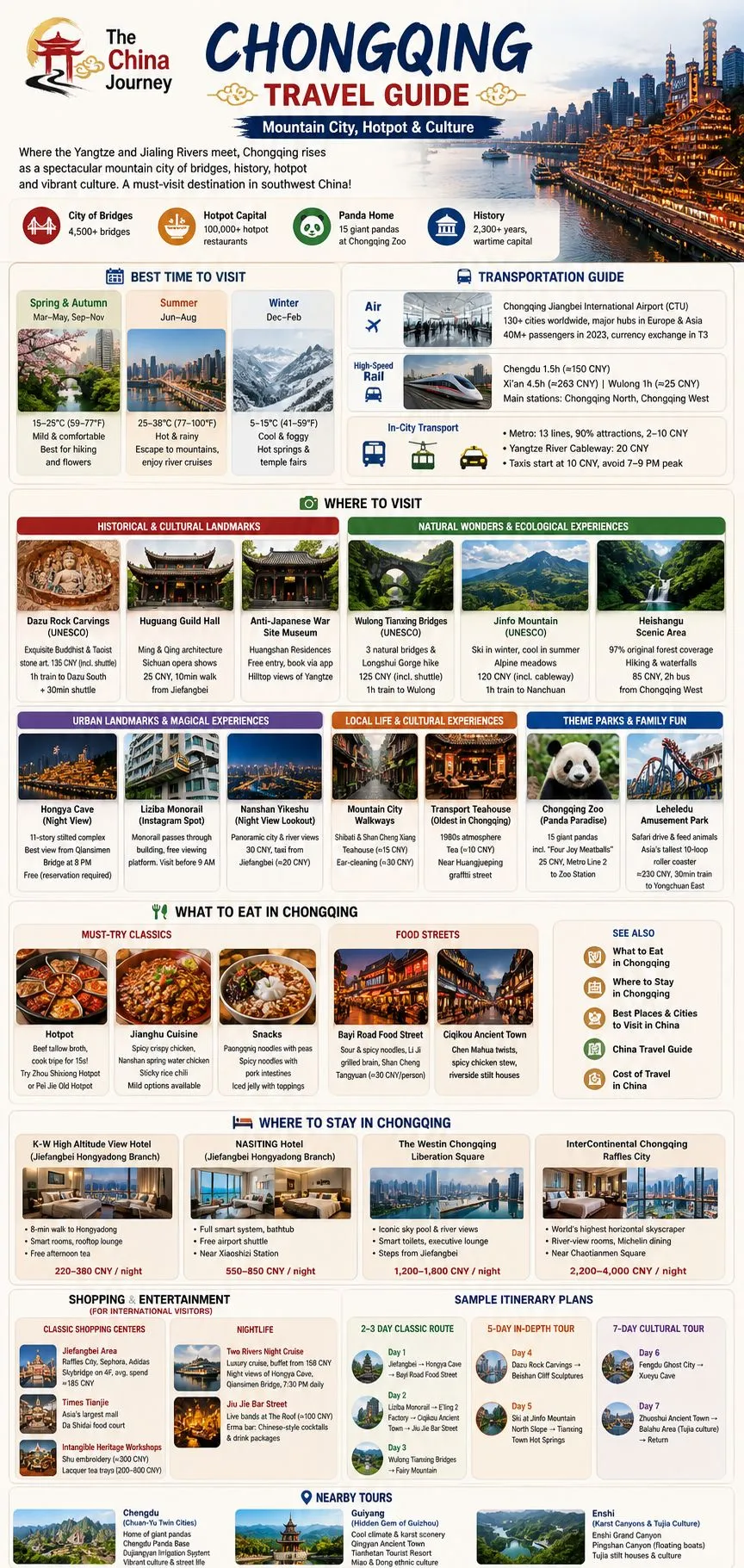
Welcome to Chongqing, a truly magical mountain city unlike any other! Nestled where the mighty Yangtze and Jialing Rivers meet, Chongqing is famous for its more than 4,500 bridges—earning it the nickname “City of Bridges.” Its dramatic 8D landscape creates jaw-dropping sights, like monorails weaving through buildings and escalators climbing steep hills.
With over 2,300 years of history, Chongqing is the birthplace of Bayu culture and played a crucial role as China’s wartime capital during World War II. You’ll find rich heritage everywhere—from the elegant Huangshan Residences to the historic Huguang Guild Hall.
Chongqing’s culture is just as exciting as its geography and history. Known worldwide as the “Hotpot Capital,” it boasts over 100,000 hotpot restaurants. It’s also the second home to giant pandas, with 15 adorable residents at Chongqing Zoo. The city perfectly blends cyberpunk vibes with lively street scenes, giving visitors a one-of-a-kind experience.
Choosing the right time to visit Chongqing can make your trip much more enjoyable. Here’s a quick guide to help you plan:
Spring and autumn are the best seasons to explore Chongqing. Temperatures are mild, ranging from 15 to 25°C (59–77°F), with comfortable humidity around 60%. This weather is perfect for hiking historic trails like the Huangge Ancient Path and enjoying beautiful flower displays, such as the cherry blossoms in Nanshan and the vibrant rapeseed flowers in Tongnan.
Summer in Chongqing can get hot, with temperatures soaring between 25 and 38°C (77–100°F). Frequent rainstorms help cool things down a bit. If you want to escape the heat, head to Fairy Mountain, where the average temperature stays around a refreshing 22°C (72°F). Don’t miss the magical Yangtze River evening cruises, which run about 40 times a day, offering cool breezes and stunning city views.
Winter brings cooler weather, with temperatures between 5 and 15°C (41–59°F). It’s generally dry but foggy, creating a mystical atmosphere. This season is ideal for relaxing in Tongjing Hot Springs and experiencing traditional cultural events like the Ci Qi Kou temple fairs.
For a broader, country-wide seasonal overview, see Best & Worst Time to Visit China.
Getting to and around Chongqing is simple and convenient with plenty of options for travelers.
For a system-level overview of how to travel between cities and regions in China, see our China Transportation Guide.
Chongqing Jiangbei International Airport (CTU) is your main gateway. It offers flights to over 130 cities worldwide, including major hubs like London, Paris, and Tokyo. In 2023, the airport served around 40 million passengers. If you need foreign currency, Terminal 3 has exchange services for US dollars and euros.
Chongqing is well connected by high-speed trains. You can reach nearby cities like:
Chengdu in just 1.5 hours (tickets around 150 CNY)
Xi’an in about 4.5 hours (around 263 CNY)
Wulong in 1 hour (approximately 25 CNY)
Main train stations include Chongqing North and Chongqing West, which serve as transport hubs for these routes.
Rail Transit: Chongqing’s metro has 13 lines covering 90% of popular attractions. Fares range from 2 to 10 CNY. For easy rides, download the “Chongqing Jiaoyuntong” app to scan QR codes at stations. Don’t miss the famous Liziba Station on Line 2, where trains pass right through a building — a favorite photo spot!
Dazu Rock Carvings (UNESCO World Heritage Site)
A must-visit for history lovers, the Dazu Rock Carvings showcase some of the finest Buddhist and Taoist stone art in China. Highlights include the Baodingshan cliff carvings, featuring the restored “Thousand-Armed Avalokitesvara,” and the Beishan carvings, which depict Taoist figures from the Tang to Song dynasties. Entry costs 135 CNY, which includes a shuttle bus service. You can reach Dazu by taking a 1-hour high-speed train from Chongqing North Station to Dazu South, followed by a 30-minute shuttle to the site.
Huguang Guild Hall
Step into the Ming and Qing dynasties at this historic guild hall, known for its beautiful yellow walls and black tiled roofs. The Yuwang Palace theater regularly hosts authentic Sichuan opera performances, offering a taste of traditional Chinese culture. Tickets are 25 CNY, and it’s just a 10-minute walk from the bustling Jiefangbei area. Many visitors combine this visit with a stroll through the nearby East Shuimen Old Street.
Chongqing Anti-Japanese War Site Museum (Huangshan Residences)
Explore this powerful historical museum featuring Chiang Kai-shek’s Yunxiu Building and Soong Mei-ling’s Song Hall. The museum offers free entry, but you need to book in advance through the “Chongqing Hongyan” app. Located on a hill overlooking the Yangtze River, the site also provides spectacular views along with its rich history.
Wulong Tiansheng Three Bridges (UNESCO Natural Heritage Site)
Famous as the filming location for the movie Curse of the Golden Flower, Wulong Tianxing Bridges offer stunning karst landscapes featuring three massive natural bridges: Qinglong Bridge, Heilong Bridge, and Tianlong Bridge. Adventurous visitors can hike the scenic Longshui Gorge trails surrounded by breathtaking cliffs and lush greenery. Tickets cost 125 CNY and include shuttle service. To get there, take a 1-hour high-speed train from Chongqing North Station to Wulong Station, followed by a 15-minute shuttle to the park entrance.
Jinfo Mountain (UNESCO Natural Heritage Site)
Jinfo Mountain is a year-round destination: enjoy skiing on the north slope during winter at Asia’s largest ski resort, and escape the summer heat on the cooler west slope, which averages about 22°C (72°F). The alpine meadows at Yaociba are perfect for camping and nature lovers. Entry is 120 CNY, including access to the cableway. It’s accessible via a 1-hour high-speed train ride to Nanchuan Station, then a 30-minute taxi to the mountain.
Heishangu National 5A Scenic Area
Known for its pristine forests with 97% original coverage and exceptionally high levels of negative oxygen ions (110,000 per cubic centimeter), Heishangu is a paradise for hikers and nature enthusiasts. Wander along the 13-kilometer riverside boardwalk, dotted with waterfalls and crystal-clear streams. Tickets cost 85 CNY. The site is a 2-hour bus ride from Chongqing West Station, making it an ideal day trip.
Hongya Cave (Night View Landmark)
One of Chongqing’s most iconic sights, Hongya Cave features an 11-story complex of stilted buildings beautifully lit at night, resembling the magical world from the movie Spirited Away. The best place to capture this breathtaking view is from Qiansimen Bridge, where the lights come alive at 8 PM. Entry is free but requires prior reservation through the Hongya Cave mini-program.
Liziba Monorail Passing Through Building (Instagram Spot)
A unique architectural wonder, the Line 2 monorail famously passes right through a residential building at Liziba Station. Visitors can enjoy this fascinating sight from a free viewing platform nearby. For the best photos and fewer crowds, plan your visit before 9 AM. Afterward, take a short walk to E’ling 2 Factory Creative Park, a trendy arts district converted from an old munitions factory.
Nanshan Yikeshu (Night View Lookout)
For stunning panoramic views of Chongqing’s Yuzhong Peninsula and the confluence of the Yangtze and Jialing Rivers, visit Nanshan Yikeshu. The lookout offers sweeping cityscapes, especially magical at night. Entrance costs 30 CNY, and it’s easiest to reach by taxi from the Jiefangbei area, usually around 20 CNY.
Mountain City Walkways
Step off the beaten path and wander through Shibati and Shan Cheng Xiang, two historic neighborhoods with charming cobblestone streets, traditional stilt houses, and even old air raid shelters. Along the way, stop at local teahouses to enjoy a cup of authentic Chongqing tea for about 15 CNY. For a truly unique experience, try the traditional ear-cleaning folk craft, offered nearby for around 30 CNY.
Transport Teahouse (Oldest in Chongqing)
Travel back in time at this beloved teahouse that preserves the atmosphere of the 1980s. With classic bamboo chairs, a tiger stove, and freshly brewed tea, it’s a cozy spot favored by locals. A visit here costs roughly 10 CNY per person. Afterward, explore the nearby Huangjueping graffiti street, a colorful alley perfect for photos and soaking in Chongqing’s modern street art scene.
Chongqing Zoo (Panda Paradise)
If you’re traveling with family or simply love animals, a visit to Chongqing Zoo is a must. It’s home to 15 giant pandas, including adorable cubs like the famous “Four Joy Meatballs.” Tickets are affordable at just 25 CNY. The zoo is easily accessible via Metro Line 2, stopping right at Zoo Station, making it a convenient and fun outing for all ages.
Leheledu Amusement Park
For thrills and wildlife combined, head to Leheledu Amusement Park. This unique park offers a safari experience where you can drive through and feed giraffes and lions yourself. Plus, it boasts Asia’s tallest 10-loop roller coaster for adrenaline junkies. Tickets cost around 230 CNY. Getting there is simple — just take a 30-minute high-speed train from Chongqing West Station to Yongchuan East Station.
To see how Chongqing compares with other destinations nationwide, refer to Best Places & Cities to Visit in China.
If Chongqing is part of a longer multi-city journey—especially across Southwest China—see the China Travel Guide for a structured overview of regions, routes, and travel styles nationwide.
Chongqing’s food scene is a delicious adventure filled with bold flavors and local favorites. Here are some must-try classics and the best places to find them.
Hotpot
No visit to Chongqing is complete without experiencing its famous hotpot. The rich beef tallow broth is perfect for cooking tender tripe—just 15 seconds is enough! For a great meal with English menus, try Zhou Shixiong Hotpot in Jiefangbei or Pei Jie Old Hotpot near Hongya Cave.
Jianghu Cuisine
Discover regional specialties like spicy crispy chicken from Gele Mountain and Nanshan spring water chicken, served with sticky rice chili. For visitors who prefer less heat, many places offer milder spice options.
Snacks
Be sure to sample Chongqing’s iconic street snacks like the savory Chongqing noodles with peas and pork, tangy and spicy noodles with pork intestines, and refreshing iced jelly topped with sticky rice or hawthorn fruit.
See also: What to Eat in Chongqing
Bayi Road Food Street
This lively street is famous for sour and spicy noodles, grilled brain at Li Ji, and sticky rice balls known as Shan Cheng Tangyuan. Expect to spend around 30 CNY per person for a satisfying local feast.
Ciqikou Ancient Town
Wander through this charming riverside town and taste crispy Chen Mahua fried dough twists and flavorful spicy chicken stew while enjoying the view of traditional stilt houses.
Chongqing offers a wide range of hotels to suit every traveler’s needs—from budget-friendly stays to luxurious experiences with stunning river views. Based on real traveler reviews from popular Chinese platforms, here are some top picks for each category.
K·W High Altitude View Hotel (Jiefangbei Hongyadong Branch)
Located just an 8-minute walk from the famous Hongyadong area and close to Xiaoshizi Metro Station, this hotel offers clean, comfortable rooms with smart controls and great city views. Enjoy free afternoon tea and relax at the rooftop lounge with stunning night views of Chongqing. Prices range from 220 to 380 CNY per night. Guests praise its excellent location and warm service.
NASITING Hotel (Jiefangbei Hongyadong Branch)
This stylish hotel features full smart systems, panoramic windows, and spacious rooms with private bathtubs. It also offers free airport shuttle service, making it convenient for travelers. Located near Xiaoshizi Station, it’s perfect for exploring the city’s top attractions. Prices range between 550 and 850 CNY per night, with guests highlighting the thoughtful service and breathtaking night views.
The Westin Chongqing Liberation Square
Just a short walk from Jiefangbei, this luxury hotel impresses with its iconic sky pool overlooking the rivers and elegant rooms equipped with smart toilets. The executive lounge provides a perfect spot to unwind after a day of sightseeing. Prices are between 1,200 and 1,800 CNY per night, and visitors rave about its ultimate luxury experience.
InterContinental Chongqing Raffles City
Experience world-class luxury in this architectural marvel, home to the world’s highest horizontal skyscraper. Located near Chaotianmen Square, the hotel features panoramic windows with breathtaking river views and Michelin-starred dining options. Prices range from 2,200 to 4,000 CNY per night. Guests consistently praise the flawless service and top-tier dining experiences.
See also: Where to Stay in Chongqing
Chongqing offers a vibrant mix of shopping experiences, unique souvenirs, and lively nightlife perfect for international travelers.
Jiefangbei Area
This bustling commercial district is home to Chongqing Raffles City, where you’ll find popular international brands like Sephora and Adidas. Don’t miss the famous skybridge on the 4th floor — a perfect spot for photos with panoramic city views. On average, shoppers spend around 185 CNY here.
Times Tianjie
As Asia’s largest single shopping complex, Times Tianjie boasts an extensive underground food court called Da Shidai, offering a wide range of local Chongqing delicacies. It’s a great place to explore both shopping and authentic eats under one roof.
Yuzhong District Intangible Heritage Workshops
Find exquisite handcrafted items such as Shu embroidery handkerchiefs priced around 300 CNY and elegant lacquer tea trays ranging from 200 to 800 CNY, perfect keepsakes of Chongqing’s rich cultural heritage.
Two Rivers Night Cruise
Experience Chongqing’s spectacular cityscape from the water aboard the luxurious “Golden Queen” cruise. Enjoy a buffet dinner starting at 158 CNY while marveling at illuminated landmarks like Hongya Cave and Qiansimen Bridge. The cruise departs daily at 7:30 PM.
Jiu Jie Bar Street
For a fun night out, visit Jiu Jie Bar Street, where live foreign bands perform at The Roof (entry around 100 CNY). You can also check out Erma, a trendy bar offering Chinese-style cocktails and special drinking packages for a unique local vibe.
Planning your trip to Chongqing? Here are some sample itineraries to help you make the most of your visit, whether you have a few days or a full week.
Day 1: Explore the vibrant Jiefangbei shopping district, enjoy the magical night views at Hongya Cave, then dive into a delicious hotpot dinner at Bayi Road Food Street.
Day 4: Immerse yourself in culture at the Dazu Rock Carvings, followed by a visit to the Beishan Cliff Sculptures for more ancient artistry.
Day 6: Discover the spooky allure of Fengdu Ghost City, then explore the stunning karst formations in Xueyu Cave.
To compare daily travel costs across China, see Cost of Travel in China.
Known as the hometown of giant pandas, Chengdu offers a blend of ancient culture and modern lifestyle. Visitors can explore the famous Chengdu Panda Breeding Research Base and the UNESCO World Heritage site Dujiangyan Irrigation System. The city also features vibrant local street life and trendy cultural scenes.
Guiyang is famous for its cool climate, stunning karst landscapes, and rich Miao and Dong ethnic heritage. Key attractions include the historic Qingyan Ancient Town and the scenic Tianhetan Tourist Resort, where visitors can enjoy waterfalls, caves, and local customs.
Enshi boasts breathtaking karst canyons and traditional Tujia stilt houses. Popular destinations include the spectacular Enshi Grand Canyon and the unique Pingshan Canyon with its floating boats. Visitors can experience authentic Tujia culture through performances and local cuisine.

Yes, Macau is part of China. It is a Special Administrative Region under the “one country, two systems” framework, with sovereignty belonging to China since 1999.

The first emperor of China was Qin Shi Huang (Ying Zheng), who unified the six warring states in 221 BCE and created the title “Huangdi” (Emperor), establishing the Qin Dynasty and China’s first centralized imperial regime.

Tsinghua University is one of China’s top institutions, renowned for its academic excellence, rich history, and commitment to fostering global talent in various fields.

Discover China’s Eight Great Ancient Capitals, including Xi’an, Beijing, and Luoyang, rich in history, cultural heritage, and iconic landmarks.

Daily spending in Beijing ranges from around ¥300 to over ¥1,500 (US$40–$210), depending on your travel style.

Find top Nanjing hotels with real local reviews. From budget to luxury, family, pet-friendly, river view, and historical stays near top attractions.
Share your travel ideas, and we’ll help you plan a smooth, personalized trip across China.
We’re looking for experienced, part-time local guides to serve international travelers.
Requirements:
• Fluent in at least one foreign language
• 3–5 years guiding international visitors
• Able to operate in multiple regions in China
• Competitive and reasonable pricing
• Proven customer reviews or testimonials
• Professional, reliable, and responsive
• Flexible availability for custom trips
Hi there!
Just a quick heads-up — a helpful user named Volker let me know that some of the non-English content on this site may not be accurate.
This site is a one-person project I run part-time. I research and publish all the content myself, and the translations are currently done by machine (Google Translate). Balancing accuracy and accessibility across multiple languages is a real challenge.
If you spot any errors, I recommend switching to the English version using the button at the bottom left. I’ll continue working to improve the translations over time.
I truly appreciate your understanding. And if you have any suggestions, feel free to leave a comment — it means a lot to me.
— Anthony 2025.6.18