
 Written by
Anthony
Written by
Anthony
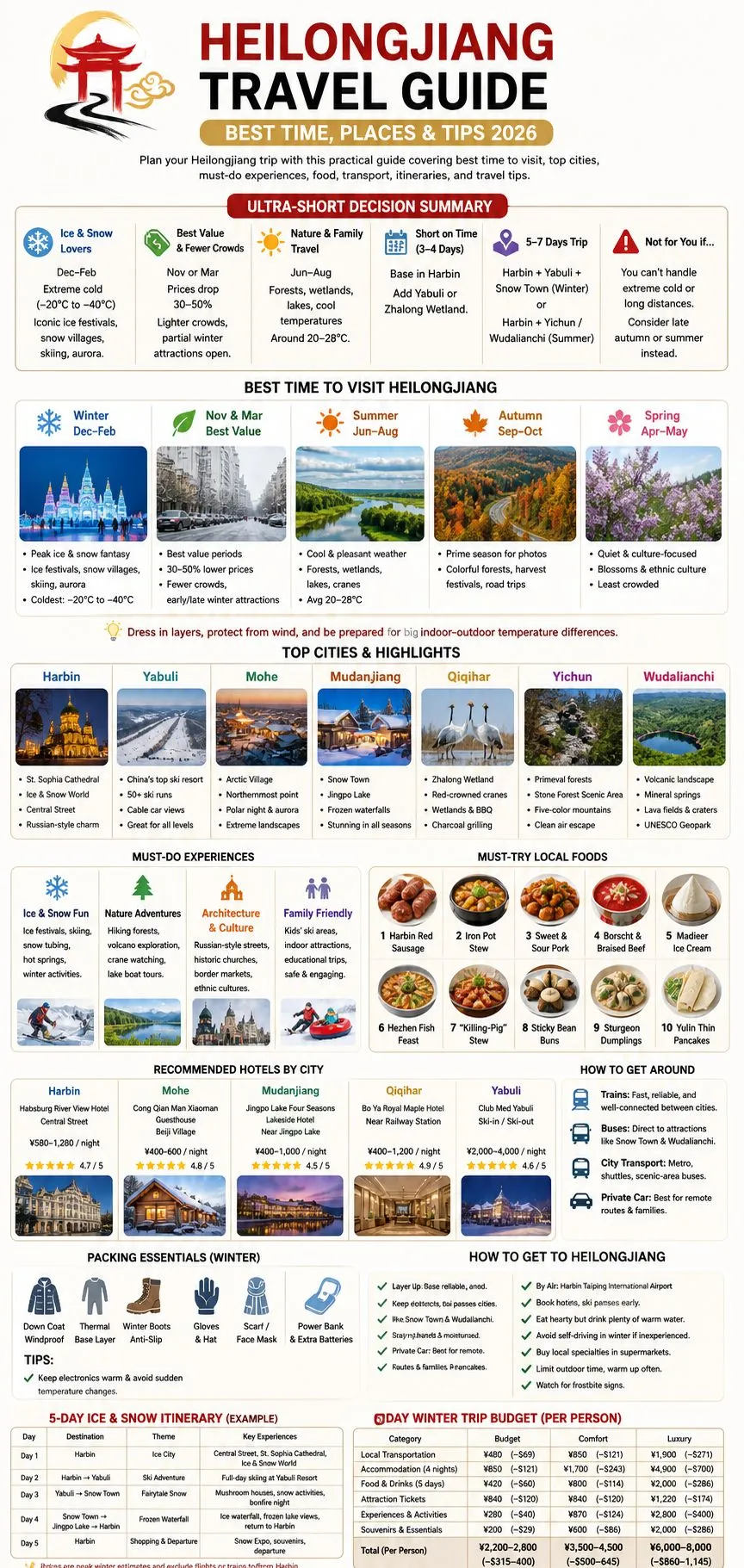
Planning a trip to Heilongjiang? Use this quick guide to decide—fast.
If you want ice festivals, snow villages, or skiing:
Visit December–February. Expect extreme cold (−20°C to −40°C) but Heilongjiang’s most iconic scenery.
If you want the best value and fewer crowds:
Choose November or March. Prices drop 30–50%, with lighter crowds and partial winter attractions still open.
If you prefer nature, mild weather, and family travel:
Visit June–August for forests, wetlands, lakes, and cool summer temperatures.
If you’re short on time (3–4 days):
Base yourself in Harbin and add Yabuli or Zhalong Wetland.
If you have 5–7 days:
Combine Harbin + Yabuli + Snow Town (winter) or Harbin + Yichun / Wudalianchi (summer).
If extreme cold or long distances aren’t for you:
Heilongjiang may feel challenging—consider late autumn or summer instead.
World-Class Ice & Snow Experiences
From the world’s largest ice-and-snow theme park to storybook snow villages and well-run ski resorts, Heilongjiang delivers winter scenery on a scale few places can match.
China’s Most Extreme Northern Landscapes
In Arctic Village (北极村), you can search for China’s northernmost marker, witness endless frozen rivers, and—on lucky nights—spot faint auroras dancing above the snow.
Distinct Russian-Style City Vibes
Harbin (哈尔滨) feels unlike any other Chinese city, with Byzantine-style churches, European boulevards, Russian bakeries, and a surprisingly relaxed pace.
Untouched Forests and Wetlands
From the primeval Korean pine forests of Yichun (伊春) to the red-crowned crane habitats at Zhalong Wetland (扎龙湿地), nature here feels vast, quiet, and refreshingly wild.
Borderland and Ethnic Cultures
Along the China–Russia border, you’ll encounter fishing traditions of the Hezhe people, the hunting heritage of the Oroqen, and daily life shaped by rivers, forests, and frontiers.
First-time visitors to Northeast China who want a well-rounded, no-regret itinerary
Snow lovers, aurora chasers, and winter photographers
Families traveling with children, especially for skiing, nature learning, and folk culture
Culture-focused travelers curious about ethnic minorities and border regions
Heilongjiang feels like a completely different destination in each season.
I’ve visited at multiple times of the year, and the experience changes dramatically depending on weather, crowd levels, and costs.
Instead of asking “What’s the best month?”, it’s more useful to choose based on what you want to experience.
Best time varies widely across China. For a nationwide comparison, see Best Time to Visit China.
Best for: first-time winter visitors, ice festivals, skiing lovers

Visit Harbin Ice and Snow World (哈尔滨冰雪大世界) at night, see the “snow mushroom” scenery in Snow Town, try skiing in Yabuli, and head north to Arctic Village for extreme northern landscapes and possible aurora sightings.
This is when Heilongjiang shows its most iconic side. Ice sculptures are at their largest and most elaborate, winter events are in full swing, and the entire region feels like a snow-covered fairytale.
Best for: budget-conscious travelers, repeat visitors

In November, you can catch the first snow and early ice displays. In March, some ice attractions remain open, and ski resorts often offer discounted passes.
Fewer tourists and 30–50% lower prices for hotels and attractions compared to peak winter make this the most cost-effective time to visit.
Best for: families, nature lovers, outdoor travelers

Hike through the primeval forests of Yichun, watch red-crowned cranes at Zhalong Wetland, boat on Jingpo Lake, and explore wetlands around Daqing (大庆).
With average temperatures around 20–28°C, Heilongjiang becomes one of China’s best summer escapes. It’s ideal for ecological travel and educational trips with kids.
Best for: photographers, road-trippers, scenery-focused travelers

Photograph the colorful “Five-Color Mountains” in Yichun and Mudanjiang (牡丹江), drive through the forests of the Greater Khingan Range (大兴安岭), and experience harvest festivals of local ethnic groups.
Red, gold, and green forests overlap in layers, making this the most visually striking season. Crowds are moderate, and travel feels relaxed.
Best for: slow travelers, culture explorers

See blooming azaleas in the Greater Khingan Range, join spring farming activities in Korean ethnic villages near Shangzhi (尚志), and explore city museums and historic neighborhoods.
This is the least crowded season, offering a calm, local feel and more opportunities to observe everyday life and folk traditions.
Heilongjiang’s weather can surprise even experienced winter travelers. Cold here isn’t just about numbers—it’s about wind, exposure, and preparation.
Dressing correctly often makes the difference between an unforgettable trip and a miserable one.
In winter, actual temperatures often drop to –20°C to –40°C. Add wind, and the feels-like temperature can be 5–10°C lower.
Cold + wind is a double hit. Wind strips heat from your body fast.
That’s why windproof clothing is more important than just wearing thick clothes. Without wind protection, cold air gets inside your layers and chills you to the bone.
Layering is the golden rule in Heilongjiang, especially since indoor heating is strong (often around 25°C) and you’ll constantly move between indoors and outdoors.

Base layer (stay dry):
Thermal underwear made of wool or synthetic fabric.
Avoid pure cotton—it absorbs sweat and makes you colder.
Mid layer (trap heat):
Fleece jackets, wool sweaters, or a light down vest.
A vest is especially practical because it keeps your core warm without restricting arm movement.
Outer layer (block wind & snow):
A long down coat (knee-length or longer) plus a windproof shell if needed.
The down keeps you warm; the outer layer keeps wind and snow out.
Spring & autumn: long sleeves + light jacket; add a windbreaker at night
Summer: T-shirts + sun-protective outer layer; long sleeves are useful in forests to prevent mosquito bites
Most cold-related problems come from feet, hands, ears, and face—and slipping on ice is a real risk.
Shoes: waterproof, high-ankle winter boots with deep tread; anti-slip spikes are strongly recommended in Snow Town and Mohe
Fit: choose boots slightly larger to allow thick socks
Socks: thick wool socks; two layers (thin inner + thick outer) work well
Walking tip: take short steps on ice, keep your center of gravity low, and avoid snow-covered edges.
Gloves: insulated, waterproof, touchscreen-compatible; for long outdoor time, use double layers
Hat: ear-covering “trapper-style” hat works best
Extras: scarf or face mask for cheeks and nose; sunglasses to reduce snow glare
Cold drains batteries fast and sudden temperature changes cause condensation.
Battery drains twice as fast in winter—carry a power bank
Keep your phone and power bank inside your coat, close to your body
Before entering a warm indoor space, seal your phone in a bag and wait 10 minutes before using it
Bring extra batteries and keep them warm in inner pockets
Use a protective cover outdoors
Seal the camera in a bag before going indoors; wait 30 minutes before opening
Thin gloves help you operate controls without freezing your fingers
Dress them slightly lighter than adults—kids sweat more
Change inner layers if they get damp
Limit long outdoor exposure; warm up indoors regularly
Helmets and proper supervision are essential for skiing and snow activities
Add an extra insulating layer, such as a down vest
Avoid heavy clothing that restricts movement
Rest indoors every 30 minutes in extreme cold
Use anti-slip canes if needed
Health note: If fingers or toes feel numb or turn purple, warm them slowly with lukewarm water (37–40°C). Do not rub aggressively. Seek medical help if symptoms persist.
Heilongjiang is far north, but getting there—and moving around once you arrive—is more straightforward than many travelers expect.
I’ve used all three main options (flying, trains, and road travel), and each works well depending on your route, budget, and travel style.
For a system-level overview of how to travel between cities and regions in China, see our China Transportation Guide.

Harbin Taiping International Airport (哈尔滨太平国际机场) is the main gateway to Heilongjiang.
International direct flights
Harbin connects directly with more than a dozen overseas cities, especially in Northeast Asia and Russia. Routes to Vladivostok, Khabarovsk, and Irkutsk operate frequently, and flights to Seoul are well served.
Domestic connections
If there’s no direct flight from your city, transferring via Beijing, Shanghai, or Guangzhou is efficient. Many airlines offer through-ticket services with short transfer times and staff assistance.

China’s rail network makes overland travel to Heilongjiang surprisingly smooth.
Beijing → Harbin:
High-speed trains on the Beijing–Harbin line reach Harbin in about 4.5 hours, with frequent departures throughout the day.
Shanghai → Harbin:
High-speed trains take around 12 hours, while overnight sleeper trains are a good option if you want to save on hotel nights.
Southern China (Guangzhou / Shenzhen):
Long-distance trains run daily, with travel times ranging from 23 to 34 hours, depending on train type.
If you plan to connect Heilongjiang with other regions, this China High-Speed Rail (HSR) guide explains routes, tickets, and booking tips.
Cross-province self-driving (within China)
Major highways like the Beijing–Harbin Expressway (G1) are well maintained. Charging stations are widely available, and many accept international credit cards.
Cross-border driving (China–Russia)
This is mainly suitable for organized group travel. Group tours may qualify for visa-free entry (up to 15 days).
Required documents include vehicle customs papers and notarized translations of driving licenses.
Common crossings include Manzhouli (individual and group access) and Hunchun (group only).
For most independent travelers, flying or trains are far simpler.

High-speed and conventional trains are the most reliable option for moving between major destinations.
Harbin → Yabuli West: about 70 minutes
Harbin → Mudanjiang: about 1.5 hours
Harbin → Jiamusi: about 2 hours
Jiagedaqi → Mohe: about 7.5 hours by regular train
Most stations are modern, heated, and easy to navigate. The official ticket app has an English version and supports international cards.
Buses are useful for reaching places without train stations.
Harbin → Snow Town:
Daily departures from the Central Street tourist hub; around 5 hours, direct to the scenic area.
Harbin → Wudalianchi:
Several daily services; good value and straightforward.
Mudanjiang → Jingpo Lake:
Frequent buses, especially during peak seasons.
Mohe → Arctic Village:
Short, frequent rides from Mohe bus station; easy even in winter.
Some cross-border bus routes also operate to Russia, with bilingual assistance.
In Harbin
Metro lines connect the airport, railway stations, and key areas. Payment via Alipay or WeChat is simple.
Ice and Snow Festival shuttle buses link Ice and Snow World, Sun Island, and Central Street, including night services.
Tourist service centers on Central Street offer luggage storage and multilingual help.
Inside Scenic Areas
Snow Town: free internal shuttle buses reduce outdoor walking
Yabuli Ski Resort: hotel shuttle buses are common
Arctic Village: sightseeing buses link major points, useful in extreme cold
For places with limited public transport, hiring a car with a local driver is often the best choice.
Recommended routes:
Arctic Village to Beihong Village, Yichun forest parks, Jingpo Lake side routes
What to check:
Snow tires, insurance coverage, and winter driving experience
Cost reference:
Harbin → Snow Town: roughly 300–500 RMB per car
Mohe day tours: around 600–800 RMB per day
Heilongjiang is vast, and its cities feel very different from each other.
To help you plan efficiently, I’ll break things down city by city, starting with the place most travelers visit first—and often remember the longest.
Russian-style architecture, ice-and-snow spectacles, and the soul of Heilongjiang

Harbin is the gateway to Heilongjiang and the city that best defines its character. With strong Russian influence, iconic winter festivals, and walkable historic streets, it’s both visually striking and easy for first-time visitors.

Harbin’s most iconic landmark, this former Russian Orthodox church features a green dome, red brick walls, and a grand square that feels especially magical in winter. Snow-covered mornings and illuminated nights offer very different—but equally photogenic—scenes.
Ticket: Square free; interior ¥15; Music and Art Exhibition (Tuesday to Thursday) ¥25
Opening hours: 8:30–20:45
Best time to visit: Winter mornings for snow scenes; evenings for lights
Rating: ⭐⭐⭐⭐⭐ (4.7/5)

The world’s largest ice-and-snow theme park, built each winter using massive ice blocks carved into castles, towers, and slides. Once the lights turn on, the entire park glows in shifting colors, creating a true winter fantasy.
Ticket: Adult ¥328; child ¥240
Opening period: Mid-Dec to late Feb (exact dates vary yearly)
Opening hours: 11:00–21:30
Best time to visit: 19:00–21:00
Rating: ⭐⭐⭐⭐½ (4.6/5)

Asia’s longest pedestrian street, paved with century-old stone blocks and lined with Byzantine and Baroque-style buildings. It’s the easiest place to experience Harbin’s European feel while sampling local snacks and Russian-influenced food.
Ticket: Free
Opening hours: 24 hours (shops usually 10:00–21:00)
Best time to visit: Any season; evenings are especially pleasant
Rating: ⭐⭐⭐⭐⭐ (4.8/5)
China’s top ski destination with terrain for every level

Yabuli is the heart of Heilongjiang’s winter sports scene and the most developed ski area in Northeast China. With large-scale infrastructure, reliable snow quality, and convenient rail access, it works well for both first-time skiers and experienced riders.

Yabuli is China’s premier ski resort, featuring more than 50 ski runs with a total length of 88.8 km. The interconnected mountains—Daguokui, Erguokui, and Sanguokui—offer terrain ranging from beginner slopes to challenging advanced runs. The 2025–2026 season also introduces more family-friendly snow activities, making it suitable beyond hardcore skiing.
Ticket:
Resort entry free;
ski pass (3 hours): ¥118 on Trip.com (includes skis, boots, and poles)
Opening hours: 8:30–17:00
Best time to ski: 9:00–11:00 and 13:30–15:30
Rating: ⭐⭐⭐⭐⭐ (4.7/5)
China’s far north, extreme landscapes, and a true edge-of-the-map experience

Mohe sits deep in the Greater Khingan Range and feels completely removed from urban China. This is where travelers come to experience China’s northernmost extremes—from polar nights and deep winter cold to endless summer daylight.

Often called China’s northernmost village, Arctic Village is famous for its symbolic landmarks and raw northern scenery. Visitors come to check off geographic milestones, explore frozen river landscapes, and—on rare winter nights—try their luck spotting the aurora.
Ticket: ¥88
Opening hours: Open all day
Best time to visit:
Dec–Feb: aurora chances and extreme winter experiences
Jun–Aug: cool weather and near-midnight daylight
Rating: ⭐⭐⭐⭐½ (4.5/5)
Storybook snow villages and volcanic lake landscapes

Mudanjiang is one of the most visually striking regions in Heilongjiang. It’s where classic winter imagery meets dramatic volcanic scenery, making it especially appealing for travelers who want iconic photos and strong seasonal contrast.

Snow Town is famous for its thick, fluffy snow that naturally forms “snow mushroom” shapes on rooftops and fences. Wooden houses, red lanterns, and forest surroundings create a scene that feels straight out of a winter fairytale.
Ticket: ¥140 (Nov–Apr); optional shuttle ¥15
Opening time: All day
Best time to visit:
5:00–7:00: clean, untouched morning snow
18:00–20:00: lantern-lit night scenes
Rating: ⭐⭐⭐⭐½ (4.6/5)

China’s largest volcanic barrier lake, Jingpo Lake offers two completely different experiences depending on the season. In winter, the Diaoshuilou Waterfall freezes into a towering ice wall; in summer, the lake turns calm and cool, ideal for boat trips.
Ticket: ¥100
Opening hours: 6:00–17:30; 18:40-21:00
Wetland landscapes, migratory birds, and China’s crane capital

Qiqihar is best known for its vast wetlands and birdlife. It’s a slower, quieter destination compared with Harbin or Mudanjiang, but for nature lovers and photographers, it offers one of the most emotionally striking wildlife experiences in Northeast China.

Zhalong is the world’s largest habitat for red-crowned cranes, set within an expansive wetland of reeds, lakes, and open sky. The highlight is the scheduled crane rewilding flights, when groups of cranes take off and glide low over the marshes—a rare and powerful sight.
Ticket: ¥75 (electric shuttle included)
Opening hours:
Apr 16 – Oct 31: 7:30–17:00 (last entry 16:00)
Nov 1 – Apr 15: 8:30–16:00 (last entry 15:00)
Best time to visit: April–June and August–September
Rating: ⭐⭐⭐⭐½ (4.6/5)
Primeval forests, clean air, and one of China’s best summer escapes

Yichun is often called China’s largest “forest city.” It’s not about iconic landmarks or urban life, but about slowing down inside vast pine forests, breathing clean air, and reconnecting with nature. If you’re traveling outside winter, this is one of Heilongjiang’s most rewarding stops.

The only 5A-rated attraction in Yichun, this scenic area is known as the “Stone Forest of the Lesser Khingan Mountains.” Massive granite rock formations rise naturally from ancient Korean pine forests, creating a landscape that feels both rugged and peaceful. Walking here feels like a long forest spa session.
Ticket: ¥50
Opening hours:
May–Oct: 7:30–17:00 (last entry 16:30)
Nov–Apr: 8:00–16:30 (last entry 15:30)
Best time to visit:
Sep–Oct: autumn foliage (“Five-Color Mountains”)
Jun–Aug: cool summer temperatures
Rating: ⭐⭐⭐⭐½ (4.6/5)
A rare volcanic landscape shaped by fire, water, and time

Located under Heihe’s administration, Wudalianchi is one of the most geologically unique destinations in China. It combines active-looking volcanic landforms with mineral springs that locals genuinely drink for wellness, making it ideal for travelers who enjoy nature, geology, and slow-paced exploration.

Wudalianchi is a UNESCO Global Geopark and a national 5A scenic area. The landscape is defined by 14 volcanoes from different eruption periods, five chain-like lava-dammed lakes, and hundreds of natural mineral springs. You can walk along hardened lava fields, look directly into volcanic craters, and taste naturally carbonated cold mineral water straight from the source.
Ticket:
Beiyao Spring: ¥10
Wenbo: ¥10
Longmen Stone Village: ¥20
Opening hours (peak season from Apr 1, 2025):
Beiyao Spring: 8:00–18:00
Wenbo: 8:00–16:00
Longmen Stone Village: 8:00–17:00
Best season:
Summer (Jun–Aug) for cool weather and wellness travel
Autumn (Sep–Oct) for richer volcanic colors
Rating: ⭐⭐⭐⭐½ (4.5/5)
Heilongjiang isn’t about checking off landmarks—it’s about experiencing extremes: deep winter cold, vast forests, volcanic landscapes, and a rare mix of Chinese, Russian, and ethnic cultures. Below are the experiences that truly define a Heilongjiang trip, grouped by interest so you can quickly find what fits your travel style.

If you’re visiting between December and February, winter becomes the main attraction.
Enter a real ice kingdom at Harbin Ice and Snow World
The world’s largest ice theme park turns frozen blocks into glowing palaces, towers, and massive slides. Visit after dark for the full effect—this is when Heilongjiang feels truly magical.
Walk through illuminated ice streets in central Harbin
Ice sculptures line Central Street, while snow-covered European buildings and church lights create cinematic night scenes around Saint Sophia Cathedral.
Play in the snow beyond sightseeing
Try skiing in Yabuli, snow tubing and sledding in forest parks, or classic northern activities like horse-drawn sleds and “throwing water into ice” in Mohe.
Soak in hot springs surrounded by snow
Outdoor winter hot springs—especially near Harbin and Daqing—offer a rare “ice and fire” contrast, where steam rises into sub-zero air.

Outside the cities, Heilongjiang is surprisingly wild and spacious.
Hike through primeval forests in Yichun
Walking among ancient Korean pine forests and stone formations feels like a natural spa. In autumn, the mountains turn into layered red, yellow, and green “five-color forests.”
Explore volcanic landscapes in Wudalianchi
Climb dormant volcanoes, walk across lava fields, and drink naturally carbonated mineral water straight from the source—locals do it daily.
Experience Mirror Lake in two completely different seasons
In summer, it’s calm and reflective; in winter, frozen waterfalls and ice-cliff diving create one of northern China’s most dramatic natural shows.
Walk wetland boardwalks with cranes in Zhalong
Watching red-crowned cranes take flight over endless reeds is one of the most peaceful wildlife moments in northeast China.

Heilongjiang’s cities feel culturally different from anywhere else in China.
Stroll Russian-style streets in Harbin
Central Street’s stone pavement, onion-domed churches, and European façades reflect a century of Russian influence.
Visit historic churches beyond the main landmarks
Smaller Orthodox churches and former railway towns like Hengdaohezi preserve quieter, less touristy slices of history.
Browse border markets and Russian goods
Chocolate, honey, vodka, and crafts fill Harbin and Heihe markets—some even accept rubles alongside RMB.
Join ethnic cultural experiences
Learn fishing traditions with the Hezhen people, or watch Korean-Chinese music, dance, and food culture in eastern Heilongjiang villages.

Heilongjiang works surprisingly well for family travel.
Let kids try snow sports safely
Yabuli has beginner slopes designed for children, with instructors and equipment scaled for young learners.
Have indoor backup plans for extreme cold
Science museums, ice-themed indoor parks, and winter activity centers ensure kids stay warm and entertained.
Mix fun with learning
Boat tours at Mirror Lake and volcano museums in Wudalianchi combine scenery with geology explanations that kids can actually follow.
Heilongjiang food reflects the region’s cold climate, frontier history, and mix of Chinese, Russian, and ethnic cultures. Portions are generous, flavors are bold, and many dishes are designed to warm you up fast. These are the foods I’d recommend trying at least once.

This iconic sausage was introduced via the Chinese Eastern Railway and adapted into a local classic. It’s double-boiled and hardwood-smoked, making it easy to store—even in extreme cold.

A winter soul food of northeast China. Meat, vegetables, and corn bread are simmered together in a large iron pot—perfect for sharing and warming up.

A benchmark dish for judging whether a northeastern restaurant is authentic. Heilongjiang’s old-style version focuses on crispness and meat quality, not heavy sauce.

A living reminder of Harbin’s Russian past. Borscht is tangy and warming, while the slow-braised beef is rich and comforting.

A Harbin ritual. Eating ice cream outdoors in sub-zero temperatures has become part of the city’s winter identity.

A traditional ethnic meal using Amur River fish, prepared in multiple ways. The highlight is raw-style fish slices seasoned with local spices.

A classic northeastern festival dish made with pork belly, blood sausage, and sauerkraut—deeply tied to winter traditions.

A traditional steamed staple made from corn or millet dough with sweet bean filling, often eaten during winter and festivals.

Made from sturgeon, known as the “king of freshwater fish.” It’s a specialty in Hezhen-influenced areas.

An intangible cultural heritage snack from Suihua, famous for being paper-thin yet elastic.
Finding good food in Heilongjiang is not difficult, but finding the right places saves time, money, and disappointment—especially in winter. Below are reliable, high-reputation restaurants I’d personally recommend, organized by city so you can eat well without guesswork.
Russian heritage, classic Northeast flavors, and iconic food streets

One of Harbin’s oldest and most famous Russian-style restaurants, often listed among China’s classic Western dining institutions.
A long-running local chain known for authentic firewood iron-pot stews and strong “local comfort food” vibes.
Often considered the gold standard for traditional Guo Bao Rou (sweet and sour pork) in Harbin.
Lake fish, volcano landscapes, and Russian influence

A long-established restaurant specializing in fresh Jingpo Lake fish, cooked to order.
Mudanjiang’s top-rated Russian restaurant with bilingual service and consistent quality.
Charcoal grilling capital of northeast China
A popular local BBQ spot known for great value set meals.
A decade-old local favorite that sticks to traditional Qiqihar grilling techniques.
Forest city with surprisingly good value food

Consistently top-rated local restaurant known for braised meats and wild ingredients.
A local favorite for traditional Korean-style cold noodles at unbeatable prices.
Post-ski comfort food

A go-to restaurant for skiers, offering classic stews in a traditional heated-kang setting.
Volcano landscapes and mineral-spring cuisine
A highly rated local restaurant offering mineral-spring-inspired dishes and large set meals.
Choosing the right place to stay in Heilongjiang can dramatically shape your trip—especially in winter. Based on location, comfort, value, and real traveler feedback, these are hotels I’d confidently recommend for a smooth and enjoyable journey.
European-style streets, ice festivals, and river views

Located right in the heart of Central Street, just a 3-minute walk to St. Sophia Cathedral, this hotel offers sweeping views of the Songhua River. The Russian castle-style exterior is eye-catching, and some rooms come with floor-to-ceiling windows overlooking the river.
China’s northernmost town and aurora dreams
(Beiji Village, Arctic Village Area)

Right inside Beiji Village, only a 5-minute walk to the “China’s North Pole” monument and the northernmost post office. The guesthouse features warm wooden interiors, traditional heated kang beds, and even aurora alert reminders in winter.
Gateway to Jingpo Lake and volcanic landscapes
(North Gate of Jingpo Lake Scenic Area)

Just a 10-minute walk to Diaoshuilou Waterfall, this lakeside hotel is perfectly positioned for exploring Jingpo Lake. Some rooms have balconies facing the lake, and the hotel offers free parking and scenic-area shuttle services.
Wetlands, cranes, and barbecue capital

Conveniently located near Qiqihar Railway Station and the main shopping district, with easy access to Longsha Park. The hotel is built to a high comfort standard and includes breakfast, laundry facilities, and EV charging.
China’s top ski destination
(Yabuli Ski Resort Core Area)

Located directly inside Yabuli Ski Resort, with ski-in/ski-out access and an all-inclusive model covering meals, activities, and professional ski instruction.
Heilongjiang souvenirs are deeply shaped by its cold climate, border history, and multi-ethnic culture. From hearty northern foods to Russian-style treats and creative ice-and-snow keepsakes, these items are easy to pack, meaningful to share, and strongly local.

This is Heilongjiang’s most iconic food souvenir, made using traditional Russian smoking techniques introduced during the railway era. It’s cured, double-smoked with fruitwood, and vacuum-packed—ideal for travel.
Brands: Lao Ha Brand, Qiulin Lidaosi
Price reference
Approx. ¥50–60 per 500g
Gift boxes: ¥120–180
Made from locally grown geographic-indication corn, these modern snacks turn traditional grains into surprisingly stylish souvenirs. Popular during recent winter travel seasons.
Price reference
Corn cookies: ¥35–45 / box
Corn coffee: ¥25–35 / cup
Gift sets: ¥88–128
Produced from organic wild blueberries in the Greater and Lesser Khingan Mountains, with no additives. Rich in natural antioxidants and easy to carry in small packs.
Price reference
Approx. ¥100–130 / 500ml
Portable sachets: ¥15–20 each
A classic northeastern “mountain delicacy,” known for thick texture and high rehydration yield. Versatile for soups and stir-fries, and long-lasting when dried.
Price reference
¥25–40 per jin
Gift boxes (2 jin): ¥120–180
A specialty of the Hezhe ethnic group along the Heilongjiang River. Nutrient-dense and deeply tied to river fishing culture, it’s a rare and distinctive souvenir.
Price reference
Approx. ¥80–120 / 100g
Locally grown, naturally aromatic, and lightly processed, these hazelnuts represent the northern forest economy. Easy to snack on or gift casually.
Price reference
¥30–45 per jin
Gift boxes: ¥100–150
Cross-border flavors with strong regional identity

Imported Russian chocolate made with cocoa butter and whole nuts. Widely available in Harbin’s Russian goods shops and known for good quality at a fair price.
Price reference
¥30–80 per bar
Gift boxes: ¥100–180
Naturally crystallized linden honey with a thick texture and mild sweetness. No preservatives and easy to transport due to its solidified form.
Price reference
Approx. ¥60–80 / 1kg
A lightly fermented bread-based drink with very low alcohol content. Sweet-sour, refreshing, and deeply associated with Harbin’s Russian-influenced food culture.
Price reference
¥8–12 per 500ml
Gift packs: ¥60–80 / 6 bottles
Small items that keep the memory alive

A visual symbol of Harbin’s multicultural past. Hand-painted versions often blend Russian patterns with northeastern elements.
Price reference
¥50–200 per piece
Premium multi-layer sets: ¥150–300
Lightweight, affordable, and easy to collect, these magnets feature landmarks like St. Sophia Cathedral, Central Street, and Ice and Snow World. Some include rotating or light-up designs.
Price reference
¥20–50 each
Sets: ¥80–120
A classic sauce-aroma (jiangxiang) liquor from Qiqihar, made from pure grains. Popular as a formal gift for elders or business partners.
Price reference
¥600–1200 per bottle
Gift boxes: ¥1980 / 4 bottles
Before diving into detailed itineraries and daily planning, it’s helpful to see how this destination fits within a broader China travel route. For a complete overview of regions, city combinations, and travel styles across the country, see our China Travel Guide.
The ideal length of a Heilongjiang trip depends on how much time you have and what you want to experience—ice and snow, forests and volcanoes, border culture, or all of the above. Here are three realistic options based on common travel patterns.

Best for weekends or short holidays
Focus on one core city plus a nearby attraction, keeping travel time short and the schedule relaxed.
Best for
First-time visitors
Travelers with limited time
People who want a quick taste of Heilongjiang’s signature experiences
Suggested routes
Winter option:
Harbin → Central Street, Ice and Snow World, St. Sophia Cathedral → Yabuli Ski Resort (1 day)
Summer option:
Harbin → Sun Island → Qiqihar Zhalong Wetland (red-crowned crane watching)
Why this works
Transportation is simple, attractions are well connected, and the budget stays manageable. You get the “wow moments” without rushing.
The most popular and balanced choice
Link two to three major regions, combining iconic sights with hands-on experiences.
Best for
Couples and families
Travelers who want variety without feeling exhausted
People visiting Heilongjiang for the first time but with enough time to explore properly
Suggested routes
Winter route:
Harbin → Yabuli Ski Resort → Snow Town (mushroom houses, night snow views) → Jingpo Lake (frozen waterfall)
Summer route:
Harbin → Yichun (forest hiking, Stone Forest) → Wudalianchi (volcanoes and mineral springs)
Northern lights route:
Harbin → Mohe (Arctic Village, Beihong Village), ideal in 5–6 days
Why this works
You cover Heilongjiang’s core themes—ice and snow, forests, geology, and border culture—at a comfortable pace, with time to enjoy local food and scenery.
For experienced travelers and slow explorers
Travel across multiple regions, including lesser-known border towns and ethnic areas, to see the province in full.
Best for
Travelers with flexible schedules
Repeat visitors to China
Those interested in geography, culture, and off-the-beaten-path destinations
Suggested route
Harbin → Mudanjiang (Jingpo Lake, Hengdaohezi Russian town) → Jiamusi (Hezhe fish cuisine) → Fuyuan (China’s easternmost sunrise, Heixiazi Island) → Tongjiang (Sanjiang River junction)
Why this works
This route connects cities, volcanoes, rivers, borders, and minority cultures, offering richer stories and stronger travel memories than a standard itinerary.
| Day | Destination | Theme | Key Experiences |
|---|---|---|---|
| Day 1 | Harbin | Ice City Introduction | Central Street, St. Sophia Cathedral, Ice & Snow World |
| Day 2 | Harbin → Yabuli | Ski Adventure | Full-day skiing at Yabuli Resort |
| Day 3 | Yabuli → Snow Town | Fairytale Snow World | Mushroom houses, snow activities, bonfire night |
| Day 4 | Snow Town → Jingpo Lake → Harbin | Frozen Waterfall | Ice waterfall, frozen lake views |
| Day 5 | Harbin | Easy City Walk & Shopping | Snow Expo, souvenirs, departure |
Overnight in Harbin (Central Street area recommended)

Morning
Arrive in Harbin and check in to your hotel. Start with a relaxed walk along Central Street, famous for its historic European-style buildings and stone-paved road. Continue to St. Sophia Cathedral, where snow-covered domes create classic winter photo scenes.
Afternoon
Visit the Flood Control Memorial Tower, then head to the frozen Songhua River, where seasonal ice activities take place. Walk across the riverside boardwalk or glass viewing platforms for panoramic winter views.
Evening
Enter Harbin Ice and Snow World in the late afternoon to enjoy the transition from daylight to illuminated night scenes. Massive ice structures, colorful lighting, and interactive ice attractions make this the visual highlight of the day.
Overnight in Yabuli Ski Resort

Morning
Take a high-speed train from Harbin to Yabuli West Station (about 1 hour). Transfer to your ski resort hotel, check in, and collect ski equipment.
Afternoon
Spend the day skiing at Yabuli Ski Resort, China’s most established ski destination. Beginners can practice on gentle slopes, while experienced skiers can challenge longer and steeper runs. Optional ski lessons are available.
Evening
Relax your muscles at a resort hot spring or enjoy a hearty northeastern-style dinner. Early rest is recommended for the next travel day.
Overnight inside Snow Town

Morning
Travel by car from Yabuli to Snow Town (about 3 hours). After arrival, check in to a local guesthouse—many feature traditional heated brick beds.
Afternoon
Explore Snow Town’s core area on foot. Photograph iconic mushroom-shaped snow roofs, wooden houses, and snow-covered lanes. Optional activities include horse-drawn sleds or short snowfield rides.
Evening
As night falls, Snow Town transforms into a storybook scene. Join a bonfire gathering, watch folk performances, or try the famous “throwing hot water into freezing air” photo activity for dramatic ice effects.
Overnight in Harbin

Morning
Depart Snow Town for Jingpo Lake (about 4 hours by car). Visit the Diaoshuilou Frozen Waterfall, where cascading water forms towering ice walls in winter.
Afternoon
Walk across the frozen lake surface and photograph natural ice cracks and blue ice textures. After sightseeing, return to Harbin by road.
Evening
Enjoy a relaxed dinner back in Harbin and take an evening stroll along Central Street to revisit the city’s winter atmosphere.

Morning
Visit the Sun Island Snow Expo, featuring large-scale snow sculptures and open photo spaces. If time allows, an optional stop at a nearby Russian-style manor adds architectural contrast.
Afternoon
Shop for local souvenirs such as Harbin sausages, Russian snacks, ice-themed magnets, and wooden crafts. Transfer to the airport or railway station for departure.
| Category | Budget Tier | Cost (CNY) | Cost (USD) | What This Covers |
|---|---|---|---|---|
| Overall Budget | Budget | ¥2,200–2,800 | $315–400 | Basic comfort, best value |
| Comfort | ¥3,500–4,500 | $500–645 | Balanced comfort & experiences | |
| Luxury | ¥6,000–8,000 | $860–1,145 | Premium, private, worry-free | |
| Local Transportation | Budget | ¥480 | ~$69 | High-speed rail + shared cars + buses |
| Comfort | ¥850 | ~$121 | Rail + small-group car + taxis | |
| Luxury | ¥1,900 | ~$271 | Private car with driver | |
| Accommodation (4 nights) | Budget | ¥850 | ~$121 | Budget hotels & basic guesthouses |
| Comfort | ¥1,700 | ~$243 | Boutique hotels & Snow Town stays | |
| Luxury | ¥4,900 | ~$700 | 5-star hotels & luxury resorts | |
| Food & Drinks (5 days) | Budget | ¥420 | ~$60 | Local eateries & street food |
| Comfort | ¥800 | ~$114 | Northeastern cuisine & Russian meals | |
| Luxury | ¥2,000 | ~$286 | Premium dining & private meals | |
| Attraction Tickets | Budget | ¥840 | ~$120 | Ice & Snow World, Snow Town, Jingpo Lake |
| Comfort | ¥840 | ~$120 | Same classic attractions | |
| Luxury | ¥1,220 | ~$174 | VIP tickets & fast access | |
| Experiences & Activities | Budget | ¥280 | ~$40 | Basic skiing & snow activities |
| Comfort | ¥870 | ~$124 | Ski lesson, hot spring, shows | |
| Luxury | ¥2,800 | ~$400 | Private ski coach, snowmobiles, aerial views | |
| Souvenirs & Essentials | Budget | ¥200 | ~$29 | Local snacks & small gifts |
| Comfort | ¥600 | ~$86 | Red sausage, chocolate, winter gear | |
| Luxury | ¥2,000 | ~$286 | Premium gift boxes & pro winter gear |
Exchange rate used: 1 USD ≈ 7 CNY
Prices reflect January 2026 peak ice & snow season
Excludes round-trip flights or high-speed trains to/from Harbin
Prices are peak winter estimates; traveling in late February or early March may reduce costs by 15–20%
Booking hotels, ski passes, and cars 10–15 days in advance helps lock in better rates
Group travel (4–6 people) significantly lowers car and accommodation costs
Bringing your own winter clothing and ski wear can reduce rental expenses
All prices are for reference and may vary slightly by weather, demand, and availability
For a broader comparison of travel costs across different Chinese cities and travel styles, see Cost of Travel in China.
For first-time visitors, it also helps to review these China Travel Tips before arrival.
Cold weather in Heilongjiang can seriously affect phones and cameras.
Keep batteries warm: In sub-zero temperatures, batteries drain 3–5× faster. Carry spare batteries in an inner pocket close to your body.
Use heat packs carefully: You can attach a heat pack outside the phone case, never directly on the device, to slow battery loss.
Prevent condensation damage: Before entering a warm indoor space, seal your phone or camera in a plastic bag. Wait 15–20 minutes before using it to avoid moisture inside the device.
Charge only after warming up: Never charge electronics while they are still cold—this can permanently damage batteries.
Prices and portions in Heilongjiang can surprise first-time visitors.
Buy Russian products in proper stores: On Harbin’s Central Street, choose established supermarkets rather than street stalls—prices are often 30% lower and quality is more reliable.
Order fewer dishes: Northeastern Chinese food portions are very large. For 2–3 people, 2–3 dishes are enough.
Travel off peak if possible: Late December to early January is the most expensive period. Visiting on weekdays or outside festival dates can cut hotel and ski costs by around 20%.
Book tickets early: Ice festival and snow park tickets often have early-bird discounts. Combo tickets are usually cheaper than buying separately.
Extreme cold requires a different mindset, especially for visitors from warmer countries.
Limit outdoor exposure: In temperatures below -20°C (-4°F), warm up indoors every 20–30 minutes.
Watch for frostbite signs: Numbness, tingling, or pale skin on fingers and toes means you should warm up immediately.
Protect your eyes: Snow reflects up to 95% of sunlight. Sunglasses are essential to prevent snow blindness.
Moisturize aggressively: Cold air + indoor heating causes severe dryness. Carry lip balm, hand cream, and face moisturizer and reapply often.
Some choices save a lot of time—and frustration.
Avoid winter self-driving unless experienced: Icy roads are extremely slippery. Visitors without snow-driving experience should use trains, transfers, or shared cars.
Snow Town accommodation books out early: Reserve 1–2 months ahead in winter. Choose places with private bathrooms to avoid freezing conditions at night.
Stay near metro lines in Harbin: Hotels slightly away from Central Street but near Metro Line 2 are much cheaper and still well connected.
These add depth beyond sightseeing.
Traditional bathhouse experience: A full local bathhouse routine (hot soak + scrub + steam) is a classic way locals recover from cold days.
Hot water freezing photos: For the “throwing water into ice” effect, use very hot water and do it during colder evening hours.
Best timing for ice attractions: Enter ice parks in late afternoon—play first, then enjoy illuminated ice sculptures after dark.
Small details that matter for international travelers.
Eat smart: Northeastern food is hearty and oily. Bring basic digestive medicine if you have a sensitive stomach.
Stay hydrated: Cold weather suppresses thirst. Aim for 2–3 liters of warm water daily.
Carry ID for border regions: Some northern and border areas require ID checks. Always keep your passport with you when traveling near borders.
Yes. Heilongjiang offers experiences you cannot find elsewhere in China, such as large-scale ice festivals, snow villages, Russian-style architecture, and vast forests. It is especially attractive for travelers interested in winter scenery, photography, and cultural diversity.
Winter temperatures usually range from -20°C to -40°C (-4°F to -40°F). Wind can make it feel colder. With proper winter clothing—down jackets, thermal layers, gloves, and boots—most travelers find the trip manageable and enjoyable.
Sometimes. Mohe, near the Arctic Circle, has rare but possible aurora sightings between December and February during clear, solar-active nights. While not guaranteed, the night skies and snow scenery are still impressive.
Yes. Many attractions are family-friendly, including ice parks, snow activities, wildlife wetlands, forest resorts, and ski areas with beginner slopes. Indoor options, hot springs, and well-heated hotels also make winter travel easier for children and seniors.
Most travelers need 5–7 days to see highlights like Harbin, Snow Town, or Yabuli. A shorter 3–4 day trip works for Harbin only, while 8–10 days allows deeper exploration, including border towns, forests, and volcano landscapes.


Find where to stay in Yunnan by route, city base, budget, hotel type, altitude, transport, and travel style.

Discover essential hotpot tips, including safe ingredient combinations, proper cooking times, and the best practices to avoid foodborne risks and ensure a flavorful meal.

Yu Garden blends classical Ming-style beauty, symbolic rockscapes, and vibrant folk traditions in the heart of modern Shanghai—a living time capsule of Chinese culture.

A complete guide to the Metal Pig zodiac: personality traits, career, love, health, Five Elements analysis, compatibility, and the 2026 fortune forecast.

In Chinese astrology, the Metal Rabbit corresponds to those born in the years of 1951, 2011, 2071, and so on. It belongs to the Metal element in the Five Elements system.

Find the best areas to stay in Dalian for first-time trips, sea views, city walks, and stopovers, with practical hotel picks and real traveler logic.

Share your travel ideas, and we’ll help you plan a smooth, personalized trip across China.

Share your travel ideas, and we’ll help you plan a smooth, personalized trip across China.
We’re looking for experienced, part-time local guides to serve international travelers.
Requirements:
• Fluent in at least one foreign language
• 3–5 years guiding international visitors
• Able to operate in multiple regions in China
• Competitive and reasonable pricing
• Proven customer reviews or testimonials
• Professional, reliable, and responsive
• Flexible availability for custom trips
Hi there!
Just a quick heads-up — a helpful user named Volker let me know that some of the non-English content on this site may not be accurate.
This site is a one-person project I run part-time. I research and publish all the content myself, and the translations are currently done by machine (Google Translate). Balancing accuracy and accessibility across multiple languages is a real challenge.
If you spot any errors, I recommend switching to the English version using the button at the bottom left. I’ll continue working to improve the translations over time.
I truly appreciate your understanding. And if you have any suggestions, feel free to leave a comment — it means a lot to me.
— Anthony 2025.6.18


