 Written by
Anthony
Written by
Anthony
Yes, three full sightseeing days are enough for the essentials.
Three days are not enough for Chengdu plus Sanxingdui, Dujiangyan, Mount Qingcheng and Leshan. If several day trips matter to you, allow five to seven days.
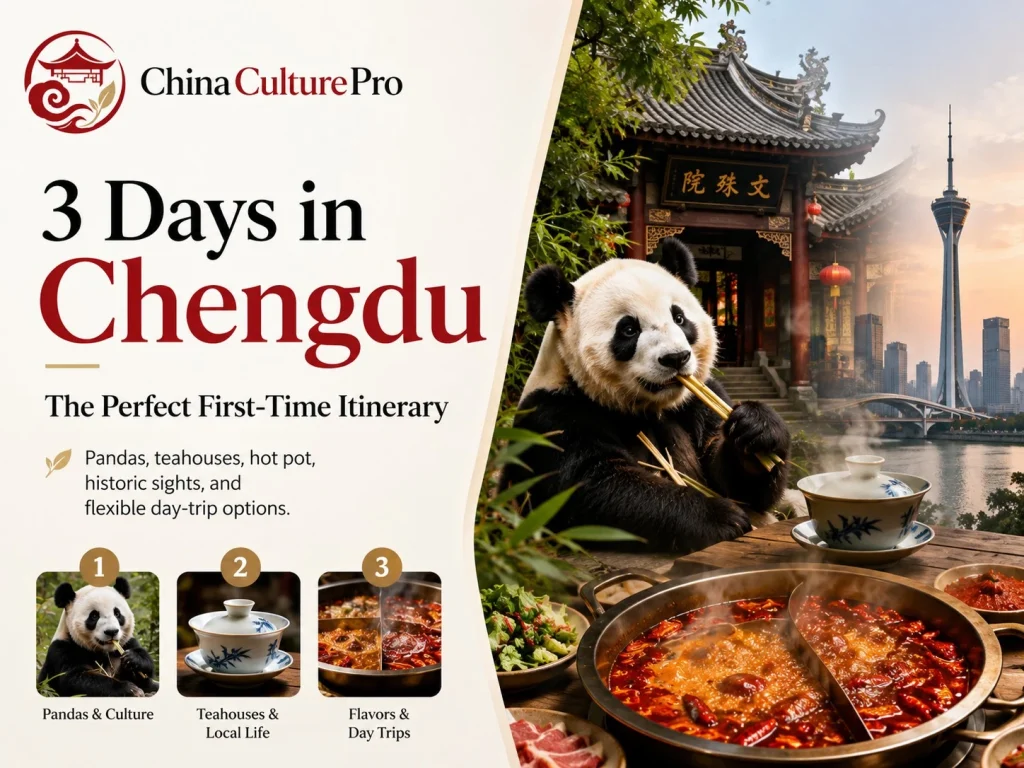
Three full days in Chengdu give a first-time visitor enough time for giant pandas, Sichuan food, Three Kingdoms history, teahouse culture, classical poetry and a glimpse of the city’s nightlife. The important word is full: this plan assumes you can start early, continue into the evening and lose no half-day to an airport or train transfer.
If your three calendar days include an afternoon arrival or a morning departure, book a fourth night or trim the itinerary. Chengdu rewards unhurried meals, tea and neighborhood time as much as formal sightseeing.
2026 planning note: The itinerary reflects official information checked in August 2026. Timed-entry rules, museum hours, shuttle services, performances and train schedules can change, so reconfirm them on official channels before travel.
| Day | Morning | Afternoon | Evening | Pace |
|---|---|---|---|---|
| Day 1 | Chengdu Panda Base at opening | Wenshu Monastery and Wenshufang | Hot pot or chuan chuan | High, then easy |
| Day 2 | Wuhou Shrine and a short Jinli visit | People’s Park; optional Kuanzhai Alleys | Sichuan opera or Yulin dinner | Moderate |
| Day 3 | Du Fu Thatched Cottage; optional Qingyang Palace | Chengdu Museum and Tianfu Square | Jiuyanqiao riverfront or Chunxi Road/Taikoo Li | Moderate to easy |
The grouping follows both geography and energy. Pandas require the earliest start, so the afternoon is deliberately light. Day 2 moves from formal history to a long tea break. Line 13, which opened in December 2025, now makes the Day 3 sequence much easier by serving Du Fu Thatched Cottage, Qingyang Palace, Xinnanmen and Jiuyanqiao.[4]
The safest pattern is four nights: arrive on Day 0, sightsee on Days 1–3 and leave on Day 4. Three nights work only if you arrive early enough to use most of the first day and depart late on the last.
The Panda Base uses real-name, timed admission and releases tickets up to 14 days ahead. From March through October, the morning session begins at 7:30; from November through February, it begins at 8:00. Adult admission is CNY55. Bring the original passport used for the booking and follow the lane for visitors without a Chinese ID card. Travelers who cannot complete online payment may ask at the on-site cash-and-card window, but only remaining inventory is sold there, so advance booking is much safer.[1]
Chengdu Museum is free, but admission requires a real-name reservation. It is normally closed on Mondays. Its summer 2026 schedule runs longer on selected days between July 4 and August 31, so check the official visitor guide for the date of your visit rather than relying on a generic closing time.[2]
Jinsha Site Museum is fully closed from December 5, 2025 through April 30, 2027 for major works. Older itineraries that recommend it during a 2026 trip are outdated.[3]
Install Amap and search destinations in Chinese characters. DiDi has an English interface and is useful for early starts, late returns and groups. Chengdu Metro gates accept contactless UnionPay cards and foreign-issued Visa, Mastercard, American Express, Diners Club and Discover cards. Use the same card to enter and exit, and remember that one card admits one passenger.[6]
Base yourself near Chunxi Road/Taikoo Li for the easiest first visit, or near Wenshu Monastery for a quieter, better-value stay. Check the exact hotel pin and its walking distance to a metro exit; a hotel marketed as a “Chunxi Road branch” can still be a long walk from the station.
Eat an early breakfast and leave central Chengdu around 6:15–6:30. From Chunxi Road, take Metro Line 3 toward Panda Avenue and transfer to the current official feeder bus, or use a direct tourist shuttle if its timetable matches your ticket. A DiDi generally makes sense for three or four people, young children or travelers who want the simplest start. Confirm the gate before setting off because the South and West entrances are far apart.
Aim to be at the correct gate before your admission session starts. The base has two principal visitor entrances:
Do not try to cover the entire 3-square-kilometer site. Prioritize two or three panda areas, watch the animals while they are feeding and moving, and use the internal sightseeing bus if your time or mobility is limited. In warm weather, pandas often retreat indoors as temperatures rise, which is why the opening-hour visit matters.
A realistic visit lasts three to four hours. Families with preschool children or travelers with limited mobility can reduce it to about two hours by choosing one or two key enclosures and using the internal bus. Do not feed the animals, tap the glass or use flash photography.
Return toward the center and transfer to Metro Line 1 for Wenshu Monastery. Allow about 45–60 minutes once walking and the transfer are included. Have a light lunch nearby rather than scheduling another major attraction.
Wenshu Monastery is a calm reset after the Panda Base. Spend 20–30 minutes in the temple, then sit with a pot of tea for an hour. If you still have energy, explore Wenshufang for small servings of sweet-water noodles, Zhong dumplings or liangfen. If not, return to the hotel for a rest.
This afternoon is intentionally loose. Saving your energy makes the evening meal enjoyable instead of turning it into another item to complete.
Choose a hot-pot restaurant around Chunxi Road, Kuixinglou Street or another neighborhood convenient to your hotel. Reservations or a queue number are useful at popular places.
For a first order:
Allow 90 minutes to two hours. Solo travelers and pairs may prefer cold-pot chuan chuan, where skewered ingredients make it easier to sample more items without ordering many full plates.
Take the metro to Wuhou Shrine Station on Line 10, opened in September 2025 directly beside the attraction. This is more convenient than the older advice that sends visitors to Gaoshengqiao Station.[5]
Allow 90–120 minutes inside Wuhou Shrine. The complex is devoted to the Shu-Han figures Liu Bei and Zhuge Liang and works best with an audio guide or concise background reading. Focus on the main halls, memorial tablets, cypress-lined paths and Liu Bei’s tomb rather than trying to memorize every inscription.
Jinli adjoins the shrine. Treat it as a 30–45 minute extension, not a separate half-day attraction. Its reconstructed streets are pleasant for photographs and one small snack, but a full meal here is usually less rewarding than eating in a nearby neighborhood restaurant.
For the simplest connection, take a DiDi from Wuhou Shrine to People’s Park. A metro journey is possible but currently requires additional walking or a transfer; check Amap for the best route on the day.
At People’s Park, go to Heming Teahouse and order a gaiwan tea. Plan to sit for at least an hour. The point is not a formal tea ceremony but the social scene: conversation, cards, chess and the slow rhythm of a public park. Tea commonly costs about CNY15–40, depending on the leaf.
After tea, decide whether Kuanzhai Alleys adds value. It is roughly a 15–20 minute walk from the park and is larger than Jinli, with three parallel lanes, courtyard buildings and more evening activity. However, it overlaps with Jinli as a commercialized heritage district.
Do not force both options into one night.
Option A: Sichuan opera. Book a reputable theater near Qingyang Palace or central Chengdu. A typical program lasts 90–120 minutes and may include excerpts, face changing, fire spitting, rolling lamps, puppetry and music. Face changing is one component of Sichuan opera, not the whole art form. Check the theater’s current venue, starting time and ticket category before paying.
Option B: Yulin. Take the metro or DiDi to the Yulin and Fangcao Street area for a neighborhood dinner. Share mapo tofu, twice-cooked pork, fish-fragrant pork or seasonal vegetables, then add a small local snack. This is the better choice for travelers who care more about everyday food culture than staged performance.
Use Line 13 to reach Du Fu Thatched Cottage Station. The new line makes this day considerably more efficient than routes in older guides.
Allow 90–120 minutes at Du Fu Thatched Cottage. The site commemorates the home where Tang poet Du Fu lived in Chengdu and wrote more than 240 poems. Even if you do not know his work, the gardens, memorial halls, reconstructed thatched house and calligraphy displays make a rewarding visit.
Then take Line 13 one stop to Qingyang Palace if Taoist history interests you. Spend about 45 minutes with the main halls, Bagua Pavilion and bronze goats. Skip it if you want a longer museum visit or a slower lunch; it is the most optional stop of the morning.
Ride to Tianfu Square and enter Chengdu Museum with your reserved passport. Two to three hours is enough for a selective visit. Prioritize the galleries on Chengdu’s urban history, then choose the folk-life, shadow-puppet or temporary galleries according to your interests.
The museum’s Monday closure is the most important scheduling trap. If Day 3 falls on Monday, use Sichuan Museum after checking its current hours, or visit Eastern Suburb Memory for industrial architecture and creative spaces.
After the museum, cross into Tianfu Square for 15–30 minutes. It is useful as Chengdu’s geographic center but does not need a long sightseeing block.
Choose one finish:
Have home-style Sichuan food, river fish or another regional meal rather than repeating hot pot. Metro closing times vary by station and direction, so check the Chengdu Metro app before settling in for the night; use DiDi after the last train.
Replacing Day 3 is reasonable if one regional site matters more to you than Du Fu Thatched Cottage and Chengdu Museum. Trying to combine a full excursion with the city schedule produces a rushed day.
| Day-trip replacement | Typical transport | Realistic visit | Best for | What you give up |
|---|---|---|---|---|
| Sanxingdui Museum | Tourist shuttle or rail plus local transfer | 4–5 hours in the museum | Ancient Shu archaeology and bronze art | All of the city Day 3 |
| Dujiangyan | Rail from Xipu plus local transfer | 4–5 hours at the irrigation system | Engineering, history and scenery | All of the city Day 3 |
| Dujiangyan + Mount Qingcheng | Rail plus local transfers | 8–10 hour outing | Travelers who want one intense heritage-and-nature day | A relaxed pace and all city stops |
| Leshan Giant Buddha | High-speed rail plus transfer to the scenic area | Full 10–12 hour day | Monumental Buddhist art | All of the city Day 3 |
Sanxingdui is the cleanest swap for museum lovers. Reserve in advance and allow enough time for the collection rather than pairing it with the Panda Base. Dujiangyan alone is a manageable day; combining it with Mount Qingcheng is physically demanding. Leshan is possible as a day trip but is the longest option.
Jiuzhaigou and Mount Emei should not be treated as one-day Chengdu excursions. Give either a separate overnight segment.
Avoid repeating the same style of meal. A balanced plan looks like this:
| Time | Food focus | Useful order | Typical cost per person |
|---|---|---|---|
| Day 1 lunch | Light snacks near Wenshu | Sweet-water noodles, Zhong dumplings or liangfen | CNY20–40 |
| Day 1 dinner | Hot pot or chuan chuan | Divided broth, beef or offal, mushrooms and greens | CNY80–150 |
| Day 2 lunch | Home-style Sichuan cooking | Mapo tofu, twice-cooked pork, one vegetable and rice | CNY40–100 |
| Day 2 dinner | Opera-area light meal or Yulin | Shared Sichuan dishes and local snacks | CNY50–150 |
| Day 3 breakfast/lunch | Noodles and small bowls | Dandan noodles, chaoshou or egg cakes | CNY15–50 |
| Day 3 dinner | A different regional meal | River fish, home-style dishes or a modern Chengdu restaurant | CNY60–180 |
For low heat, ask for wei la (微辣) or shao la (少辣), choose clear-broth wontons, steamed or braised dishes and a divided hot pot. “Less spicy” does not guarantee no chili oil or fermented bean paste. Vegetarians should say bu yao rou, zhu you, rou tang (不要肉、猪油、肉汤: no meat, lard or meat stock). Anyone with a serious peanut or sesame allergy should show a written Chinese allergy card because both ingredients are common and kitchens may share equipment.
These are planning ranges, not fixed prices. They exclude travel to Chengdu and assume two people share a room.
| Category | Budget | Mid-range | Comfortable |
|---|---|---|---|
| Hotel, per room/night | CNY200–350 | CNY350–700 | CNY700–2,000+ |
| Food, per person/day | CNY100–180 | CNY180–350 | CNY350–650 |
| Local transport, per person/day | CNY15–40 | CNY40–100 | CNY100–250 |
| Core admission per person | About CNY155 | CNY155 plus opera or exhibitions | CNY155 plus premium experiences |
The core admission figure uses CNY55 for the Panda Base, CNY50 for Wuhou Shrine and CNY50 for Du Fu Thatched Cottage. Chengdu Museum is free with a reservation. Qingyang Palace, temporary exhibitions, internal sightseeing buses, Sichuan opera and any day trip are extra.
A realistic three-day total per person, including half of a three-night room, is roughly CNY800–1,400 on a budget, CNY1,400–2,800 mid-range, and CNY2,800–6,000+ for a comfortable trip. Four nights, which is safer for three full days, raises the accommodation component.
The best three-day Chengdu itinerary is not the one with the longest checklist. Think of the trip in three rhythms: nature on Day 1, history and slow living on Day 2, then poetry and modern city life on Day 3.
Jinli, Kuanzhai Alleys and Chunxi Road do not each need half a day. They are different expressions of commercial street life, and you can choose according to your interests. The experiences that deserve protection are the early panda visit, a complete Sichuan meal, enough time to understand one or two historical sites and an unhurried cup of gaiwan tea.
Four nights are the safest choice: arrive on Day 0, use Days 1–3 for sightseeing and depart on Day 4. Three nights work only with a very early arrival and a late departure. If an airport or train transfer consumes a morning or afternoon, do not count that calendar day as full.
Choose Kuanzhai Alleys for the larger, more complete district and its easy pairing with People’s Park. If you are already visiting Wuhou Shrine and care about Three Kingdoms culture, spend 30 minutes at adjacent Jinli instead. There is no need to make both major stops.
The city-focused Day 3 is the better default because it adds poetry, Chengdu’s history museum and a modern evening. Replace it only if Sanxingdui archaeology, Dujiangyan or Leshan is a personal priority. With four or five full days, add the excursion instead of sacrificing the city day.
It is technically possible but not recommended. The Panda Base deserves the early morning and Sanxingdui merits at least four hours, with a substantial transfer between them. Separate days produce a much better experience and make timed reservations easier.
Yes, after reducing walking. Use the sightseeing bus at the Panda Base, take DiDi between less convenient sights, keep longer meal and rest breaks, and replace Du Fu Thatched Cottage or Qingyang Palace with a more accessible indoor museum if necessary.
On Monday, replace Chengdu Museum because it is closed. In rain, keep reserved attractions unless tickets can be changed, carry proper rain gear and substitute indoor galleries for optional walks. A workable wet-weather Day 3 is Du Fu Thatched Cottage, Qingyang Palace and Eastern Suburb Memory, subject to current opening notices.
[1] Chengdu Research Base of Giant Panda Breeding. Ticket Information
[2] Chengdu Museum. Summer 2026 Opening and Reservation Notice
[3] Jinsha Site Museum. Temporary Full-Closure Notice
[4] Sichuan Online. Chengdu Metro Line 13 Phase 1 Opening
[5] Sichuan Online. Wuhou Shrine Station Opening
[6] Chengdu Official News Portal. Foreign Bank-Card Access on the Metro


Choose the best area to stay in Changsha with practical hotel picks, real traveler logic, and clear advice for first-time visitors, nightlife, and stopovers.

Nestled at the northern edge of China’s Pearl River Delta, Guangzhou stands as the cradle of Lingnan culture, with roots tracing back over two thousand years to the ancient Nanyue Kingdom.

Yes, it snows in many parts of China, especially in the north and mountains. Learn where and when to expect snow across the country.

Discover the rich flavors of Shandong cuisine with iconic dishes like Braised Sea Cucumber, Sweet and Sour Carp, highlighting authentic culinary traditions of China.

Yu Garden blends classical Ming-style beauty, symbolic rockscapes, and vibrant folk traditions in the heart of modern Shanghai—a living time capsule of Chinese culture.

Explore the rich history and culinary delights of China’s most famous time-honored restaurants. Learn about iconic dining spots that showcase traditional flavors and culture.

Share your travel ideas, and we’ll help you plan a smooth, personalized trip across China.

Share your travel ideas, and we’ll help you plan a smooth, personalized trip across China.
We’re looking for experienced, part-time local guides to serve international travelers.
Requirements:
• Fluent in at least one foreign language
• 3–5 years guiding international visitors
• Able to operate in multiple regions in China
• Competitive and reasonable pricing
• Proven customer reviews or testimonials
• Professional, reliable, and responsive
• Flexible availability for custom trips
Hi there!
Just a quick heads-up — a helpful user named Volker let me know that some of the non-English content on this site may not be accurate.
This site is a one-person project I run part-time. I research and publish all the content myself, and the translations are currently done by machine (Google Translate). Balancing accuracy and accessibility across multiple languages is a real challenge.
If you spot any errors, I recommend switching to the English version using the button at the bottom left. I’ll continue working to improve the translations over time.
I truly appreciate your understanding. And if you have any suggestions, feel free to leave a comment — it means a lot to me.
— Anthony 2025.6.18


