
Where to Stay in Xiamen: Best Areas & Hotels
Choose the best area to stay in Xiamen for Gulangyu, Zhongshan Road, beaches, and stopovers, with practical hotel picks and real traveler logic.
Written by
Anthony
The 24 Solar Terms are an ancient time-keeping system rooted in China’s farming culture.
Based on observations of celestial movements and the sun’s position, they reflect seasonal changes and guide agricultural activities.
These terms hold deep cultural significance, forming an essential part of Chinese heritage.
In 2016, the system was recognized by UNESCO as an Intangible Cultural Heritage.
Each solar term carries unique meaning, contributing to China’s traditional meteorological knowledge.
Date: Lichun falls between February 3rd and 5th in the Gregorian calendar.
Lichun, the first of the 24 Solar Terms, marks the transition from winter to spring.
It symbolizes the start of warmer days, with plants beginning to sprout and nature slowly awakening, signaling new growth and vitality in the natural world.
Date: Yushui falls between February 18th and 20th in the Gregorian calendar.
Yushui, the second solar term of spring, signifies the beginning of rainfall.
This gentle rain nourishes the soil, essential for crop growth.
In northern China, winter’s cold lingers, while southern regions start to experience early spring vitality.
Date: Jingzhe falls between March 5th and 7th in the Gregorian calendar.
Jingzhe, the third solar term of spring, signals the warming of the earth and the first spring thunder.
This awakening stirs hibernating insects, marking the resurgence of life and nature’s vitality as temperatures rise and rainfall increases.
Date: Chunfen falls between March 20th and 22nd in the Gregorian calendar.
The Spring Equinox marks the time when day and night are equal, each lasting 12 hours.
It divides the spring season in half and signals the transition to longer daylight hours in the Northern Hemisphere as the sun moves further north, bringing warmer temperatures and more rain.
Date: Qingming falls between April 4th and 6th in the Gregorian calendar.
Qingming reflects the clear skies and vibrant landscapes of spring.
During this period, the weather is mild, the sunlight bright, and plants start to thrive.
In southern China, the season brings warm and pleasant conditions, while northern regions begin to experience the transition from winter to spring.
Date: Guyu falls between April 19th and 21st in the Gregorian calendar.
Guyu, meaning “Rain for the Crops,” is the last solar term of spring.
It signals a period of increased rainfall essential for the growth of young crops. This timely rain nourishes the fields, allowing grains and plants to flourish.
In southern China, Guyu often marks the start of the rainy season, with frequent rainstorms.
Date: Lixia falls between May 5th and 7th in the Gregorian calendar.
Lixia marks the start of summer, signaling rising temperatures and an increase in thunderstorms.
It represents the transition from spring to summer, when crops enter their peak growing season.
In southern China, Lixia brings signs of summer, while northern regions still experience spring-like weather.
Date: Xiaoman falls between May 20th and 22nd in the Gregorian calendar.
Xiaoman, meaning “grain full,” signals the arrival of the rainy season, particularly in southern China.
During this time, crops such as wheat begin to fill with grain, though they are not yet fully ripe.
In the south, rainfall increases, while in the north, warmer temperatures dominate.
Date: Mangzhong falls between June 5th and 7th in the Gregorian calendar.
Mangzhong refers to the sowing of crops with awns, such as rice and millet.
It signifies a busy planting season in the south and the wheat harvest in the north.
With rising temperatures and abundant rainfall, this period is crucial for agricultural activities.
Date: Xiazhi falls between June 21st and 22nd in the Gregorian calendar.
Summer Solstice marks the longest day of the year in the Northern Hemisphere, as the sun reaches its farthest point north, almost directly overhead at the Tropic of Cancer.
This day represents a turning point, as daylight will begin to gradually shorten after the solstice.
Date: Xiaoshu falls between July 6th and 8th in the Gregorian calendar.
Xiaoshu signifies the onset of summer heat, though the temperature is not yet at its peak.
This period marks the start of the “dog days” of summer, with frequent thunderstorms and high humidity, benefiting crop growth due to the simultaneous occurrence of heat and rainfall.
Date: Dashu falls between July 22nd and 24th in the Gregorian calendar.
Dashu represents the hottest period of the year.
During this time, extreme heat and humidity peak, with frequent thunderstorms and typhoons in southern China.
Despite the discomfort, this season is crucial for rapid crop growth, as the abundant rainfall and heat promote agricultural productivity.
Date: Liqiu falls between August 7th and 9th in the Gregorian calendar.
Liqiu marks the transition from summer to autumn, symbolizing the gradual shift from the dominance of yang (warmth) to the growth of yin (coolness).
Although it signals the start of autumn, the heat persists, with the hottest days often extending until after Liqiu.
Date: Chushu falls between August 22nd and 24th in the Gregorian calendar.
Chushu signifies the end of the scorching summer heat as temperatures begin to gradually decline.
It indicates a shift from hot to cooler weather as solar radiation decreases and humidity levels drop, signaling the arrival of early autumn.
Date: Bailu falls between September 7th and 9th in the Gregorian calendar.
Bailu reflects the growing presence of cold air, with significant temperature drops at night and larger day-night variations.
Dew begins to form as the heat fades, and the transition from summer to autumn becomes more pronounced.
Date: Qiufen falls between September 22nd and 24th in the Gregorian calendar.
Qiufen marks the day when day and night are equal in length.
After this day, daylight in the Northern Hemisphere decreases as the sun moves southward, bringing cooler weather and the end of the summer heat.
Date: Hanlu falls between October 8th and 9th in the Gregorian calendar.
Hanlu signals the arrival of cooler temperatures and increasing dryness.
Cold air begins to move southward, bringing noticeable temperature drops, especially at night, as autumn deepens.
Date: Shuangjiang falls between October 23rd and 24th in the Gregorian calendar.
Shuangjiang reflects the season’s dramatic temperature drops and greater day-night temperature fluctuations.
Frost may begin to form, marking the transition from autumn to winter as cold air increasingly dominates.
Date: Lidong falls between November 7th and 8th in the Gregorian calendar.
Lidong marks the start of winter, signaling the transition from autumn’s dry weather to colder, wetter conditions.
It symbolizes the end of growth and the beginning of a resting period, as nature prepares for the cold months ahead.
Date: Xiaoxue falls between November 22nd and 23rd in the Gregorian calendar.
Xiaoxue marks the onset of colder weather and the increasing frequency of cold fronts.
Although it is named “Minor Snow,” the snowfall during this period is often light, as the temperature hasn’t yet dropped dramatically.
Date: Daxue falls between December 6th and 8th in the Gregorian calendar.
Daxue signals the official arrival of midwinter, with significant temperature drops and increasing snowfall.
This period reflects the intensification of cold weather and precipitation, as the season’s characteristic climate takes hold.
Date: Dongzhi falls between December 21st and 23rd in the Gregorian calendar.
Dongzhi marks the shortest day and longest night in the Northern Hemisphere, as the sun reaches its lowest point in the sky.
After Dongzhi, daylight hours gradually increase.
In China, this solar term is both an important part of the 24 Solar Terms and a traditional festival, marked by various customs such as eating dumplings in the north and honoring ancestors in the south.
Date: Xiaohan falls between January 5th and 7th in the Gregorian calendar.
Xiaohan signals a period of intense cold, though not yet at its peak.
During this time, cold air frequently moves southward, and temperatures continue to drop.
It is a prelude to the harsh winter chill, with an emphasis on preparation for the colder days ahead.
Date: Dahan falls between January 20th and 21st in the Gregorian calendar.
Dahan marks the coldest period of the year in many parts of China.
While northern regions may experience colder days during Xiaohan, southern regions typically face their coldest weather during Dahan.
This solar term concludes the 24 Solar Terms, leading into the new cycle with the arrival of spring.
The Twenty-Four Solar Terms serve as a time knowledge system developed through observing the sun’s annual movement, guiding agricultural practices and reflecting seasonal changes.
Originating from the Yellow River basin, they evolved during ancient China’s farming civilization and were fully established by the Qin and Han dynasties as part of the Taichu Calendar.
The system divides Earth’s orbit around the sun into 24 equal segments, each spanning 15° of solar longitude, starting from the Spring Equinox at 0°.
They represent changes in temperature (e.g., Major Heat), rainfall (e.g., Rain Water), seasonal transitions (e.g., Spring Begins), and agricultural activities (e.g., Grain Rain).
In 2016, the Twenty-Four Solar Terms were inscribed on UNESCO’s Representative List of the Intangible Cultural Heritage of Humanity, reflecting their cultural value.

Choose the best area to stay in Xiamen for Gulangyu, Zhongshan Road, beaches, and stopovers, with practical hotel picks and real traveler logic.

Shaanxi, home to ancient dynasties like Qin and Tang, is a key region for China’s Belt and Road Initiative. It represents rich cultural heritage and historical significance.

Most travelers need 3 to 7 days in Guilin to explore the city, cruise the Li River, visit Yangshuo, and hike the Longji Rice Terraces. 5 days offers the best mix of scenery and culture.
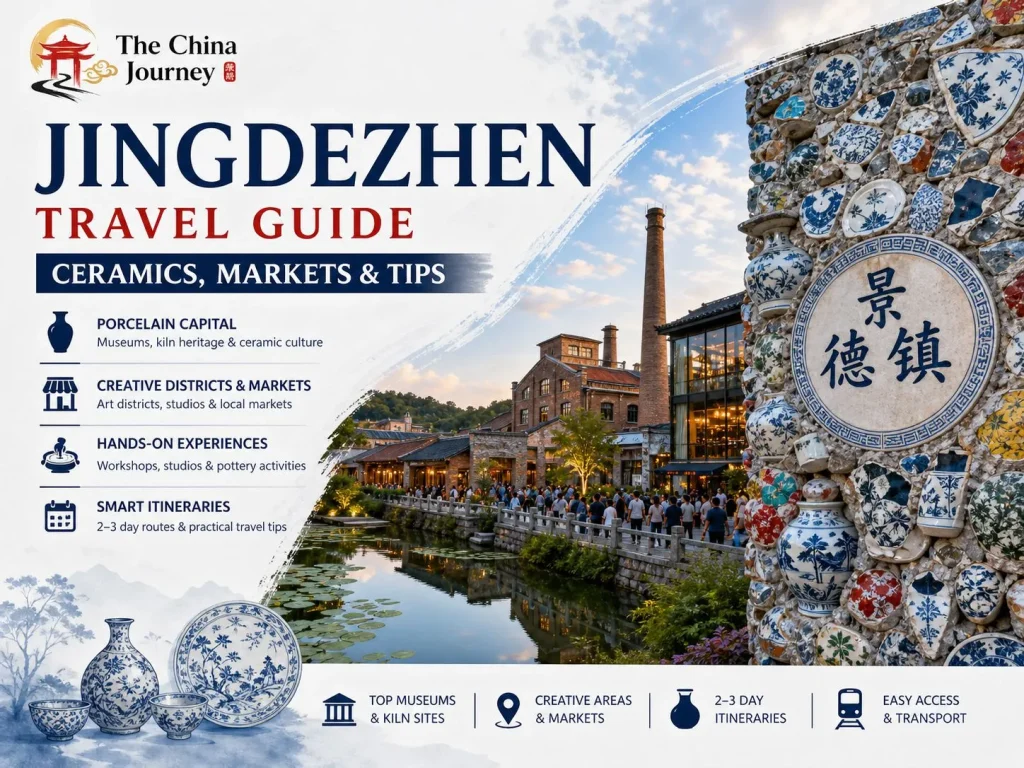
Plan your Jingdezhen trip with top ceramic museums, kiln heritage, creative districts, markets, transport tips, and a smart 2–3 day itinerary.
Beijing is the capital of China. Discover why it’s the political, cultural, and historical center of the country with over 3,000 years of legacy.

Navigate Chengdu by metro, DiDi, bus, and bike. Learn foreign-card tap payment, Panda Base transfers, airport links, and practical tips for visitors in 2026.
Share your travel ideas, and we’ll help you plan a smooth, personalized trip across China.
We’re looking for experienced, part-time local guides to serve international travelers.
Requirements:
• Fluent in at least one foreign language
• 3–5 years guiding international visitors
• Able to operate in multiple regions in China
• Competitive and reasonable pricing
• Proven customer reviews or testimonials
• Professional, reliable, and responsive
• Flexible availability for custom trips
Hi there!
Just a quick heads-up — a helpful user named Volker let me know that some of the non-English content on this site may not be accurate.
This site is a one-person project I run part-time. I research and publish all the content myself, and the translations are currently done by machine (Google Translate). Balancing accuracy and accessibility across multiple languages is a real challenge.
If you spot any errors, I recommend switching to the English version using the button at the bottom left. I’ll continue working to improve the translations over time.
I truly appreciate your understanding. And if you have any suggestions, feel free to leave a comment — it means a lot to me.
— Anthony 2025.6.18