

News
Lingyin Feilai Peak to Offer Free Entry in Hangzhou
Starting Dec 1, 2025, Hangzhou’s Lingyin–Feilai Peak scenic area will be free to enter, with daily visitor limits and online reservations required.
 Written by
Anthony
Written by
Anthony
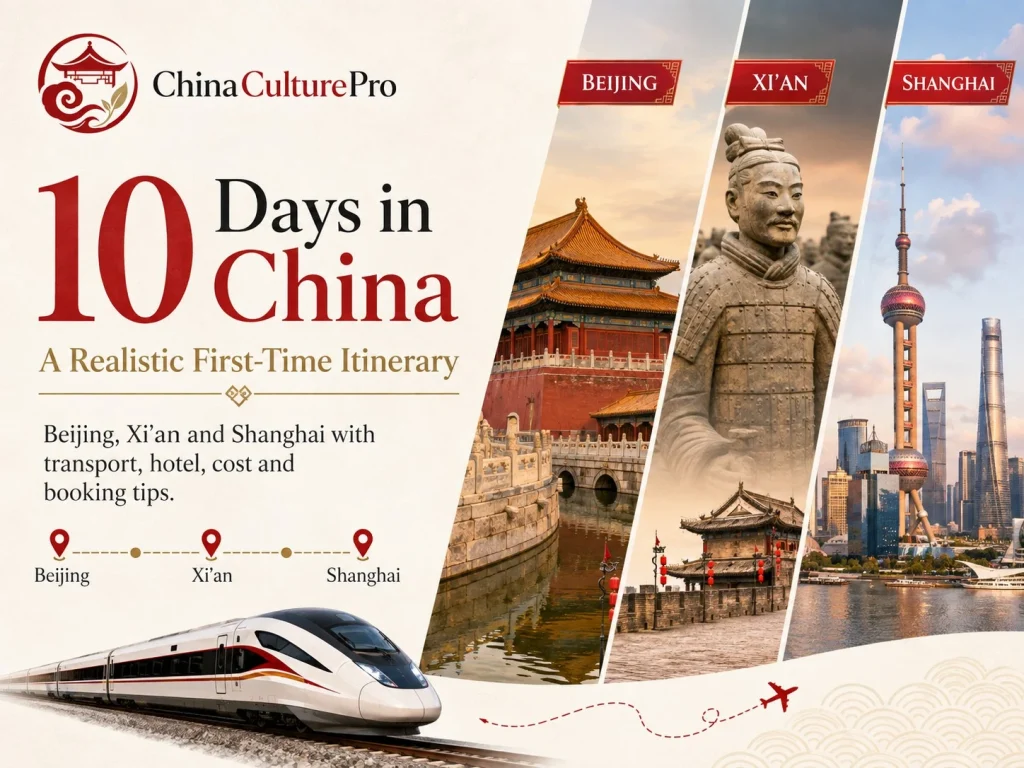
Yes. Ten calendar days are enough for a rewarding first trip to China if you limit the route to three cities: Beijing, Xi’an and Shanghai. This itinerary gives Beijing four days, Xi’an two days and Shanghai four days, including the arrival, departure and intercity travel days.
The important limit is three cities. Adding Chengdu, Guilin or Zhangjiajie without removing another stop turns the trip into a chain of stations, airports and hotel check-ins. If you are deciding whether a fourth stop is sensible, use this guide to how many cities are realistic for one China trip. Travelers who prefer a slower pace should skip Xi’an and divide the trip between Beijing and Shanghai.
| Day | Base | Main plan | Booking priority |
|---|---|---|---|
| 1 | Beijing | Arrive, check in and take a light evening walk | None |
| 2 | Beijing | Tiananmen Square, Forbidden City and Jingshan Park | Forbidden City and Tiananmen |
| 3 | Beijing | Mutianyu Great Wall day trip | Entry and transport |
| 4 | Beijing | Temple of Heaven, hutongs and Peking duck | Temple ticket; dinner reservation |
| 5 | Xi’an | Morning train, City Wall and Bell Tower area | Train and City Wall |
| 6 | Xi’an | Terracotta Army and optional Lishan Garden | Museum ticket |
| 7 | Shanghai | Travel from Xi’an, check in and see the Bund | Flight or train |
| 8 | Shanghai | Yu Garden, Old City, Lujiazui and riverfront | Garden and observation deck |
| 9 | Shanghai | Historic neighborhoods or modern Shanghai | Optional museum |
| 10 | Shanghai | Breakfast, last purchases and departure | Airport transfer |
Days 5 and 7 are transfer days with only half a day of sightseeing. That is deliberate: a train or flight may look short on a timetable, but hotel-to-station travel, security, waiting and check-in consume several additional hours.
Stay near a metro station in each city and save every hotel name and address in Chinese. Carry the passport used for reservations: major attractions and train tickets are tied to the document number.
Beijing has two major international airports: Capital (PEK) and Daxing (PKX). Check the code on your ticket and compare the complete journey to your hotel rather than assuming one airport is always better. From landing to a central hotel, allow roughly two hours for immigration, baggage collection and the airport train or a taxi; a busy international arrival can take longer.
Do not book a timed attraction on Day 1. Check in, eat near the hotel and take a short walk around Qianmen or Wangfujing if you still have energy. The purpose of the evening is to adjust to the time zone and protect Day 2, not to squeeze in an extra landmark.
Reserve Tiananmen Square and the Forbidden City separately; a Palace Museum ticket does not replace the square reservation. Aim to clear security early and enter the museum through the Meridian Gate around 9:00. Follow the central axis through the main ceremonial halls, then choose one or two side areas rather than attempting every courtyard. Three to four hours is realistic.
The Palace Museum uses real-name reservations and accepts foreign passports. Tickets are released at 20:00 seven days before the visit, no same-day tickets are sold, and the museum normally closes on Mondays except statutory holidays. Standard admission is currently ¥60 in the April–October high season and ¥40 from November through March; the Treasure Gallery and Gallery of Clocks cost extra.[3]
Exit through the Gate of Divine Prowess and cross to Jingshan Park. The climb to Wanchun Pavilion takes about 20 minutes and gives the classic overhead view of the palace complex. Eat around Dongsi or Wangfujing afterward, then keep the evening easy.
Mutianyu is a practical first-time section of the Great Wall of China: the restored ramparts are scenic, and cable-car access makes the day manageable for a wider range of travelers. Use a reputable direct shuttle or a private car. A chain of local buses saves money but adds uncertainty and usually costs valuable sightseeing time.
Leave central Beijing around 7:30–8:00, reach the visitor area in the late morning and allow three to four hours on the wall. A cable car up and cable car or toboggan down reduces climbing, but you will still encounter steep steps and uneven surfaces. Wear shoes with grip, carry water and bring a layer because the ridge can be cooler and windier than central Beijing.
Return before the evening rush where possible. Do not add the Summer Palace or an evening show: the long transfer and stair climbing make this one of the trip’s most tiring days.
Enter the Temple of Heaven from the east in the morning and spend about two hours around the Hall of Prayer for Good Harvests, the Imperial Vault of Heaven and the Circular Mound Altar. Arriving early also reveals the park’s everyday role as a place for exercise, music and social gatherings.
In the afternoon, explore the Shichahai area at walking pace. A route through Yandai Xiejie, the lakeside and selected hutong lanes is more satisfying than trying to cover every commercial street. Nanluoguxiang is easy to add, but it can be crowded and is not essential.
Reserve Peking duck for the final Beijing dinner. One duck generally suits two or three diners when accompanied by vegetables or another shared dish. Return to the hotel early enough to pack and confirm the departure station for the next morning.
Book a morning G-train from Beijing West to Xi’an North. The railway journey is usually about 4.5–5.5 hours, but the hotel-to-hotel trip is closer to 6.5–7 hours after transfers, security and boarding. Arrive at Beijing West 45–60 minutes early because it is large and busy.
After checking in, enter Xi’an City Wall at Yongning Gate. Walk one section or rent a bicycle if weather and opening conditions permit; completing the full 13.7-kilometer circuit is unnecessary. Continue to the Bell and Drum Tower area after dark and sample a few dishes around the Muslim Quarter. Treat it as a food district, not a checklist: order small portions and leave room for Day 6.
Start around 8:00 for the Terracotta Army in Lintong. Metro Line 9 does not reach the museum entrance. Take Line 9 to Huaqingchi and transfer to a local tourist bus, or use an authorized direct shuttle from central Xi’an. Allow about an hour each way, depending on the connection and traffic.
Spend three to four hours across Pits 1, 2 and 3 and the exhibition areas. Pit 1 provides the scale; Pits 2 and 3 explain the army’s formations and command structure. An official guide or a good audio guide adds substantial context. The same museum itinerary can include Lishan Garden, with a free shuttle linking the sites, but doing both properly lengthens the visit.[4]
Return to the city for dinner. If the first evening focused on the Muslim Quarter, try Yongxingfang or a neighborhood restaurant instead. Skip Huaqing Palace, the Big Wild Goose Pagoda and the Shaanxi History Museum unless one of them replaces the City Wall or evening food time; two days cannot hold every Xi’an highlight comfortably.
Flying is usually the efficient choice from Xi’an to Shanghai. A flight takes roughly 2–2.5 hours, while the complete hotel-to-hotel journey is often five to six hours. Choose Hongqiao Airport when the schedule and fare are competitive because it is closer to central Shanghai. The high-speed train to Shanghai Hongqiao commonly takes about six to eight hours and works well for travelers who prefer rail or want to avoid airports.
After checking in, rest and walk to the Bund near sunset. Stay as the Pudong skyline illuminates, but do not build the plan around a fixed lighting schedule because seasonal and event arrangements change. Day 7 intentionally excludes Yu Garden; repeating it here and on Day 8 would turn an already substantial travel day into a rush.
Visit Yu Garden when it opens, then explore the surrounding Old City and City God Temple streets. The garden itself rewards a slower look at rockeries, pavilions, framed views and water features; the commercial lanes outside are useful for snacks but become congested later in the day.
Cross the Huangpu River to Lujiazui in the afternoon. Choose one observation deck—Shanghai Tower, the Oriental Pearl Tower or another current option—rather than paying for several similar views. Finish on the Pudong riverfront promenade, where the historic Bund skyline is directly across the water.
In the evening, take a Huangpu cruise if a river perspective matters to you, or simply walk the Bund again. The cruise is optional; the free promenades on both banks already deliver the essential skyline experience.
Make Day 9 interest-led instead of treating every famous district as mandatory.
Choose only one main museum and verify its branch, exhibition and reservation procedure. Shanghai’s museums can use timed entry, and special exhibitions may have separate tickets. End with a Shanghainese dinner such as hong shao rou, xiaolongbao or seasonal river and seafood dishes.
Keep the final morning for breakfast and last purchases near the hotel. Leave luggage at reception only if your flight time creates genuine spare time; do not cross the city for another attraction.
Allow about 30–60 minutes from central Shanghai to Hongqiao and 60–90 minutes to Pudong under normal conditions, then add the airline’s recommended international check-in buffer. For an early flight, cancel sightseeing and go directly to the airport.
| Route | Recommended mode | Typical running time | Realistic door-to-door time | Key caution |
|---|---|---|---|---|
| Beijing to Xi’an | G-train | 4.5–5.5 hours | 6.5–7 hours | Depart from Beijing West; arrive at Xi’an North |
| Xi’an to Shanghai | Flight | 2–2.5 hours | 5–6 hours | Compare Hongqiao and Pudong airports |
| Xi’an to Shanghai | High-speed train | 6–8 hours | About 8–9 hours | Arrives at Shanghai Hongqiao |
China’s railway tickets use real-name booking, and foreign travelers must carry the original passport used for purchase. The official 12306 system is the source of inventory; schedules and presale rules should be checked again for the travel date.[5] For booking choices, station names, seat classes and boarding procedures, see the China Transportation Guide.
For the Xi’an–Shanghai segment, compare total time and arrival location rather than the headline duration. A cheap flight to Pudong at an awkward hour may save little over a daytime train to Hongqiao.
| City | Recommended base | Why it works | Watch for |
|---|---|---|---|
| Beijing | Qianmen or Wangfujing | Central for imperial sights and evening dining | Hotel names may overstate walking distance to the metro |
| Xi’an | Bell Tower or Yongning Gate | Convenient for the wall, food streets and Line 2 to Xi’an North | Rooms facing nightlife streets can be noisy |
| Shanghai | People’s Square or East Nanjing Road | Strong metro access; convenient for the Bund and both sides of the river | The Bund itself carries a location premium |
Choose a hotel within about 800 meters of a metro entrance, or within 500 meters when carrying large luggage. Verify the actual address in a Chinese map app rather than trusting labels such as “Forbidden City Branch” or “The Bund Hotel.” Foreign guests should bring their original passports for check-in, and every traveler in the room must be registered.
The following ranges are planning estimates per person for nine nights, assuming solo occupancy. They exclude international flights, visas, shopping and luxury private tours.
| Category | Budget | Mid-range | Comfortable |
|---|---|---|---|
| Nine nights | ¥1,350–1,800 | ¥3,150–4,500 | ¥7,200–10,800 |
| Intercity transport | ¥1,000–1,300 | ¥1,300–1,800 | ¥2,000–3,000 |
| Food | ¥900–1,200 | ¥1,500–2,200 | ¥3,000–4,000 |
| Local transport | ¥200–300 | ¥300–500 | ¥800–1,200 |
| Attractions and activities | ¥600–800 | ¥800–1,200 | ¥1,200–2,000 |
| Estimated total | ¥4,050–5,400 | ¥7,050–10,200 | ¥14,200–21,000 |
Two people sharing a room can reduce the per-person total substantially. During major holidays, accommodation and domestic transport may rise by 20–50%, so treat these as August 2026 planning bands rather than fixed prices. Keep ¥200–500 in cash as backup even if you use Alipay or WeChat Pay with a foreign card.
Use a replace, do not add rule.
| Interest | Change | Revised route | Main trade-off |
|---|---|---|---|
| Pandas and Sichuan food | Replace Xi’an with Chengdu | Beijing → Chengdu → Shanghai | Lose the Terracotta Army; gain pandas, teahouses and Sichuan cuisine |
| Karst landscapes | Replace Xi’an with Guilin/Yangshuo | Beijing → Guilin → Shanghai | More flights and weather dependence; less imperial history |
| Slow travel | Remove Xi’an | Beijing 5 days + Shanghai 5 days | Fewer icons, but deeper neighborhoods and more recovery time |
| More history | Give Xi’an one extra night | Beijing 4 + Xi’an 3 + Shanghai 3 | Less flexible time in Shanghai |
Do not add Chengdu as a fourth stop merely because a two-hour flight looks short. Packing, checking out, reaching the airport, security, baggage collection and another check-in usually consume most of a day. A fourth city is reasonable only if you have unusually high stamina and accept that each destination becomes a highlights-only visit.
Book time-sensitive essentials, not every meal and hour. A controlled amount of flexibility lets you respond to rain, fatigue or a delayed arrival without rebuilding the entire route.
The best 10-day China itinerary is not the one with the most cities. It is the one that protects full experiences: an unhurried morning in the Forbidden City, enough time to walk the Great Wall, context at the Terracotta Army and an evening beside the Huangpu River.
Use open-jaw flights, count transfer days honestly and keep the route to Beijing, Xi’an and Shanghai. If another destination matters more, replace one city instead of adding a fourth. That single rule prevents most first-time itineraries from becoming exhausting.
It normally means 10 calendar days and nine nights: arrival is Day 1 and departure is Day 10. Both are partial travel days. If you want 10 complete sightseeing days, book 11 nights and place the arrival and departure outside those days.
Potentially, but only if the traveler, ports and onward itinerary meet the official conditions. The policy currently covers citizens of 55 countries entering through designated ports and continuing to a third country or region within 240 hours.[2] A route such as Country A → Beijing, travel within permitted areas, then Shanghai → Country B may qualify; Country A → China → Country A does not meet the third-country transit requirement.
Read the full China 240-hour transit visa-free policy and verify eligibility with the National Immigration Administration before purchasing separate, nonrefundable tickets.
Yes. Beijing to Xi’an is an easy high-speed-rail segment, and Xi’an to Shanghai also has direct trains. The second journey is much longer, so flying generally preserves more sightseeing time. Choose the train if you value predictable city-to-city travel, prefer avoiding airports or find a convenient daytime schedule; choose a flight if it saves several hours door to door.
April to May and September to October usually offer the best balance of comfortable temperatures and outdoor conditions. Summer is hot, humid and busy; winter is colder in Beijing and Xi’an but can provide lower prices and lighter crowds. Holiday dates matter as much as weather, so compare the season with the best time to visit China and avoid the main national travel peaks when possible.
Yes, with fewer walking-intensive add-ons. Use the cable car both ways at Mutianyu, explore only part of Xi’an City Wall, take taxis for awkward transfers and schedule a midday rest after the Forbidden City. A first-class train seat can improve the Beijing–Xi’an transfer, but good hotel locations and lighter daily plans make a larger difference than upgrading every ticket.
If Day 2 is Monday, swap the Forbidden City with the Great Wall or Temple of Heaven day because the Palace Museum normally closes on Mondays outside statutory holidays.[3] During a public holiday, attractions may remain open but reservations, trains and hotels become much more competitive. Secure timed tickets first, allow extra travel time and remove optional stops rather than extending every day late into the evening.
[1] Beijing Municipal Government. Public Holidays for 2026
[2] National Immigration Administration. China Expands 240-Hour Visa-Free Transit Policy to 55 Countries
[3] The Palace Museum. Ticket Booking Information
[4] Shaanxi Provincial Cultural Heritage Administration. Visitor Notice for the Qin Shi Huang Mausoleum Museum and Lishan Garden
[5] China Railway 12306. Official English Railway Ticketing Website

Starting Dec 1, 2025, Hangzhou’s Lingyin–Feilai Peak scenic area will be free to enter, with daily visitor limits and online reservations required.
Plan 3 days in Chongqing with a practical first-time route covering city views, mountain streets, food, night views, costs, hotels, and key tips.

Shanghai is about 1,068 km from Beijing by air and over 1,300 km by train. Learn travel times, distances, and best ways to get between the cities.

A calm and steady 2026 forecast for people born in 1959, covering career, wealth, relationships, health, and guidance for a balanced and secure year.

Beijing is famous for Peking duck, zhajiangmian, and a variety of traditional street snacks that blend imperial refinement with local flavors.

Plan your first Taiyuan trip with the best things to do, where to stay, what to eat, and how to fit Taiyuan into a wider Shanxi route.

Share your travel ideas, and we’ll help you plan a smooth, personalized trip across China.

Share your travel ideas, and we’ll help you plan a smooth, personalized trip across China.
We’re looking for experienced, part-time local guides to serve international travelers.
Requirements:
• Fluent in at least one foreign language
• 3–5 years guiding international visitors
• Able to operate in multiple regions in China
• Competitive and reasonable pricing
• Proven customer reviews or testimonials
• Professional, reliable, and responsive
• Flexible availability for custom trips
Hi there!
Just a quick heads-up — a helpful user named Volker let me know that some of the non-English content on this site may not be accurate.
This site is a one-person project I run part-time. I research and publish all the content myself, and the translations are currently done by machine (Google Translate). Balancing accuracy and accessibility across multiple languages is a real challenge.
If you spot any errors, I recommend switching to the English version using the button at the bottom left. I’ll continue working to improve the translations over time.
I truly appreciate your understanding. And if you have any suggestions, feel free to leave a comment — it means a lot to me.
— Anthony 2025.6.18

