

Travel Guide
Tianjin Travel Guide
Discover Tianjin with our complete travel guide—top attractions, local food, transport tips, and hidden gems just 30 minutes from Beijing.
 Written by
Anthony
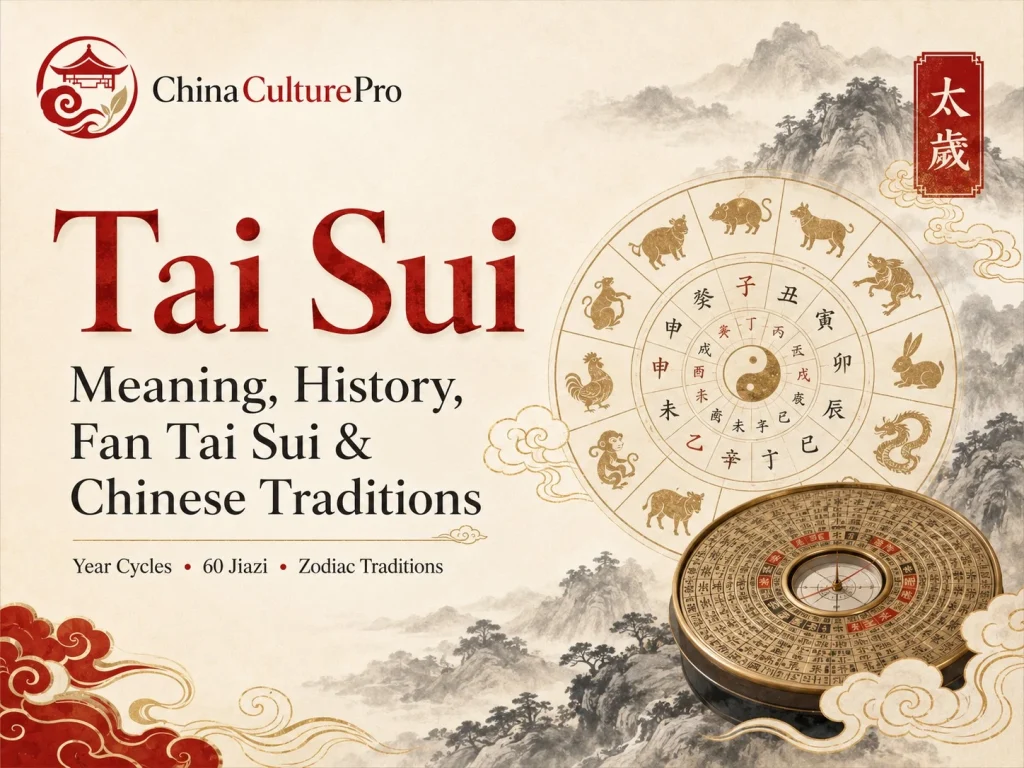
Tai Sui (太岁, Tàisuì), commonly translated as “Grand Duke Jupiter,” is a layered concept spanning Chinese astronomy, calendrical tradition, religion, zodiac interpretation, and Feng Shui. It developed from an idealized point used in ancient year-counting into an annual direction, a personified God of the Year, and a system of sixty deities linked with the 60 Jiazi cycle.
The essential points are:
Sui Xing (岁星), the Year Star, was the ancient Chinese name for Jupiter; Tai Sui was not simply the physical planet.
The idealized Tai Sui moved through twelve annual positions and later became personified as the deity governing each year.
The 60 Jiazi combinations were eventually associated with sixty yearly Tai Sui deities.
Fan Tai Sui (犯太岁) describes traditional annual relationships, not proof that misfortune must occur.
Personal Fan Tai Sui and the annual Tai Sui direction are related but separate calculations.
Annual Tai Sui names, directions, and commonly listed zodiac relationships change with the year.
Ancient Chinese observers called Jupiter Sui Xing (岁星), the Year Star. Jupiter completes one orbit in about 11.86 years, close to the twelve-part cycle used in traditional Chinese timekeeping. Its movement was therefore connected with twelve divisions of the sky and, eventually, the Twelve Earthly Branches (十二地支).
Jupiter’s actual movement did not fit a perfectly regular twelve-year system. Traditional calendrical theory consequently developed an idealized Tai Sui point that moved through twelve annual positions in the opposite sequence. This provided a more regular framework for naming years.
Tai Sui was therefore not originally only a deity or zodiac warning. One of its earlier functions was to connect astronomical observation with a standardized twelve-part system of cyclical time.
The annual Tai Sui position gradually became associated with direction, seasonal order, authority, and taboos against disturbing the ground. It was later personified as Tai Sui Xingjun (太岁星君), the Tai Sui Lord or God of the Year.
The deity governing the current year is called the Zhinian Tai Sui (值年太岁), or Tai Sui on duty. Religious and folk traditions may regard this figure as overseeing the order, opportunities, difficulties, and conduct associated with the year. These are devotional and cosmological interpretations rather than descriptions of the physical planet Jupiter.
The twelve-year layer comes from the Twelve Earthly Branches and zodiac cycle, while the sixty-year layer comes from combining the ten Heavenly Stems (天干) with the branches to form the 60 Jiazi (六十甲子).
A zodiac animal returns every twelve years, but a complete stem-branch pair returns only once every sixty years. Horse years, for example, recur every twelve years, while a specific Horse year such as Bing-Wu (丙午) returns every sixty years.
Later religious traditions associated each pair with a Tai Sui deity. The deity governing the current year is the Zhinian Tai Sui, while the one associated with a person’s birth year may be called the Benming Tai Sui (本命太岁).
Modern lists often depict sixty named generals or celestial officials, but their names, images, biographies, and temple arrangements vary across periods and regions. They should not be treated as sixty uniformly documented historical military figures. The familiar system developed through long religious evolution, local traditions, and regional transmission.
The full cyclical structure is explained in Heavenly Stems and Earthly Branches.
Fan Tai Sui (犯太岁) is commonly translated as “offending Tai Sui,” but fan here means encountering, conflicting with, or forming a traditionally difficult relationship with the year’s Tai Sui. It does not imply moral wrongdoing, deliberate insult, or deserved punishment.
In popular tradition, the term describes a significant relationship between a person’s birth branch and the current year branch. Such a year may be viewed as changeable or demanding, but it does not guarantee illness, financial loss, conflict, or failure.
| Type | Chinese | Basic Relationship | Common Traditional Interpretation |
|---|---|---|---|
| Zhi Tai Sui | 值太岁 | The birth branch is the same as the year branch | A return to one’s zodiac position, commonly linked with Ben Ming Nian |
| Chong Tai Sui | 冲太岁 | The birth branch directly opposes the year branch | Strong contrast, movement, disruption, or confrontation |
| Xing Tai Sui | 刑太岁 | The branches form a punishment relationship | Friction, pressure, complications, or repeated difficulties |
| Hai Tai Sui | 害太岁 | The branches form a harm relationship | Hidden tension, misunderstanding, obstruction, or weakened support |
| Po Tai Sui | 破太岁 | The branches form a break relationship | Disrupted plans, separation, instability, or weakened arrangements |
These are symbolic categories within traditional branch theory, not predictions that specific events must occur. Their classification also varies: some traditions emphasize only Zhi and Chong Tai Sui, while others add Xing, Hai, Po, Ke, or further relationships.
Xing Tai Sui is especially variable because punishment rules differ among schools. Any annual list should therefore be understood within its temple, region, almanac, or astrological tradition rather than treated as universally fixed.
A basic zodiac-level check follows five steps:
A returning zodiac year is explained in Ben Ming Nian, while a broader birth-time analysis is introduced in [BaZi Four Pillars].
Popular zodiac and festival usage usually changes the year at Chinese New Year. Some BaZi, Feng Shui, and Tai Sui traditions instead use Lichun (立春), the Start of Spring, as the annual transition point.
These conventions serve different systems. Anyone born between Lichun and Chinese New Year should check whether the calendar, temple, calculator, or practitioner follows the lunar-new-year boundary or the solar-term boundary.
The distinction is explained more fully in the Chinese Lunar Calendar.
Tai Sui also has a spatial dimension. Each annual Earthly Branch corresponds to a traditional compass sector known as the Tai Sui direction, or Tai Sui Fang (太岁方). The opposite sector is called Sui Po (岁破), the direction that clashes with Tai Sui.
| Concept | Chinese | What It Refers To | Traditional Concern |
|---|---|---|---|
| Tai Sui Direction | 太岁方 | The annual compass sector associated with Tai Sui | Keeping the sector relatively quiet |
| Sui Po Direction | 岁破方 | The sector directly opposite Tai Sui | Avoiding unnecessary major disturbance |
| Personal Fan Tai Sui | 个人犯太岁 | The relationship between a person’s birth branch and the year branch | Annual zodiac or astrological interpretation |
| Directional Tai Sui | 方位太岁 | The relationship between construction activity and the annual sector | Excavation, demolition, drilling, or wall-breaking |
Traditional Feng Shui recommends keeping the Tai Sui and Sui Po sectors relatively quiet and, where practical, avoiding major excavation, demolition, drilling, or wall-breaking. Routine use of the area does not automatically cause harm, and necessary repairs need not be abandoned; believers may instead choose a suitable date, begin from another sector, seek professional guidance, or observe a customary ritual.
This spatial rule is separate from personal Fan Tai Sui. A person’s zodiac relationship concerns the birth and annual branches, while directional Tai Sui concerns where construction or disturbance occurs.
The expression Tai Sui Tou Shang Dong Tu (太岁头上动土) literally means “moving earth on Tai Sui’s head.” It originates in the taboo against disturbing the annual Tai Sui sector.
In modern Chinese, it describes someone daring to challenge or provoke a powerful person—similar to knowingly confronting an authority who is not easily offended.
Annual directions and spatial timing belong to the broader practice of Feng Shui.
Chinese communities have developed several ways of honoring, settling, transforming, or thanking Tai Sui. The terminology and procedures vary by region, temple, language, and religious tradition.
| Practice | Chinese | Typical Meaning |
|---|---|---|
| An Tai Sui | 安太岁 | Registering or installing a tablet, talisman, lamp, or prayer for peace during the year |
| Bai Tai Sui | 拜太岁 | Worshipping or paying respects to the year’s Tai Sui |
| Hua Tai Sui | 化太岁 | Seeking to ease or transform a difficult Tai Sui relationship |
| She Tai Sui | 摄太岁 | A regional term for conducting a Tai Sui protection rite |
| Tai Sui Lamp | 太岁灯 | A temple lamp registered in a believer’s name for annual peace and protection |
| Xie Tai Sui | 谢太岁 | Thanking Tai Sui near the end of the year |
| Huan Tai Sui | 还太岁 | Fulfilling a vow or formally completing the annual observance |
Historically, families might bring home a Tai Sui tablet or talisman and maintain offerings throughout the year. Many modern temples instead register a person’s name, birth information, and address near the turn of the lunar year, then maintain a tablet, lamp, or collective ritual on the family’s behalf.
For many Chinese families, the practice is less dramatic than “appeasing an angry god” suggests. Parents, grandparents, and younger relatives may visit together, register family names, light incense, and ask for ping’an (平安)—peace, safety, and a steady year.
Red clothing, talismans, and symbolic objects may provide reassurance or cultural meaning, especially during Ben Ming Nian, but they cannot guarantee protection. Temple teachings may place equal or greater emphasis on responsible conduct, good deeds, careful work, and maintaining relationships.
There is no single universal date or procedure. Some observances take place before Chinese New Year, others during the first lunar month, and some traditions recognize Lichun as the annual transition. Toward the end of the year, believers may return to give thanks or complete a vow.
Traditional sayings can describe Fan Tai Sui in severe terms, but many Chinese people treat it more practically—as a reminder to reduce unnecessary risk, prepare for change, and avoid careless decisions rather than as a sentence of inevitable disaster.
Useful responses include:
Fan Tai Sui is a traditional interpretive framework, not scientific evidence that a zodiac relationship causes disease, job loss, accidents, or relationship breakdown. It should not replace medical treatment, legal advice, financial planning, or informed decision-making.
The most useful cultural lesson is not “something bad must happen,” but “do not move through a demanding year carelessly.”
| Related Concept | Relationship to Tai Sui | Explore Further |
|---|---|---|
| Chinese Zodiac | The annual and birth-year animals come from the Twelve Earthly Branches | Chinese Zodiac |
| Ben Ming Nian | The return of one’s birth branch, commonly treated as Zhi Tai Sui | Ben Ming Nian |
| Heavenly Stems and Earthly Branches | Provide the twelve-year branch structure and complete sixty-year cycle | Heavenly Stems and Earthly Branches |
| Chinese Zodiac Compatibility | Explains branch relationships such as clash, harm, punishment, and break | Chinese Zodiac Compatibility |
| BaZi | Examines annual influence through all four birth pillars rather than the zodiac animal alone | [BaZi Four Pillars] |
| Feng Shui | Applies the year branch to the Tai Sui and Sui Po directions | Feng Shui |
| Chinese Almanac | Records Gan-Zhi dates, branch clashes, taboos, and traditional date-selection information | [Chinese Almanac] |
| Chinese Lunar Calendar | Provides the festival and year-boundary context used in popular practice | Chinese Lunar Calendar |
Tai Sui connects ancient sky observation and cyclical dating with annual deities, directional taboos, temple worship, and family prayers for peace. These layers developed over time rather than belonging to one unchanged system from the beginning.
Reducing Tai Sui to “these zodiac signs will be unlucky” removes most of its cultural meaning. It is better understood as an enduring example of how Chinese traditions joined astronomy, timekeeping, religion, space, and everyday practice. Related belief systems are explored across [Chinese Culture].
Tai Sui is a Chinese calendrical, directional, and religious concept. It developed from an idealized year-counting point and was later personified as the deity governing a particular stem-branch year.
No. Jupiter was called Sui Xing, the Year Star. Tai Sui was an idealized counterpart used within a twelve-part year system and later became the personified God of the Year.
The ten Heavenly Stems and twelve Earthly Branches form sixty recurring pairs. Later religious traditions associated each Jiazi year with a corresponding Tai Sui deity.
Fan Tai Sui means forming a traditionally significant or difficult relationship with the year’s Tai Sui. It does not necessarily mean deliberately insulting a deity or being guaranteed bad luck.
The most commonly listed types are Zhi Tai Sui, Chong Tai Sui, Xing Tai Sui, Hai Tai Sui, and Po Tai Sui. Exact classifications vary by tradition.
Ben Ming Nian is commonly treated as Zhi Tai Sui because the current zodiac branch matches a person’s birth branch. It is one form of Fan Tai Sui, not the entire system.
Confirm your correct birth-year branch, identify the current year branch, and compare their traditional relationships. People born near Chinese New Year should verify which year boundary is being used.
No. Traditional belief treats it as a year requiring greater caution and adaptability. It does not prove that illness, financial loss, conflict, or other misfortune must occur.
It is the compass sector associated with the current year’s Earthly Branch. Traditional Feng Shui advises avoiding unnecessary major disturbance in that sector.
An Tai Sui is a folk and religious practice of registering, installing, or honoring the yearly Tai Sui through a tablet, talisman, lamp, temple rite, or household observance.
Popular zodiac and festival practice usually follows Chinese New Year. Some BaZi, Feng Shui, and Tai Sui traditions use Lichun as the annual transition point.
Tai Sui Tou Shang Dong Tu refers literally to disturbing ground in the Tai Sui sector. Figuratively, it means daring to challenge someone powerful or dangerous.

Discover Tianjin with our complete travel guide—top attractions, local food, transport tips, and hidden gems just 30 minutes from Beijing.

Discover the Double Ninth Festival, a Chinese tradition blending mountain climbing, chrysanthemum viewing, and heartfelt respect for elders every autumn.

Discover the 1989 Earth Snake zodiac meaning and 2026 forecast, including personality, career, wealth, love, health, lucky elements, and practical advice.

Explore Kung Fu’s rich history, diverse styles, health benefits, and philosophical roots. Discover how this ancient art enhances body, mind, and spirit.
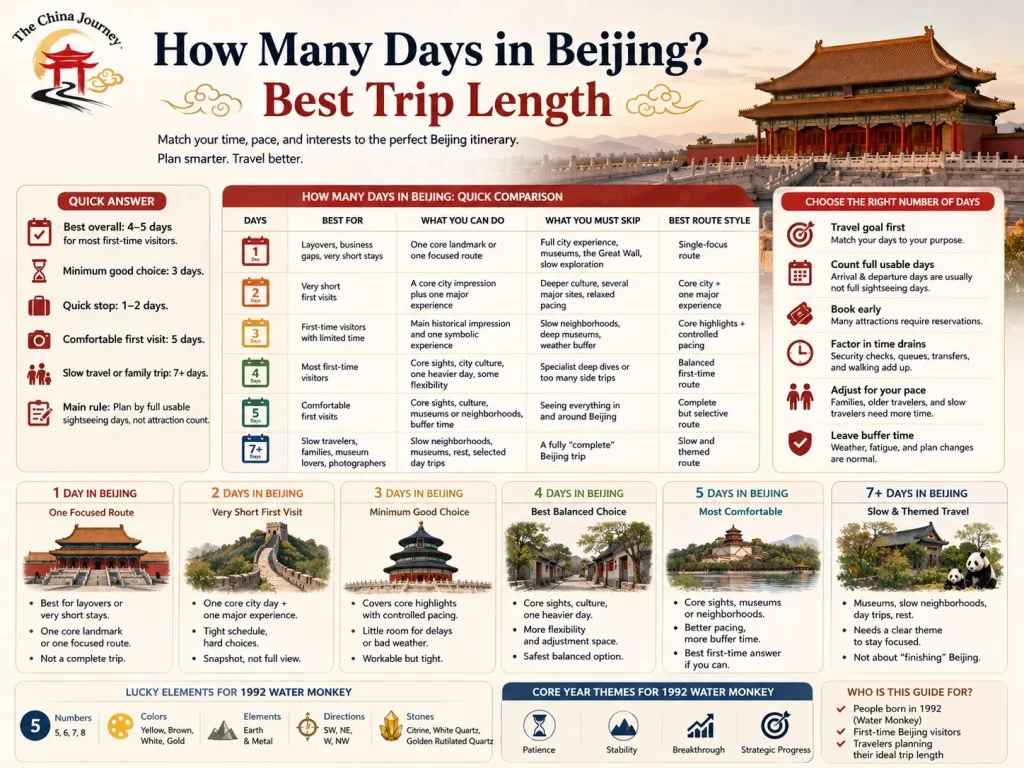
Most first-time visitors need 4–5 days in Beijing. Compare 1, 2, 3, 4, 5, and 7+ day trip lengths by pace, route, and travel style.
Plan Chengdu Panda Base with current ticket rules, South vs West Gate advice, realistic routes, transport options, best visiting times and passport tips.

Share your travel ideas, and we’ll help you plan a smooth, personalized trip across China.

Share your travel ideas, and we’ll help you plan a smooth, personalized trip across China.
We’re looking for experienced, part-time local guides to serve international travelers.
Requirements:
• Fluent in at least one foreign language
• 3–5 years guiding international visitors
• Able to operate in multiple regions in China
• Competitive and reasonable pricing
• Proven customer reviews or testimonials
• Professional, reliable, and responsive
• Flexible availability for custom trips
Hi there!
Just a quick heads-up — a helpful user named Volker let me know that some of the non-English content on this site may not be accurate.
This site is a one-person project I run part-time. I research and publish all the content myself, and the translations are currently done by machine (Google Translate). Balancing accuracy and accessibility across multiple languages is a real challenge.
If you spot any errors, I recommend switching to the English version using the button at the bottom left. I’ll continue working to improve the translations over time.
I truly appreciate your understanding. And if you have any suggestions, feel free to leave a comment — it means a lot to me.
— Anthony 2025.6.18

