


Festival
Qingming Festival
Discover the traditions of Qingming Festival, a time for tomb-sweeping, ancestor worship, and celebrating spring with outdoor activities and special foods.
 Written by
Anthony
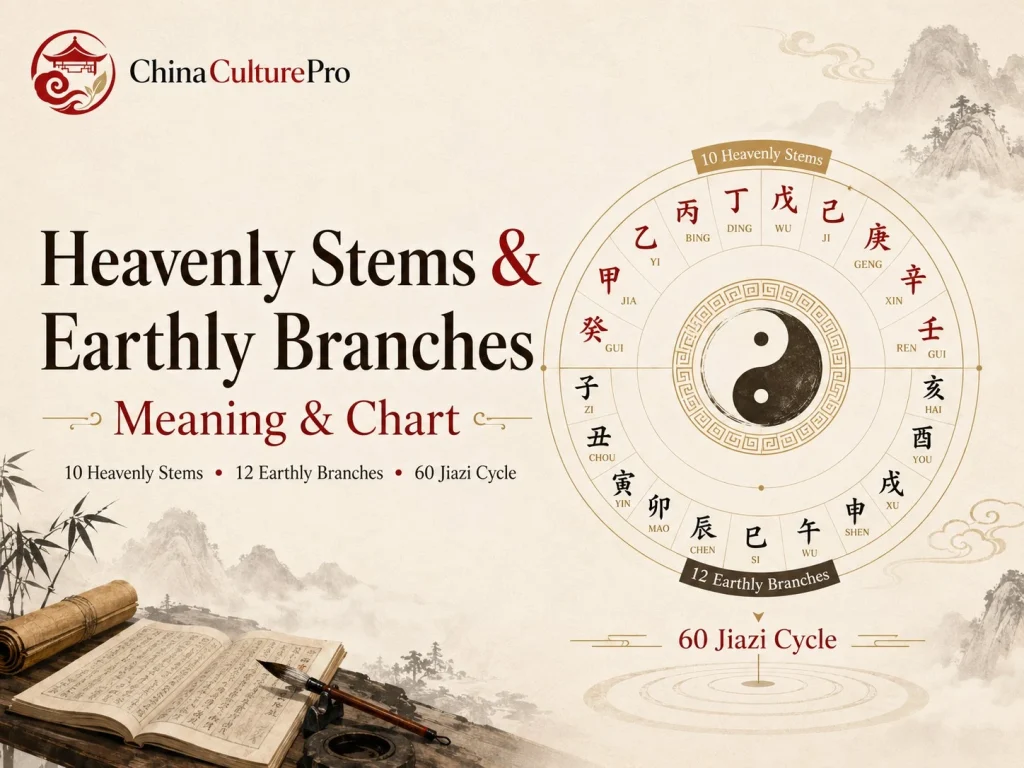
The Heavenly Stems (天干, Tiāngān) and Earthly Branches (地支, Dìzhī), collectively called Gan-Zhi (干支), are two ordered sequences used in traditional Chinese chronology. Ten stems and twelve branches advance together to form sixty recurring pairs known as the 60 Jiazi (六十甲子), or sexagenary cycle.
The essential points are:
The earliest securely attested written evidence comes from late Shang oracle-bone inscriptions, where Gan-Zhi primarily recorded days.
The system originally provided order and dates rather than fortune-telling interpretations.
The two sequences return to their shared starting point after sixty steps.
Yin-Yang, Five-Phase, zodiac, Na Yin, and BaZi correspondences developed or became systematized later.
The Yellow Emperor and Da Nao account is a traditional origin story, not a verified record of an individual inventor.
“Heavenly Stems” and “Earthly Branches” are conventional later terms and may not preserve the signs’ original Shang meanings.
The ten Heavenly Stems follow a fixed order and, in later Chinese cosmology, each carries a Yin or Yang quality and one of the Five Phases (五行, Wuxing).
| Order | Stem | Pinyin | Yin or Yang | Five Phase | Later Traditional Image |
|---|---|---|---|---|---|
| 1 | 甲 | Jiǎ | Yang | Wood | Large tree, upright growth, leadership |
| 2 | 乙 | Yǐ | Yin | Wood | Vine, flexible wood, gradual growth |
| 3 | 丙 | Bǐng | Yang | Fire | Sun, bright or intense fire |
| 4 | 丁 | Dīng | Yin | Fire | Lamp, candlelight, stars |
| 5 | 戊 | Wù | Yang | Earth | Mountain, wall, solid earth |
| 6 | 己 | Jǐ | Yin | Earth | Field, cultivated or moist soil |
| 7 | 庚 | Gēng | Yang | Metal | Blade, hard or unrefined metal |
| 8 | 辛 | Xīn | Yin | Metal | Jewelry, refined or delicate metal |
| 9 | 壬 | Rén | Yang | Water | River, ocean, powerful water |
| 10 | 癸 | Guǐ | Yin | Water | Rain, dew, small or gentle water |
Images such as “Jia is a large tree” and “Bing is the Sun” belong to later interpretive traditions, not proven Shang meanings. The earliest evidence presents the stems mainly as ordered calendrical signs.
That ordinal function survives in modern Chinese. Jiafang (甲方) and Yifang (乙方) mean Party A and Party B; Jia and Yi also distinguish grades, categories, disease types, and chemical terms such as methanol (甲醇) and ethanol (乙醇).
Later traditions connected the twelve Earthly Branches with zodiac animals, double hours, compass sectors, seasons, and other calendrical correspondences.
| Order | Branch | Pinyin | Yin or Yang | Zodiac Animal | Double Hour | Traditional Compass Sector | Seasonal Position |
|---|---|---|---|---|---|---|---|
| 1 | 子 | Zǐ | Yang | Rat | 23:00–01:00 | North | Midwinter |
| 2 | 丑 | Chǒu | Yin | Ox | 01:00–03:00 | North-northeast | Late winter |
| 3 | 寅 | Yín | Yang | Tiger | 03:00–05:00 | East-northeast | Early spring |
| 4 | 卯 | Mǎo | Yin | Rabbit | 05:00–07:00 | East | Midspring |
| 5 | 辰 | Chén | Yang | Dragon | 07:00–09:00 | East-southeast | Late spring |
| 6 | 巳 | Sì | Yin | Snake | 09:00–11:00 | South-southeast | Early summer |
| 7 | 午 | Wǔ | Yang | Horse | 11:00–13:00 | South | Midsummer |
| 8 | 未 | Wèi | Yin | Goat | 13:00–15:00 | South-southwest | Late summer |
| 9 | 申 | Shēn | Yang | Monkey | 15:00–17:00 | West-southwest | Early autumn |
| 10 | 酉 | Yǒu | Yin | Rooster | 17:00–19:00 | West | Midautumn |
| 11 | 戌 | Xū | Yang | Dog | 19:00–21:00 | West-northwest | Late autumn |
| 12 | 亥 | Hài | Yin | Pig | 21:00–23:00 | North-northwest | Early winter |
The Earthly Branches are not simply another name for the twelve zodiac animals. The branch sequence is older and also organizes hours, months, directions, seasons, and other calendrical relationships. The animals became its most recognizable popular layer.
English readers should also distinguish Wu (戊, Wù), the fifth Heavenly Stem, from Wu (午, Wǔ), the seventh Earthly Branch. 戊 is the Yang Earth stem; 午 is the Horse branch associated with midday.
The twelve animal signs follow the older sequence explained in Chinese Zodiac.
| Dimension | Heavenly Stems | Earthly Branches |
|---|---|---|
| Number | 10 | 12 |
| Earliest Attested Role | Ordered calendrical signs; also used in Shang royal ancestral names | Ordered signs within the sexagenary day sequence |
| Later Five-Phase Layer | Two stems for each phase, one Yang and one Yin | Each branch acquired seasonal, directional, and elemental associations |
| Zodiac Animals | None | Twelve animals were later paired with the branches |
| Double Hours | Help determine the hour stem but do not name the twelve periods | Each branch names one traditional double hour |
| Four Pillars | Forms the upper character of each pillar | Forms the lower character of each pillar |
| Later BaZi Interpretation | Sometimes described as visible or expressed Qi | Sometimes described as rooted or concealed Qi |
The final distinction belongs to later BaZi (八字) interpretation. “Stems are external and branches are internal” is not a historical definition of Gan-Zhi.
Ten stems and twelve branches could produce 120 combinations if every sign were freely matched. Gan-Zhi instead advances both sequences one position at a time:
Jia-Zi → Yi-Chou → Bing-Yin → Ding-Mao → Wu-Chen → Ji-Si → Geng-Wu → Xin-Wei → Ren-Shen → Gui-You
After the tenth pair, the stems return to Jia while the branches continue. The two sequences return to their starting positions together after sixty steps because 60 is the least common multiple of 10 and 12.
Because the sequences move together, odd-numbered stems meet only odd-numbered branches, while even-numbered stems meet even-numbered branches. Later tradition describes this as Yang pairing with Yang and Yin with Yin. This does not independently remove sixty combinations; it interprets the parity already produced by the synchronized sequence.
The sixtieth pair is Gui-Hai (癸亥). The following step returns to Jia-Zi (甲子), completing the cycle.
Consider Geng-Zi (庚子), the 37th pair:
The ordered pair came first; its elemental, zodiac, and interpretive meanings were added later.
Each stem carries a later classification explored in Yin and Yang and Five Elements.
A group of ten consecutive pairs is called a xun (旬). The full cycle contains six xun, each beginning with Jia.
| Xun | Ten Stem-Branch Pairs |
|---|---|
| Jia-Zi Xun (甲子旬) | 甲子 Jia-Zi, 乙丑 Yi-Chou, 丙寅 Bing-Yin, 丁卯 Ding-Mao, 戊辰 Wu-Chen, 己巳 Ji-Si, 庚午 Geng-Wu, 辛未 Xin-Wei, 壬申 Ren-Shen, 癸酉 Gui-You |
| Jia-Xu Xun (甲戌旬) | 甲戌 Jia-Xu, 乙亥 Yi-Hai, 丙子 Bing-Zi, 丁丑 Ding-Chou, 戊寅 Wu-Yin, 己卯 Ji-Mao, 庚辰 Geng-Chen, 辛巳 Xin-Si, 壬午 Ren-Wu, 癸未 Gui-Wei |
| Jia-Shen Xun (甲申旬) | 甲申 Jia-Shen, 乙酉 Yi-You, 丙戌 Bing-Xu, 丁亥 Ding-Hai, 戊子 Wu-Zi, 己丑 Ji-Chou, 庚寅 Geng-Yin, 辛卯 Xin-Mao, 壬辰 Ren-Chen, 癸巳 Gui-Si |
| Jia-Wu Xun (甲午旬) | 甲午 Jia-Wu, 乙未 Yi-Wei, 丙申 Bing-Shen, 丁酉 Ding-You, 戊戌 Wu-Xu, 己亥 Ji-Hai, 庚子 Geng-Zi, 辛丑 Xin-Chou, 壬寅 Ren-Yin, 癸卯 Gui-Mao |
| Jia-Chen Xun (甲辰旬) | 甲辰 Jia-Chen, 乙巳 Yi-Si, 丙午 Bing-Wu, 丁未 Ding-Wei, 戊申 Wu-Shen, 己酉 Ji-You, 庚戌 Geng-Xu, 辛亥 Xin-Hai, 壬子 Ren-Zi, 癸丑 Gui-Chou |
| Jia-Yin Xun (甲寅旬) | 甲寅 Jia-Yin, 乙卯 Yi-Mao, 丙辰 Bing-Chen, 丁巳 Ding-Si, 戊午 Wu-Wu, 己未 Ji-Wei, 庚申 Geng-Shen, 辛酉 Xin-You, 壬戌 Ren-Xu, 癸亥 Gui-Hai |
A full sixty-term cycle is also associated with the expression huajia (花甲). Reaching age sixty means completing one return of the year cycle.
The earliest securely attested written evidence for the stem-branch cycle comes from late Shang oracle-bone inscriptions of the late second millennium BCE. Some surviving bones contain complete sexagenary tables, while many divination inscriptions begin by identifying the day with a Gan-Zhi pair.
A record might begin with a day label such as Gui-Wei (癸未), followed by the divination statement. The pair functions as a date marker, showing that the sequence was already established when these inscriptions were made.
Heavenly Stems also appear in the ancestral names of Shang rulers, including Da Jia (大甲), Wu Ding (武丁), and Di Xin (帝辛). Their precise relationship to lineage, ritual scheduling, and royal organization remains debated, but the evidence places the stems in both calendrical and royal ancestral contexts.
| Period | Main Development |
|---|---|
| Late Shang | Mature 60-day sequence used in oracle-bone dates; stems also appeared in royal ancestral names |
| Western Zhou and Spring and Autumn | Gan-Zhi continued to identify dates in inscriptions, chronicles, and historical records |
| Warring States to Han | Yin-Yang, Five Phases, seasons, directions, and broader cosmological correspondences became increasingly systematic |
| Qin and Han | Gan-Zhi use expanded across years, calendars, administration, astronomy, and additional time units |
| Eastern Han and later | The branch-animal sequence became standardized, while new calendrical, ritual, and divinatory applications developed |
| Medieval and later imperial periods | Na Yin, Tai Sui, Four Pillars, branch relationships, and other technical systems became increasingly elaborate |
The modern system therefore contains several historical layers: a Shang-era foundation of ordered day signs, later Yin-Yang and Five-Phase correspondences, and subsequent zodiac, BaZi, Na Yin, Tai Sui, and almanac applications.
Later traditional accounts attribute the creation of Jiazi to Da Nao (大挠), a figure associated with the Yellow Emperor (黄帝). This story gives Gan-Zhi a place within Chinese cultural memory, while oracle bones provide the earliest securely datable physical evidence.
The inscriptions show that the cycle was mature by the late Shang period, but they do not identify one inventor or reveal exactly when the system began.
Although Gan-Zhi is now closely associated with year names, its earliest clearly documented function was recording days. Its application to years, months, and hours developed over different historical periods.
| Time Unit | How Gan-Zhi Is Used | Important Detail |
|---|---|---|
| Year | Each year receives one pair and repeats after 60 years | Popular zodiac usage generally changes at Chinese New Year; some BaZi systems use Lichun |
| Month | Each month receives a stem and branch; the sequence repeats every 60 months, or five years | Branch months follow seasonal divisions; BaZi month pillars usually use solar-term boundaries |
| Day | Each day advances one position through the 60-term cycle | The sequence does not restart at the beginning of a month or year |
| Shichen / Double Hour (时辰) | Each roughly two-hour period has a branch, while its stem depends on the day stem | Sixty double hours equal five days |
Traditional branch months run from Yin (寅) through Chou (丑), but calendrical and BaZi month boundaries often follow solar terms rather than the first day of a lunar month. Month stems derive from the year stem through the Five Tigers method (五虎遁), while hour stems follow the day stem through the Five Rats method (五鼠遁).
The year, month, day, and hour pairs form the Four Pillars (四柱). Their eight characters constitute BaZi (八字), a later specialized application of Gan-Zhi rather than its original purpose.
A known Jia-Zi year provides a simple reference point:
Both sequences advance by one position each year, and the same pair returns every sixty years. This is sufficient for following year names, but exact day and hour pillars require a reliable calendrical tool because local time, date boundaries, solar terms, and calculation conventions may affect the result.
Use the Chinese Zodiac Calculator to identify a birth year’s animal and Gan-Zhi pair.
Two boundary conventions appear in different contexts:
People born between Lichun and Chinese New Year should check which convention a calendar, calculator, or practitioner follows.
Gan-Zhi is also not another name for the Chinese lunar calendar. The traditional Chinese calendar is a lunisolar system combining lunar months, solar terms, and leap-month rules; Gan-Zhi is a repeating system for naming and ordering units of time.
The broader calendar structure is explained in [Chinese Calendar] and 24 Solar Terms.
The Chinese zodiac assigns one animal to each Earthly Branch, but the branch sequence predates the standardized animal list. Early manuscripts preserve alternative pairings, while Eastern Han texts contain a sequence substantially matching the modern zodiac. Historically, the animals were attached to the branches rather than the branches being created from the animals.
The animals made the sequence easier to remember and use in age reckoning and popular culture, while the branches retained broader functions in timekeeping, directions, seasons, and calendrical systems.
The development of these pairings is explained in [Chinese Zodiac Origin].
Later tradition assigns two stems to each Five Phase: Jia and Yi to Wood, Bing and Ding to Fire, Wu and Ji to Earth, Geng and Xin to Metal, and Ren and Gui to Water. The first stem in each pair is Yang and the second is Yin.
This framework became important in cosmology, medicine, divination, and BaZi, but it is a later interpretive layer rather than the proven original meaning of the Shang stem signs.
| System | Relationship to Gan-Zhi |
|---|---|
| BaZi / Four Pillars (八字/四柱) | Uses the Gan-Zhi pairs of the birth year, month, day, and hour |
| Hidden Stems (藏干) | Assigns one to three concealed Heavenly Stems to each Earthly Branch |
| Na Yin (纳音) | Assigns one of thirty named elemental categories to each pair of consecutive Gan-Zhi combinations |
| Tai Sui (太岁) | Connects the current year’s stem-branch identity with annual ritual and astrological traditions |
| Ben Ming Nian (本命年) | Occurs when the current year branch matches a person’s birth branch |
| Branch Relationships | Includes combinations, clashes, punishments, harms, and breaks among the branches |
These traditions use Gan-Zhi as an underlying language, but they do not represent its earliest purpose. A calendar date, zodiac sign, BaZi chart, and Tai Sui interpretation may use the same characters while asking different questions.
The symbolic elemental names are covered in Na Yin Five Elements, while annual branch relationships are discussed in [Tai Sui] and Ben Ming Nian.
Gan-Zhi supplied a compact language for dates, periods, categories, historical events, and technical relationships across Chinese and East Asian cultures.
| Field | How Gan-Zhi Was Used |
|---|---|
| Calendars | Records days, years, months, and double hours within recurring cycles |
| Historical Events | Names events such as the Jia-Wu War (甲午战争, 1894–1895) and Xin-Hai Revolution (辛亥革命, 1911) after their Gan-Zhi years |
| Inscriptions and Art | Dates paintings, calligraphy, gravestones, contracts, and inscriptions with expressions such as suici (岁次) followed by a year pair |
| Traditional Time | Uses Earthly Branches for twelve double hours and connects month pillars with seasonal and solar-term systems |
| Traditional Medicine | Appears in Five Movements and Six Qi (五运六气) and other historical medical correspondences |
| Almanacs and Date Selection | Uses branch combinations and clashes in traditional auspicious-date systems |
| Divinatory Arts | Provides a shared technical language for BaZi, Qimen Dunjia, Liu Ren, and related systems |
| Modern Chinese | Preserves Jia and Yi as labels for contracting parties, grades, categories, disease types, and chemical compounds |
| East Asian Culture | Was adapted historically in Japan, Korea, and Vietnam for calendars, inscriptions, dates, and technical terminology |
These uses fall into two broad categories: calendrical and documentary uses identify time and order, while astrological and divinatory uses interpret relationships among the signs. Both are historically important, but they are not the same function.
Gan-Zhi is one of the foundational time systems covered in Chinese Culture.
The Heavenly Stems and Earthly Branches are best understood as a layered system:
This explains how the same signs can appear in an oracle-bone date, the names Jia-Wu War and Xin-Hai Revolution, a modern contract’s Party A and Party B, and a BaZi chart without serving the same purpose in each context.
They are two ordered Chinese sign systems: ten Heavenly Stems and twelve Earthly Branches. The sequences advance together to form sixty recurring pairs used to identify days, years, months, hours, and later cultural correspondences.
The sequence is Jia (甲), Yi (乙), Bing (丙), Ding (丁), Wu (戊), Ji (己), Geng (庚), Xin (辛), Ren (壬), and Gui (癸).
The sequence is Zi (子), Chou (丑), Yin (寅), Mao (卯), Chen (辰), Si (巳), Wu (午), Wei (未), Shen (申), You (酉), Xu (戌), and Hai (亥).
Gan-Zhi (干支) is the shortened Chinese name for the combined Heavenly Stem and Earthly Branch system. The conventional English terms reflect later terminology and may not preserve the signs’ original Shang meanings.
The ten stems and twelve branches advance simultaneously rather than combining freely. Their sequences return to the first positions together after sixty steps, the least common multiple of ten and twelve.
Jia-Zi (甲子) is the first pair in the cycle: Jia is the first Heavenly Stem and Zi is the first Earthly Branch. The term can also refer more broadly to the complete sixty-pair sequence.
No. Zodiac animals are later cultural correspondences attached to the branches. Earthly Branches also organize traditional hours, months, directions, seasons, and stem-branch dates.
Later tradition assigns Jia and Yi to Wood, Bing and Ding to Fire, Wu and Ji to Earth, Geng and Xin to Metal, and Ren and Gui to Water. Each pair contains one Yang stem and one Yin stem.
Yes. Gan-Zhi records years, months, days, and double hours. Day dating is its earliest securely documented use, while four pairs for a birth time form the Four Pillars or Eight Characters.
Gan-Zhi is the underlying system of stems, branches, and sixty recurring pairs. BaZi is a later divinatory system that analyzes the four pairs assigned to a person’s birth year, month, day, and hour.
Popular zodiac and Lunar New Year usage generally changes at Chinese New Year. Some BaZi and solar-term traditions change the year pillar at Lichun. People born near these dates should confirm which convention is being used.
Discover the traditions of Qingming Festival, a time for tomb-sweeping, ancestor worship, and celebrating spring with outdoor activities and special foods.

Plan 7 days in Kunming with city walks, nature, culture, local life, day trips, costs, route options, and practical travel tips.

Explore Kunming, the vibrant City of Eternal Spring, known for its stunning landscapes, cultural heritage, and year-round mild climate.
Choose the best area to stay in Guilin with practical hotel picks, real traveler logic, and clear advice for first-time visitors, city sightseeing, and stopovers.

Explore the Longmen Grottoes, a UNESCO World Heritage site featuring thousands of intricate Buddhist statues and carvings along the Yi River.

Plan the perfect trip to Zhejiang, China. Discover top cities, water towns, food, best time to visit, transport, hotels, itineraries, and travel tips.

Share your travel ideas, and we’ll help you plan a smooth, personalized trip across China.

Share your travel ideas, and we’ll help you plan a smooth, personalized trip across China.
We’re looking for experienced, part-time local guides to serve international travelers.
Requirements:
• Fluent in at least one foreign language
• 3–5 years guiding international visitors
• Able to operate in multiple regions in China
• Competitive and reasonable pricing
• Proven customer reviews or testimonials
• Professional, reliable, and responsive
• Flexible availability for custom trips
Hi there!
Just a quick heads-up — a helpful user named Volker let me know that some of the non-English content on this site may not be accurate.
This site is a one-person project I run part-time. I research and publish all the content myself, and the translations are currently done by machine (Google Translate). Balancing accuracy and accessibility across multiple languages is a real challenge.
If you spot any errors, I recommend switching to the English version using the button at the bottom left. I’ll continue working to improve the translations over time.
I truly appreciate your understanding. And if you have any suggestions, feel free to leave a comment — it means a lot to me.
— Anthony 2025.6.18

